MANILA (April 1) — The Philippines’ record-low fertility rate is no longer just a demographic milestone—it is fast becoming an economic warning sign.
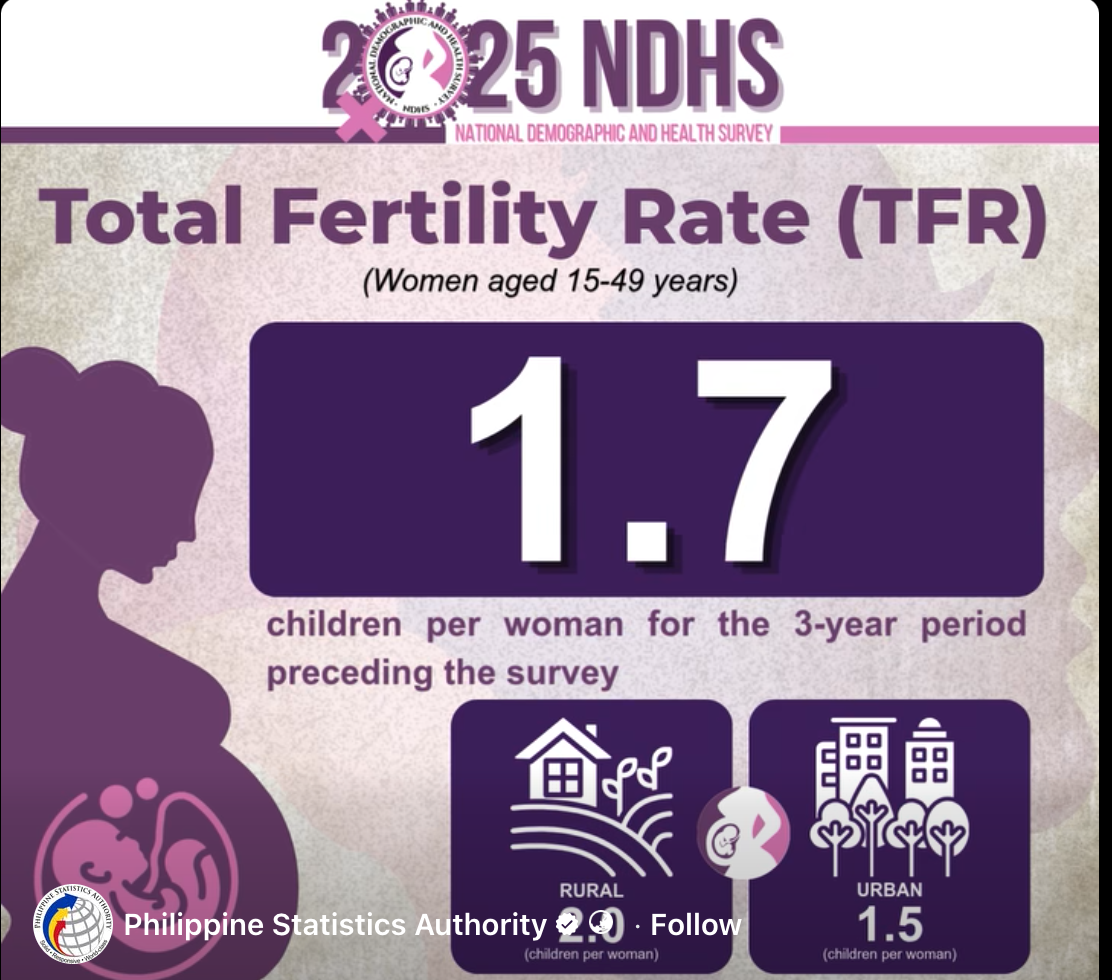
New data from the Philippine Statistics Authority show Filipinos are having an average of 1.7 children per woman in 2025—well below the 2.1 replacement level, and a steep fall from 4.1 in 1993.
For decades, the country’s young and growing population has been a key economic advantage—fueling consumption, labor supply, and remittance-driven growth. That edge is now beginning to erode.
From demographic dividend to looming slowdown
Economists have long pointed to the Philippines’ “demographic sweet spot”—a large, youthful workforce supporting fewer dependents—as a driver of growth. But sustained fertility decline threatens to flip that equation.
Fewer births today mean fewer workers tomorrow.
If the trend holds, the country could face:
- A shrinking labor force, particularly in low- and mid-skilled sectors
- Slower domestic consumption, as smaller families spend less overall
- Accelerated population aging, increasing pressure on healthcare and social protection systems
The shift is already visible in urbanized regions. Fertility in Calabarzon has dropped to 1.3, while the National Capital Region and Negros Island Region follow at 1.4—levels comparable to aging economies in East Asia.
Even the Bangsamoro Autonomous Region in Muslim Mindanao, which still has the highest fertility rate at 2.4, is seeing rapid decline.
Choice, cost, and changing priorities
The drop is not accidental—it is driven by choice.
More than 57% of married women say they do not want more children. Among those with two children, nearly two-thirds prefer to stop.
Behind these decisions are rising living costs, job insecurity, and shifting aspirations. Raising children—especially in cities—has become more expensive, from education to healthcare to housing.
Women’s increasing participation in education and the workforce is also reshaping family planning decisions, with many delaying or limiting childbirth.
Contraceptive use reflects this shift, with 44.5% of married women now using modern methods.
Inequality shapes fertility
The decline is uneven—and that disparity carries its own economic risks.
Women in the richest households average just 1.1 children, while those in the poorest still have 2.8. Those with limited education continue to have the highest fertility rates.
This suggests a future where population growth is concentrated among the most economically vulnerable, potentially widening inequality and straining public services.
At the same time, gaps in access remain. About 12.5% of married women still have unmet family planning needs, while nearly half of sexually active unmarried women cannot access contraception.
A policy blind spot?
The Philippines now faces a delicate balancing act.
On one hand, falling teenage pregnancy—now at a record low of 4.8%—marks a major public health and education success.
On the other, the broader fertility decline raises urgent policy questions:
- How to sustain economic growth with a smaller future workforce
- How to support families who want children but are constrained by cost
- How to prepare for an aging population before it fully arrives