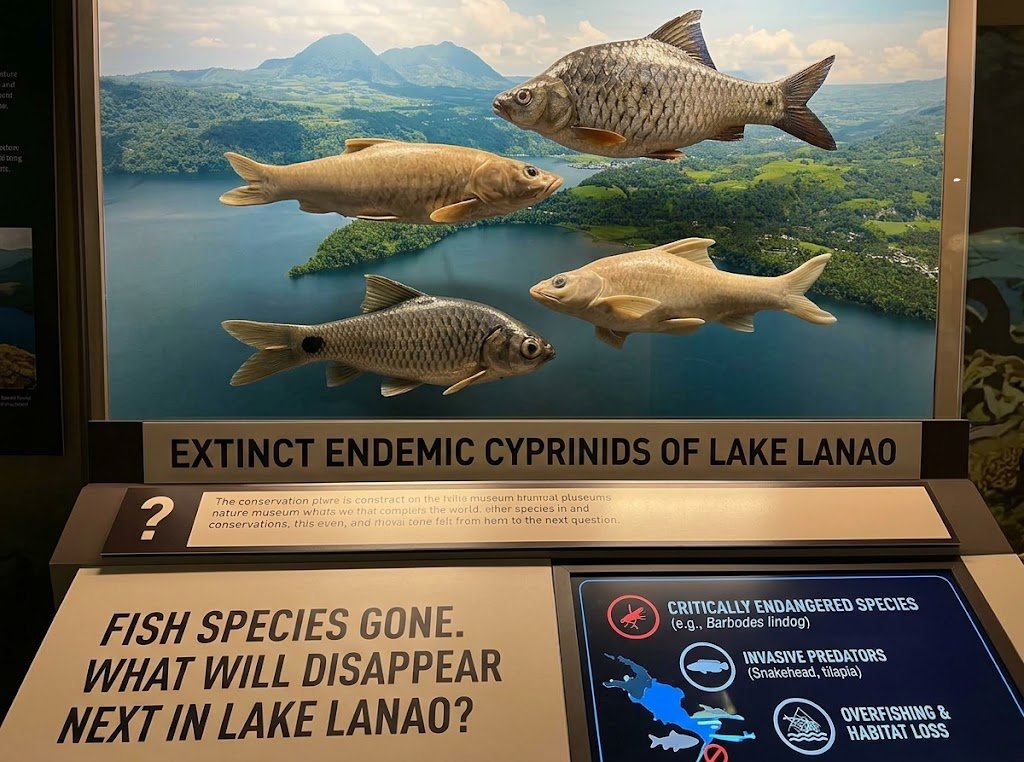
MARAWI CITY(September 14) — Fifteen fish species that evolved in Lake Lanao and existed nowhere else on Earth are gone.
Not displaced. Not hiding in another Philippine lake.
Extinct.
The loss is one of the Philippines’ most devastating freshwater biodiversity disasters—and it happened in one of Mindanao’s most important lakes.
The International Union for Conservation of Nature (IUCN) assessments published in 2020 classified 15 endemic cyprinid species from Lake Lanao as extinct, while two others, Barbodes lindog and Barbodes sirang, were assessed as critically endangered and possibly extinct, according to Quantitative Aquatics, whose freshwater experts participated in the assessments.
These were not ordinary fish populations that could simply be replenished from another lake or river. They were species found nowhere else in the world.
A biodiversity hotspot collapsed
Lake Lanao once supported an extraordinary group of closely related cyprinids—freshwater fish that evolved into different species occupying different ecological niches.
Scientists consider this diversification a striking example of rapid, or “explosive,” evolution.
Now, much of that evolutionary history has disappeared.
The 15 species classified as extinct are Barbodes amarus, B. baoulan, B. clemensi, B. disa, B. flavifuscus, B. herrei, B. katolo, B. lanaoensis, B. manalak, B. pachycheilus, B. palaemophagus, B. palata, B. resimus, B. tras and B. truncatulus.
Quantitative Aquatics reported that the 15 Lake Lanao species represented almost half of the species declared extinct in that IUCN Red List update.
The scale of the loss is difficult to overstate.
These were 15 distinct evolutionary lineages found nowhere else on the planet.
Invasive fish helped drive the collapse
Research points to introduced predatory fish as a major driver of the disappearance of Lake Lanao’s endemic cyprinids.
Non-native fish can fundamentally alter an ecosystem—preying on native species, competing for food and habitat, and disrupting ecological relationships that developed over long periods.
Research into the decline of Lake Lanao’s endemic fishes has implicated introduced species, particularly predatory fish. The University of Santo Tomas has likewise reported that the decline and extinction of endemic species, including the once-prized Barbodes baoulan, were linked to the proliferation of introduced predatory fish in the lake.
But invasive species were not the only pressure.
Scientific studies have also identified overexploitation, pollution and changes affecting the Lake Lanao–Agus River system as threats to the lake’s native fishes.
The collapse therefore cannot be reduced to a single culprit.
It was the result of mounting pressures on a highly specialized ecosystem—and, in many cases, the failure to detect or reverse those pressures before populations disappeared.
Could more species already be gone?
The extinction list may not tell the whole story.
Barbodes lindog and Barbodes sirang remain classified as critically endangered and possibly extinct. Their status underscores the need for intensive surveys to determine whether any surviving populations remain.
There is, however, evidence that part of Lake Lanao’s native fish heritage survives.
Researchers have confirmed Barbodes tumba in the Agus River system through DNA barcoding, providing a basis for continuing conservation efforts.
But the survival of one species does not diminish the scale of what has already been lost.
The extinction happened here
Extinction is often imagined as something happening in distant rainforests, remote islands or ecosystems most Filipinos will never see.
Lake Lanao tells a different story.
It happened here in Mindanao.
Fifteen species evolved in this lake, occupied its waters for generations and existed nowhere else on Earth.
Now they are gone.
For communities around Lake Lanao, the crisis is not merely about fish. The lake is intertwined with food, livelihoods, culture and the Agus River system. Damage to its ecosystem can therefore reach far beyond the species disappearing beneath its waters.
The loss of the endemic cyprinids is a warning of what can happen when invasive species, overfishing, pollution and other human pressures accumulate in an ecosystem with nowhere else for its unique species to go.
There is no second Lake Lanao where these fish can be recovered.
Fifteen species are already beyond saving.
The question now is not whether extinction can happen in Mindanao.
It already has.
The question is: what will disappear next in Lake Lanao?