MANILA (April 29) — The case against former president Rodrigo Roa Duterte has entered a new judicial phase, with the International Criminal Court formally constituting a Trial Chamber to hear the charges following the confirmation of evidence by judges.
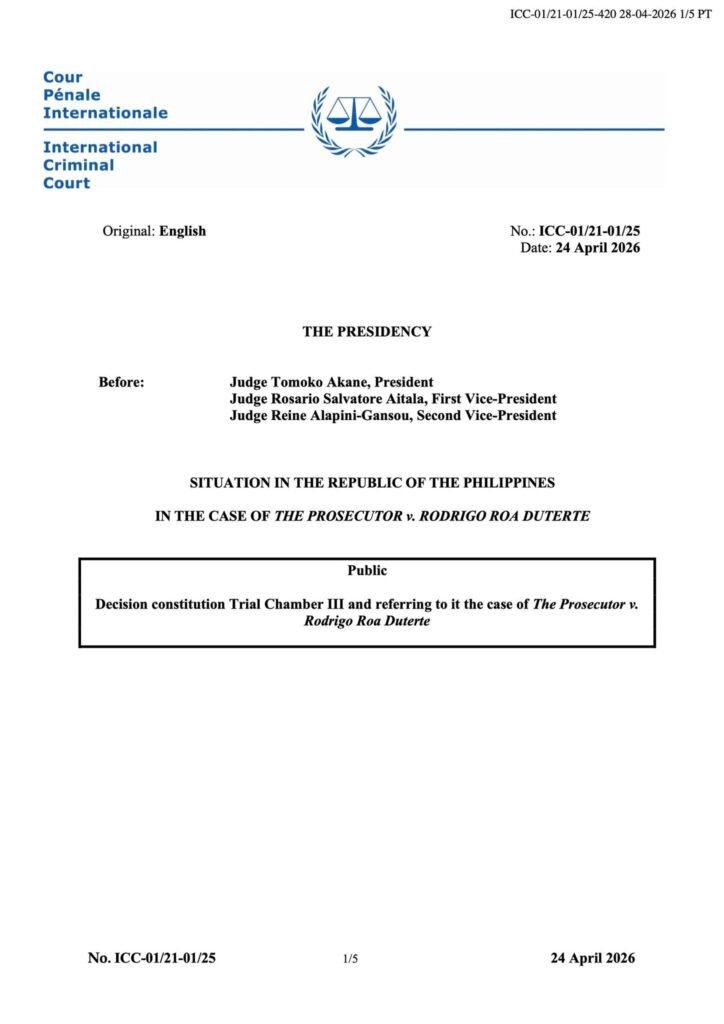
The development stems from the Pre-Trial Chamber’s April 23, 2026 ruling finding sufficient grounds to proceed with The Prosecutor v. Duterte, which involves alleged crimes linked to the Philippines’ anti-drug campaign.
On April 24, the complete case record—including filings, transcripts, and evidentiary materials—was transmitted to the ICC Presidency, officially moving the case out of the pre-trial stage and into trial preparation.
The Presidency, led by Judge Tomoko Akane, has since constituted Trial Chamber III, which will handle the proceedings, evaluate evidence, and ultimately decide on Duterte’s criminal responsibility.
The chamber will be composed of Judge Joanna Korner, Judge Keebong Paek, and Judge Nicolas Guillou, according to the ICC’s decision released April 24 but made public only on Tuesday.
The court noted that the chamber had previously been dissolved but was reactivated as part of internal restructuring aimed at balancing workload, expediting proceedings, and improving judicial efficiency.
Under Article 61(11) of the Rome Statute, once charges are confirmed, a trial chamber must be constituted to hear the case. The ICC Rules of Procedure and Evidence further require that the full case record and confirmation decision be formally transmitted to the assigned chamber.
While a public redacted version of the decision has been released, several annexes remain confidential due to sensitive material, reflecting the complexity of the case.
With the Trial Chamber now in place, proceedings will move into the evidentiary phase, where judges will assess submissions from both prosecution and defense before issuing a verdict.
The case remains one of the most closely watched before the ICC, given its implications for accountability over alleged abuses tied to the Philippines’ “war on drugs.”