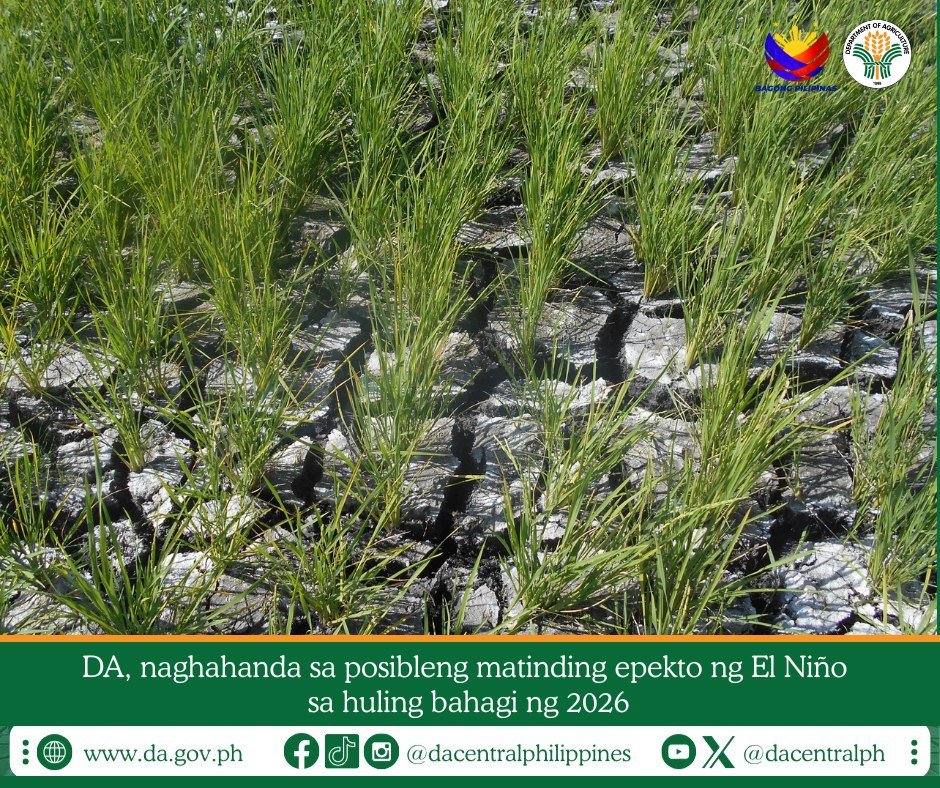
Caraga maps drought-prone farms as El Niño threat builds

Date:

Share post:

Photo: DA

BUTUAN CITY (April 28) — With dry months looming, Caraga’s agriculture sector is bracing early—pinpointing which farms are most likely to be hit and moving resources before crops begin to fail.

The Department of Agriculture in the region (DA-13) has started mapping vulnerable rice and corn areas, focusing on rainfed communities where farmers depend heavily on unpredictable rainfall.

Majority of farms at risk

According to DA-13 disaster risk reduction focal person Gerlie Antipaso, about 57% of rice farms in Caraga rely on rainfed systems—making them highly exposed to prolonged dry spells linked to El Niño.

Initial data show the scale of vulnerability:

  • 17,228 hectares of rainfed rice farms
  • 1,897 hectares in upland rice areas
  • 1,109 hectares of corn farms in rain-dependent and river-adjacent zones

Farmers at the tail end of irrigation systems are also flagged as high-risk due to limited water access during drought conditions.

“We are identifying which barangays will need support first,” Antipaso said, emphasizing the need to act before water shortages intensify.

Seeds, water, and timing

To cushion the impact, DA-13 is building up buffer stocks and pre-positioning inputs. Currently available for distribution are:

  • 1,720 bags of certified rice seeds
  • 1,950 bags of hybrid rice seeds

Procurement is ongoing, while bidding for additional corn seeds has already been completed—aimed at helping farmers replant quickly or shift to more resilient varieties.

At the same time, the agency is working with its engineering division to maximize water impounding systems, capturing rain from localized thunderstorms to stretch water supply through the dry months.

Catching every drop

Recent rains in Butuan City and nearby towns—triggered by localized thunderstorms—offered a brief reprieve. But officials say these bursts must be harnessed.

“Even short rains are important,” Antipaso noted. “If we can store that water, it can sustain crops longer as the drought progresses.”

Protecting yields, incomes

For Caraga, early mapping is not just about crops—it’s about livelihoods.

Rice and corn farmers form a large part of the region’s rural economy, and production losses could ripple into food supply and household incomes. By identifying vulnerable areas ahead of time, DA-13 aims to prioritize interventions, reduce crop damage, and keep farms productive despite climate stress.

As El Niño conditions persist, the region’s strategy is clear: act early, target precisely, and make every available resource count before fields begin to dry.

spot_img

Related articles

Retrieval halted in Panabo tunnel tragedy as danger levels spike

Photo: Panabo City Information Office PANABO CITY (April 28) — Authorities have halted retrieval operations for three men believed...

Davao braces early as LGUs activate El Niño task forces

Photo: Civil Defense Davao Region DAVAO CITY (April 28) — With drought risks looming, local governments across the region...

Lanao del Sur tightens guard vs VAWC, trafficking amid rising local cases

MARAWI CITY (April 28) — A rise in reported abuse and trafficking cases is pushing Lanao del Sur...

Misamis Occidental cashes in on pageant spotlight to drive local economy

Misamis Occidental Gov. Henry S. Oaminal outlines the province’s hosting of Miss Universe Philippines 2026 events during...