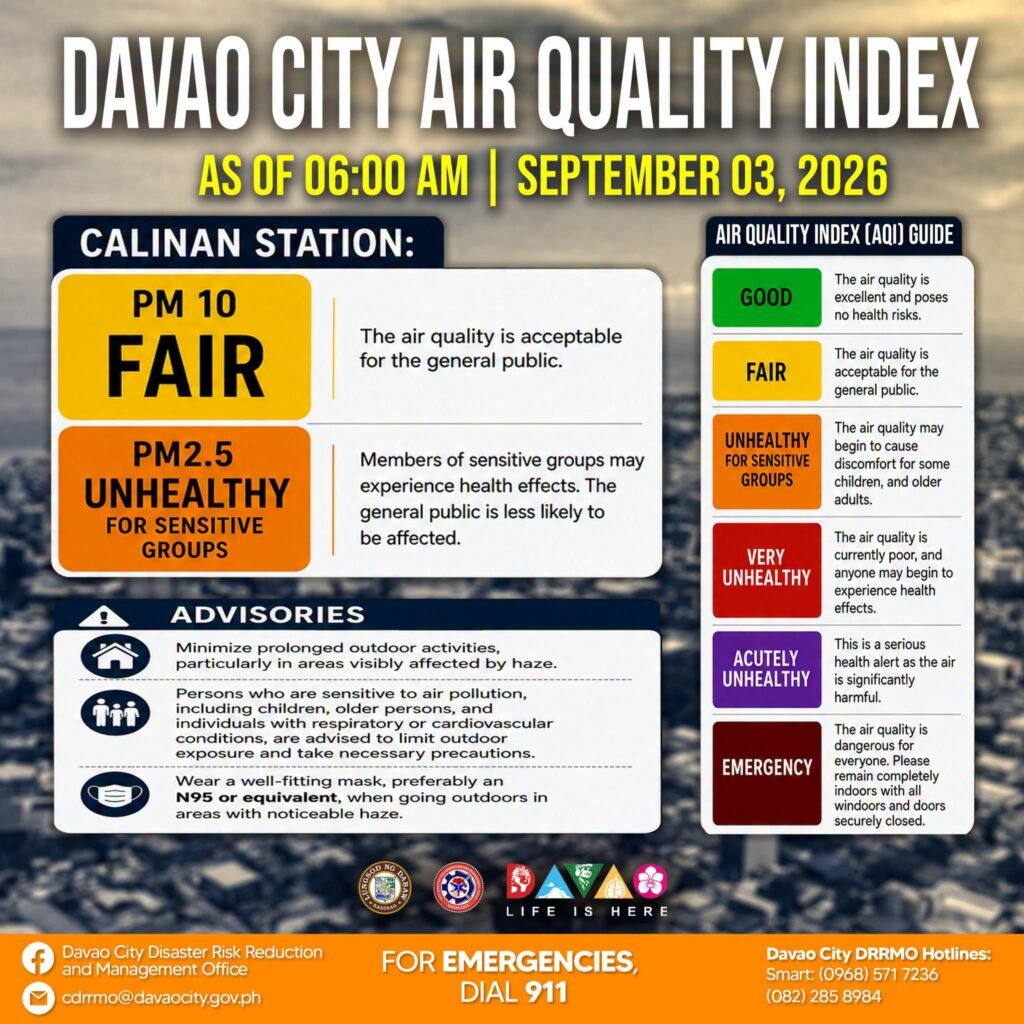
Photo: Davao City Disaster Risk Reduction and Management Office
DAVAO CITY (September 4) — Smoke from forest and peatland fires in Indonesia has pushed fine-particle pollution at a Davao City monitoring station into the “Unhealthy for Sensitive Groups” category, prompting authorities to warn children, older adults and people with heart or lung conditions to limit prolonged outdoor exposure.
The Department of Environment and Natural Resources-Environmental Management Bureau (DENR-EMB)-Davao recorded elevated levels of fine particulate matter, or PM2.5, at its Calinan monitoring station from August 30 to September 1.
Another air-quality parameter at the station remained in the “Fair” category.
The DENR-EMB said the haze was linked to forest and peatland fires in Kalimantan, Indonesia. The state weather bureau, the Philippine Atmospheric, Geophysical and Astronomical Services Administration (PAGASA), also attributed the deteriorating air quality to transboundary smoke.
Strong, dry southwest monsoon, or habagat, winds carried fine smoke particles across the equator and into parts of the Philippines, including Mindanao.
The impact, however, varied across the region.
As of September 1, the Digos monitoring station in Davao del Sur recorded “Fair” air quality, while the Malita station in Davao Occidental remained in the “Good” category across all monitored parameters.
The Calinan reading places Davao among areas affected by a regional haze episode that has also reached other parts of the country.
Metro Cebu recorded “Very Unhealthy” air quality, prompting Cebu City authorities to suspend face-to-face classes in public and private schools and encourage private companies to adopt work-from-home arrangements.
Under national air-quality standards, exposure to air classified as “Unhealthy for Sensitive Groups” may aggravate respiratory conditions, particularly among children, older adults, pregnant women and people with existing heart or lung conditions.
DENR-EMB-Davao continues to monitor air quality through its stations and said it will provide updates as conditions change.
Authorities advised residents in areas affected by visible haze to reduce prolonged outdoor activities, keep windows closed when appropriate and use well-fitting face masks or N95 respirators when going outside.
The episode highlights the vulnerability of Davao and other Philippine areas to transboundary air pollution, in which smoke from fires beyond the country’s borders can affect local air quality depending on wind and weather conditions.