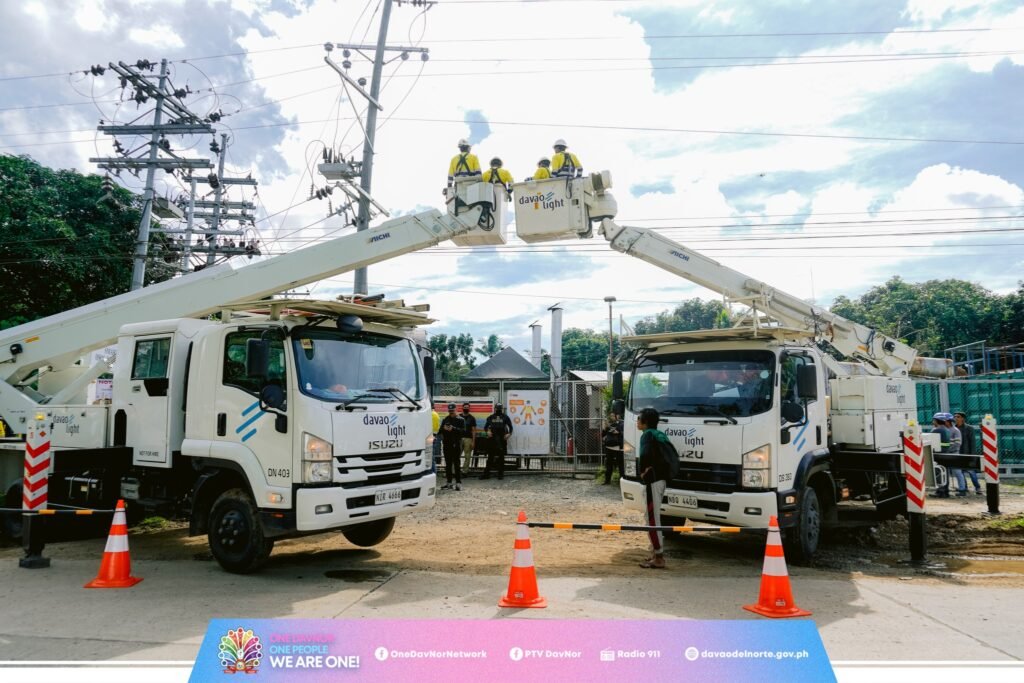
DAVAO CITY (March 20) — The takeover of power distribution in the Island Garden City of Samal (IGaCoS) by Davao Light and Power Company is being hailed by officials as a long-overdue solution to years of crippling blackouts—but it also raises a sharper question: who answers for the damage already done?
The transition, enabled by a court-issued writ of possession, effectively ends the tenure of Northern Davao Electric Cooperative, whose operations had long been criticized for unreliable service that disrupted daily life and stunted business growth on the island.
For residents, the consequences were not abstract. Frequent outages and voltage fluctuations damaged appliances, interrupted livelihoods, and forced businesses—especially in tourism—to absorb higher costs just to stay operational.
In 2023, the crisis escalated to the point that the Samal government declared a state of calamity, diverting public funds to emergency generator sets just to stabilize basic services.
Yet as the narrative shifts toward optimism, accountability remains largely unaddressed.
No clear reckoning has been laid out for NORDECO’s years of service failures—whether in terms of regulatory sanctions, financial liabilities, or compensation for affected consumers. The absence of such measures risks reinforcing a familiar cycle: public suffering, institutional failure, and quiet transition without consequences.
Mayor Lemuel “Toto” Reyes has framed the takeover as a turning point, even urging residents to “start buying appliances” again, confident that improved reliability will follow. But for many, the issue is not just future stability—it is whether past losses will ever be acknowledged or remedied.
The takeover itself was made possible by Republic Act 12144, which expanded Davao Light’s franchise into areas previously served by electric cooperatives. While this opens the door for better-performing private utilities, it also exposes gaps in oversight: how long can underperforming providers operate before intervention is triggered?
At the regional level, the Mindanao Development Authority has pointed to the Samal case as a potential model for reform. But that framing risks oversimplifying a deeper structural issue—whether regulatory bodies are proactive enough in preventing crises, rather than reacting after they spiral.
Assistant Secretary Romeo Montenegro acknowledged that transitions depend on member-consumer decisions and due process, while also noting that some electric cooperatives in Mindanao perform well.
That distinction matters—but it also sharpens the contrast. If some cooperatives can deliver reliable service and even pursue renewable energy, why was Samal allowed to deteriorate into a prolonged power crisis before decisive action was taken?
For Samal’s tourism sector, the stakes are immediate. Years of unreliable electricity have already inflated operating costs and undermined investor confidence. While improved service could reverse these trends, recovery will not be automatic—and credibility, once lost, takes time to rebuild.
The entry of Davao Light may well stabilize the island’s power supply. But stability alone does not resolve the deeper issue.
Without transparency, accountability, and safeguards against future failures, the transition risks being seen not as reform—but as replacement.
And for consumers who bore the brunt of years of outages, that distinction matters.