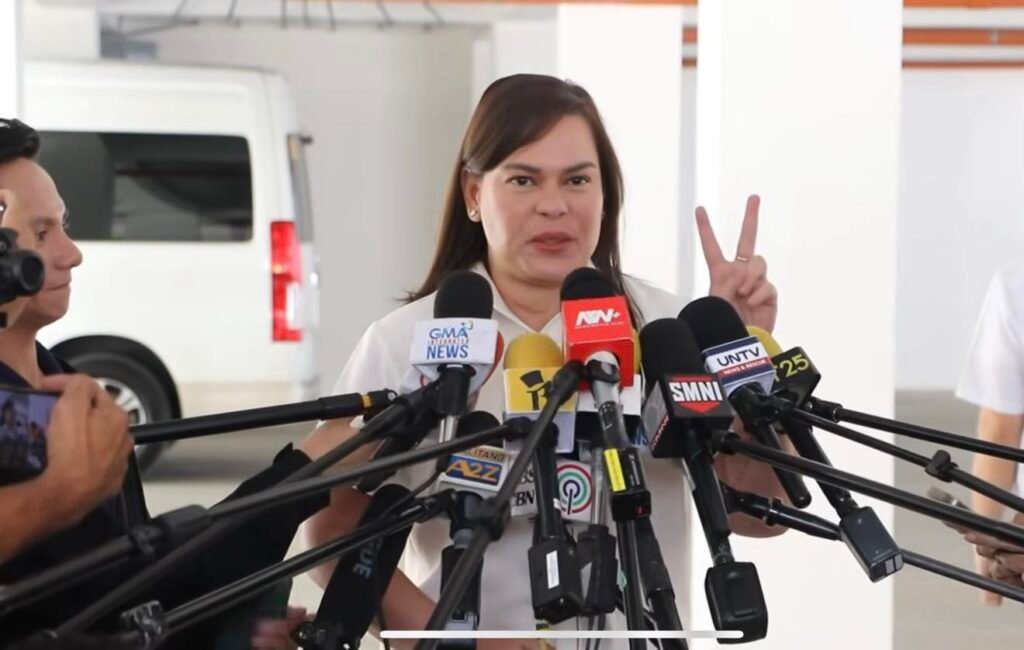
DAVAO CITY – Vice President Sara Duterte is facing two impeachment complaints filed within two days, reflecting heightened political tensions and scrutiny of her leadership.
The complaints, submitted by civil society activists and progressive groups, accuse Duterte of constitutional violations, betrayal of public trust, and the misuse of confidential funds.
First Impeachment Complaint: Allegations of Death Threats
On December 2, 2024, a coalition of civil society activists led by former peace adviser Teresita Quintos Deles filed the first impeachment complaint. It accused Duterte of issuing death threats against President Ferdinand Marcos Jr., First Lady Louise Araneta-Marcos, and House Speaker Martin Romualdez.
The complaint cited these actions as violations of the Constitution and grounds for impeachment under betrayal of public trust and other high crimes.
Prominent signatories include: Teresita Quintos Deles, former Presidential Adviser on the Peace Process, Eufemia Cullamat, former Bayan Muna party-list representative and Lumad leader, Emmi de Jesus, former GABRIELA party-list representative, Former Senator Leila de Lima, Former Magdalo representative Gary Alejano, Fr. Robert Reyes, known for his advocacy on human rights.
Second Impeachment Complaint: Misuse of Confidential Funds
On December 4, 2024, a second complaint was filed by the progressive bloc led by Teodoro “Teddy” Casiño, chairperson of Bagong Alyansang Makabayan (Bayan). It alleged that Duterte misused ₱612.5 million in confidential funds from the Office of the Vice President (OVP) and the Department of Education (DepEd), where she also serves as Secretary.
The group claimed irregularities in expenditures, including unaccounted payments for confidential information and renting “safe houses,” citing these as betrayals of public trust.
The complaint had over 70 signatories, including: Teddy Casiño, former Bayan Muna representative, Liza Maza, former GABRIELA representative, Neri Colmenares, human rights lawyer, Sarah Elago, former Kabataan party-list representative and Satur Ocampo, former Bayan Muna representative.
Observers note that tensions between the Duterte camp and progressive groups date back to her father, former President Rodrigo Duterte’s administration, which launched a controversial campaign against alleged communist sympathizers and their allied organizations.
While impeachment is a political process requiring substantial support in the House of Representatives and the Senate, the complaints signal a growing divide among political factions.
Impeachment Process Overview
The impeachment process begins in the House of Representatives, where complaints are assessed for sufficiency in form and substance by the Committee on Justice. If the Committee finds merit, a one-third vote of all House members is required to transmit the articles of impeachment to the Senate for trial. A two-thirds vote in the Senate is necessary for conviction.
The two complaints are now under review in the House of Representatives. If endorsed by at least one-third of the House, Vice President Duterte could face a trial in the Senate. Until then, the complaints remain a test of political alliances and the rule of law.
Vice President Duterte has yet to issue an official statement on the complaints. The public and political analysts alike will closely monitor developments in this high-profile case as it unfolds.
Edith Z Caduaya studied Bachelor of Science in Development Communication at the University of Southern Mindanao.
The chairperson of Mindanao Independent Press Council (MIPC) Inc.