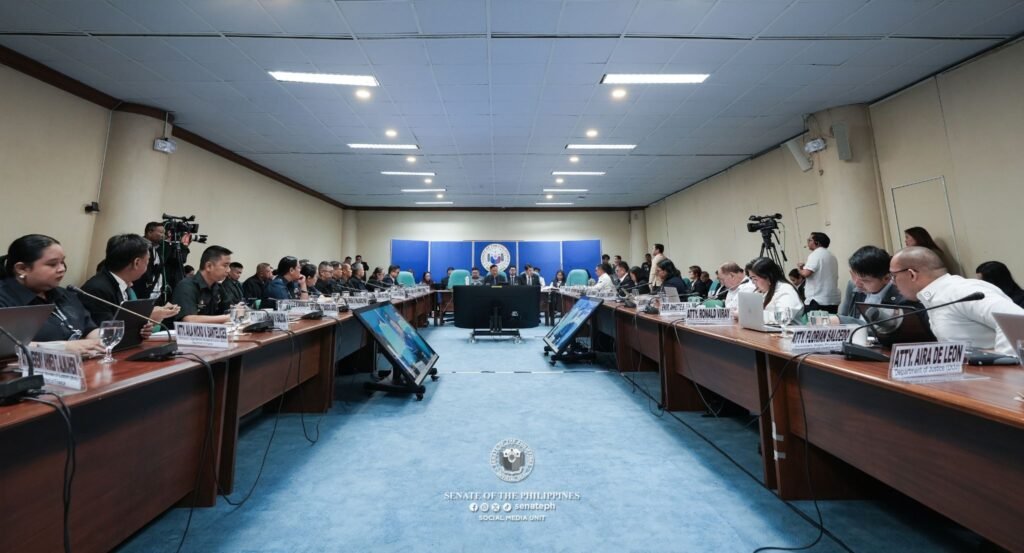
MANILA (February 26) — Lawmakers on Wednesday weighed a proposal to create a Presidential Drug Enforcement Authority (PRDEA), a move seen to centralize and tighten the country’s anti-illegal drug operations under a single command structure.
The measure, proposed by Senate President Vicente Sotto III, was deliberated by the Senate Committee on Public Order and Dangerous Drugs chaired by JV Ejercito.
Ejercito said the proposal forms part of broader reforms meant to reinforce the anti-drug campaign while safeguarding institutional checks.
“Today, we have a packed and significant agenda focused on two major pillars of our law enforcement: measures focused on strengthening the conduct of our anti-drug campaign, including the proposal of Senate President Sotto to establish the Presidential Drug Enforcement Authority, and the organizational welfare of the Philippine National Police,” he said.
He stressed that reforms must fortify institutions without undermining the rule of law.
“Nais po nating matiyak na ang anumang reporma na ating isusulong ay makakatulong sa pagpapalakas ng ating mga institusyon habang sinisigurong iginagalang ang rule of law,” Ejercito added.
Toward a single anti-drug command
Under Sotto’s proposal, the PRDEA would unify enforcement, prosecution, prevention and rehabilitation functions — consolidating responsibilities that are currently spread across multiple agencies, including the Philippine National Police and the Philippine Drug Enforcement Agency.
The envisioned authority would also oversee the proper filing of drug cases and ensure lawyers are assigned in every precinct handling drug-related arrests — a move aimed at reducing procedural lapses that often weaken prosecutions.
Supporters of the measure said a centralized body could streamline coordination, reduce case dismissals, and promote a more holistic approach that balances enforcement with rehabilitation.
Revisiting safeguards under RA 9165
Apart from the proposed creation of PRDEA, senators also tackled possible amendments to Section 21 of Republic Act 9165, which sets rules on the handling and inventory of seized drugs.
Sotto proposed easing current witness requirements during drug inventories, suggesting a two-witness rule composed of ordinary citizens or the use of body-worn cameras in place of mandatory representatives from the Department of Justice or the media.
Meanwhile, Erwin Tulfo filed Senate Bill No. 1303 seeking to remove the requirement for media representatives to sign the inventory of confiscated drugs.
“With my proposed measure, Senate Bill No. 1303, media representatives are no longer required to be signatories in the inventory of confiscated drugs and other drug-related items,” Tulfo said.
Reforming the framework
The deliberations signal a fresh attempt in the Senate to recalibrate the country’s anti-drug strategy — focusing not only on enforcement intensity but also on structural coherence and procedural compliance.
Whether the proposed PRDEA will gain broad legislative support remains to be seen, but lawmakers agree that any overhaul must balance operational efficiency with accountability safeguards — a recurring challenge in the country’s long-running campaign against illegal drugs.