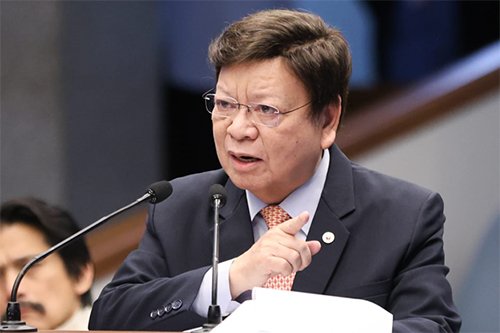
MANILA (June 4) – Senator-elect and incumbent SAGIP Party-list Representative Rodante Marcoleta is facing criticism from members of the Senate media after he allegedly characterized many mainstream journalists as “paid hacks” during a Senate Blue Ribbon Committee hearing, a remark that has reignited concerns about the growing tendency of public officials to make broad accusations against institutions without presenting supporting evidence.
In a statement, members of the Senate media condemned what they described as a reckless and irresponsible attack on the press, arguing that Marcoleta’s comments unfairly painted an entire profession with a broad brush while offering no factual basis to support such claims.
At the center of the controversy is not merely the criticism of media organizations—a right protected in any democratic society—but the apparent absence of evidence accompanying the senator’s allegations.
The issue raises a fundamental question: Should public officials be allowed to make serious accusations against journalists and media institutions without presenting proof?
In democratic systems, allegations alone do not constitute evidence. Public trust in institutions—whether government, the judiciary, law enforcement, or the media—is shaped not only by criticism but by the credibility of the claims being made. When accusations are aired in public forums without substantiation, they risk becoming political rhetoric rather than constructive accountability.
Media organizations have long been subject to scrutiny, criticism, and public evaluation. Cases involving ethical violations, conflicts of interest, and biased reporting have occurred both in the Philippines and abroad. However, journalists note that identifying individual cases of misconduct is vastly different from portraying a large segment of the press as corrupt without documentation, investigation, or proof.
The Senate media emphasized that journalists perform a constitutional role as the “Fourth Estate”—monitoring government actions, scrutinizing those in power, and providing information necessary for public decision-making. They argued that broad attacks on media credibility, when unsupported by evidence, may contribute to public distrust and expose journalists to harassment and intimidation.
The controversy also highlights a broader trend in contemporary politics, where allegations are often amplified through speeches, social media posts, and public hearings before they are subjected to verification.
Political observers note that such statements can be effective in mobilizing supporters because they appeal to existing frustrations with institutions. However, they warn that repeated accusations unsupported by evidence can weaken public confidence in democratic institutions and blur the distinction between verified facts and political narratives.
Critics of Marcoleta argue that if evidence exists of corruption or unethical conduct within media organizations, it should be presented and investigated through appropriate channels. Otherwise, sweeping accusations risk being viewed as an attempt to discredit critical reporting rather than address specific wrongdoing.
The Senate media, in its statement, stressed that criticism of journalists is legitimate and necessary in a democracy. What they rejected was the wholesale condemnation of an entire profession based on allegations that have yet to be substantiated.
As public discourse becomes increasingly polarized, the episode serves as a reminder that accountability applies not only to journalists but also to elected officials. Serious allegations, regardless of who makes them, carry a responsibility to provide evidence.
Without proof, accusations remain allegations. And in a democracy, institutions are strengthened not by rhetoric, but by facts.