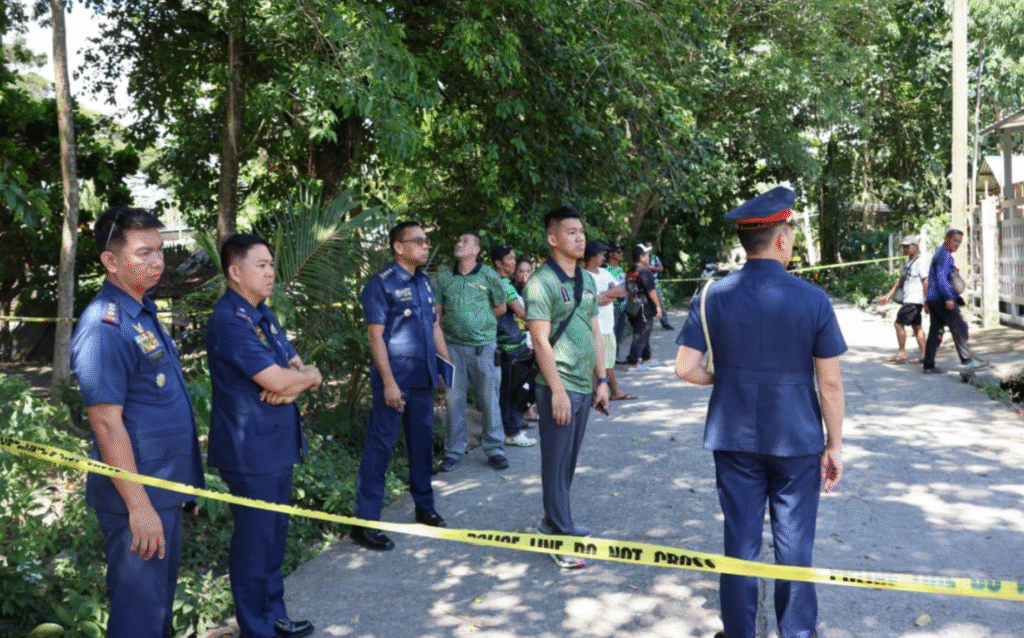
DAVAO CITY(February 10) — More than three months after Barangay Captain Oscar “Dodong” Bucol of Tres de Mayo was gunned down in public view, the unresolved case has become a litmus test of whether the rule of law can prevail over impunity in Davao del Sur.
On Monday, Philippine National Police (PNP) chief Director General Jose Melencio Nartatez issued a blunt warning to local police leadership: solve the case—or be relieved.
“I will have the provincial director relieved if this is not resolved,” Nartatez said during a briefing at the Police Regional Office XI headquarters.
A killing that challenged authority
Bucol was shot dead in November 2025 while livestreaming on Facebook, an attack that shocked residents of Tres de Mayo and sent a chilling message to barangay officials across the province: even elected community leaders are not beyond reach.
For many locals, the brazenness of the crime—and the absence of arrests months later—has raised troubling questions about accountability, influence, and whether perpetrators believe they can act without consequence.
Nartatez said leaving such a case unresolved erodes public confidence and signals weakness in law enforcement.
“It’s shameful if it’s not immediately resolved,” he said, recalling how a high-profile shooting during his tenure as NCRPO chief was solved in less than 20 hours.
Impunity vs. justice
Turning to PRO XI Director Brig. Gen. Leon Victor Rosete, Nartatez stressed that the Bucol case must not be treated as just another homicide.
“I am tracking this. It’s near [resolution],” he said. Rosete responded, “Yes, it’s near.”
But for residents of Tres de Mayo, “near” has yet to translate into accountability.
Security officials warn that unresolved killings of barangay officials weaken the very foundation of local governance. Barangay captains serve as frontline enforcers of ordinances, mediators in disputes, and partners of police—roles that become increasingly risky when attackers are not brought to justice.
Allegations heighten scrutiny
The case has drawn further attention after the National Bureau of Investigation (NBI) XI disclosed earlier that the suspect could be a member of law enforcement or a government official—an assertion that, if proven, would strike at the heart of institutional credibility.
Human rights advocates and local leaders say such allegations make swift, transparent investigation even more critical, as perceived protection of powerful suspects deepens distrust in state institutions.
Stakes for public safety
Police officials acknowledge that impunity in high-profile cases emboldens criminals and discourages communities from cooperating with authorities.
“When justice fails, fear fills the vacuum,” a senior security official said, noting that witnesses are less likely to come forward when cases stall.
Nartatez confirmed he has personally briefed Davao del Sur Rep. John Tracy Cagas on the status of the investigation.
“I have talked to him and given updates. Hopefully, we can resolve that,” the PNP chief said.
A defining moment
For Tres de Mayo and neighboring barangays, the outcome of the Bucol case is no longer just about one slain official. It has become a measure of whether law enforcement can assert the rule of law over influence, fear, and silence.
As residents wait, the message from the country’s top police officer is clear: justice delayed is not only justice denied—it is a doorway to impunity.