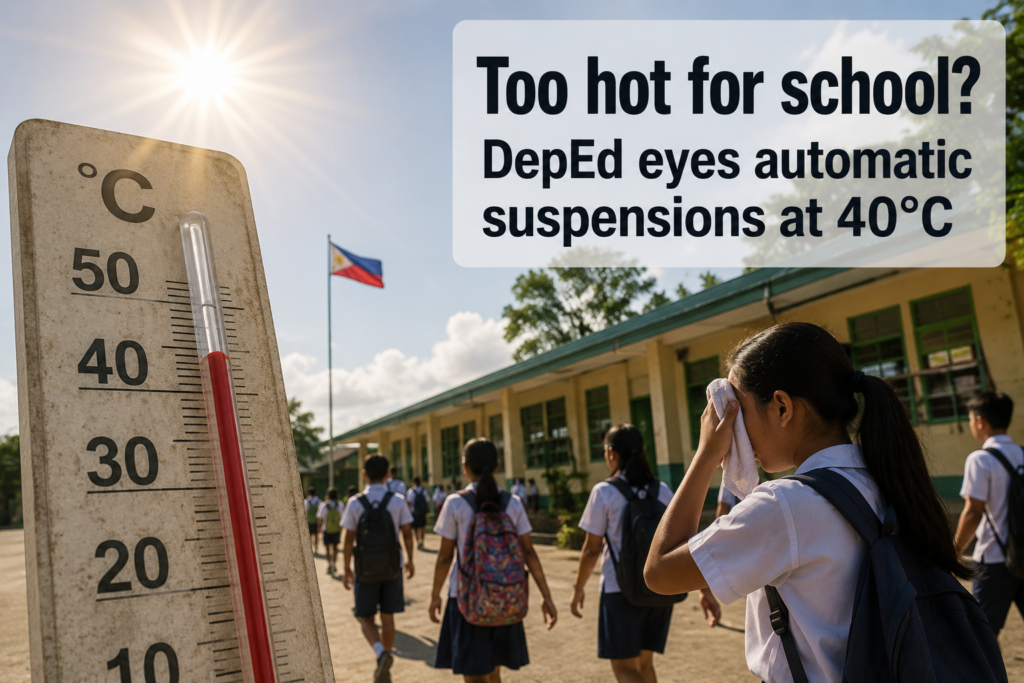
DAVAO CITY (July 30) — STUDENTS may no longer have to wait for last-minute announcements before being sent home when classroom conditions become dangerous, as the Department of Education (DepEd) considers automatic suspension of face-to-face classes and onsite work once extreme-weather thresholds are reached.
Among the proposed triggers is a heat index of 40°C or higher, a threshold that could automatically halt in-person classes under a draft executive order now being developed by DepEd.
The proposed policy seeks to establish uniform rules nationwide on when classes and onsite work should be suspended—and when schools can safely reopen—during extreme heat, heavy rains and other hazards.
DepEd began nationwide consultations Wednesday with local governments, education officials and other stakeholders on the proposed executive order.
“When extreme weather or hazards threaten our communities, keeping our learners and teachers safe will always be the top priority. At the same time, we must prevent unnecessary disruptions to education,” Education Secretary Sonny Angara said.
Under the draft framework, face-to-face classes and onsite work would automatically be suspended once technical thresholds issued by national government agencies are reached.
These include a heat index of at least 40°C, official rainfall warnings, and elevated air-quality risks or volcanic smog advisories.
Classes and onsite work would automatically resume once the relevant government advisories are lifted and safety inspections have been completed.
The proposal could also address a recurring problem for families during emergencies: uncertainty over who can suspend classes and how quickly decisions can be made.
DepEd is proposing a three-tiered system.
National agencies would trigger automatic suspensions based on technical hazard advisories. Local chief executives could declare localized suspensions, while school heads would be allowed to recommend campus-specific suspensions based on documented on-site conditions.
For public schools, localized or granular suspensions would require the concurrence of the Schools Division Superintendent. Resumption following a localized suspension would need approval from the local chief executive.
Private school heads could declare granular suspensions or resumptions, subject to prompt coordination with local governments.
The proposed framework also recognizes that suspending face-to-face classes does not have to mean suspending learning.
DepEd plans to use flexible learning delivery and self-learning modules to keep instruction going when students cannot safely remain inside classrooms.
One proposal under discussion is a one-hour response period for local governments to act on school requests for granular class suspensions and resumptions.
That could be crucial for parents and students who often receive suspension announcements only after children have already left home or reached school.
For communities experiencing increasingly disruptive weather conditions, speed and clarity can be as important as the suspension itself.
A delayed announcement can leave students traveling under dangerous conditions, teachers stranded at school and parents scrambling to arrange childcare or transportation.
The proposed policy aims to replace such uncertainty with clearer, threshold-based decisions.
But setting a 40°C trigger on paper will not by itself protect students.
Schools will still need reliable monitoring, timely government advisories, functioning communication systems and workable alternative learning arrangements. Local officials will likewise have to act quickly once conditions cross the prescribed thresholds.
DepEd said consultations with teachers, parents and students will continue before the proposed executive order is finalized and submitted to the Office of the President.
For students and families already coping with hotter classrooms and increasingly unpredictable weather, the proposed policy carries a simple message:
When heat and other hazards become dangerous, school attendance should never come before safety.