CAGAYAN DE ORO CITY(July 30) — PHILIPPINE fruits and other farm products are being positioned for a bigger share of the global market, but the government’s branding push will face a harder test at home: whether farmers and fisherfolk who produce these premium goods will actually earn more from their growing international reputation.
The Department of Agriculture (DA) and the Intellectual Property Office of the Philippines (IPOPHL) are doubling down on geographical indications (GIs)—a system that links a product’s quality and reputation to its specific place of origin—in an effort to turn homegrown produce into higher-value domestic and export brands.
The renewed partnership comes as the DA expands its global marketing campaign for 15 priority high-value crops, including mangoes, bananas, pineapples, durian and ube.
These products will be showcased at major international trade events, including Seoul Food 2026 in Korea this month and Asia Fruit Logistica in Hong Kong in September.
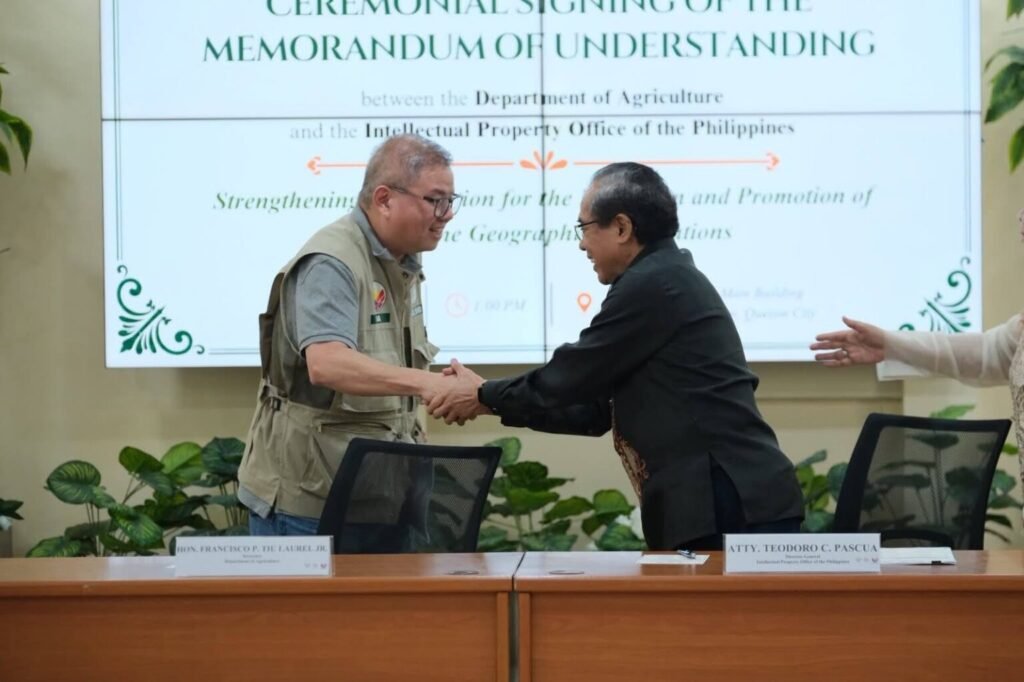
The DA and IPOPHL signed a new memorandum of understanding Wednesday, updating their 2018 agreement and strengthening efforts to register and protect Philippine products whose identity is rooted in particular communities and production areas.
Among those being eyed for GI protection are Cordillera Heirloom Rice, Davao Pomelo, Zambales Mangoes, Davao Cacao, Davao Durian, Bonuan Bangus, Quezon Lambanog, Camarines Norte Queen Pineapple and Oriental Mindoro Calamansi.
An application for Bohol Ubi Kinampay has already been filed with IPOPHL.
Agriculture Secretary Francisco P. Tiu Laurel Jr. said GI protection can preserve the authenticity of products while opening new opportunities for farming and fishing communities.
“For generations, our farmers, fisherfolk and indigenous communities have cultivated products whose quality and identity are deeply rooted in their places of origin,” Tiu Laurel said.
But branding alone does not guarantee better livelihoods.
The real measure of success will be whether the premium commanded by a protected Philippine product reaches the people who plant, harvest, process and produce it—or is absorbed elsewhere along the supply chain.
That makes traceability, producer organization and market access as important as the GI label itself.
Under the renewed agreement, a joint technical working group will develop a national GI roadmap, strengthen producer organizations, improve certification and traceability systems, and help local products enter higher-value domestic and international markets.
The initiative supports President Ferdinand Marcos Jr.’s push to move Philippine agriculture beyond raw commodity production toward value-added exports. In his State of the Nation Address, Marcos specifically cited ube as a product with strong export potential.
A geographical indication differs from a trademark. While a trademark identifies a company or business, a GI identifies a product whose reputation or qualities are closely associated with a particular place.
The concept has helped turn products such as Champagne from France, Scotch Whisky from Scotland, Parmigiano Reggiano from Italy and Kobe Beef from Japan into globally recognized premium brands.
The Philippines now wants to build similar recognition around its own products.
But the country’s challenge goes beyond getting Philippine names onto international shelves.
It must build the infrastructure behind those names—from consistent quality and certification to cold chains, processing, traceability and organized producer groups.
More importantly, farmers and fisherfolk must have enough bargaining power to capture a fair share of the value their products create.
Otherwise, the country could succeed at branding Philippine agriculture for the world while leaving the producers behind.
The global branding campaign, therefore, should be judged not only by how many Philippine products make it to trade fairs or foreign markets.
The real victory will be when a farmer in Davao, a rice grower in the Cordilleras, a pineapple producer in Camarines Norte or an ube farmer in Bohol earns substantially more because the world finally recognizes the value of what they grow.