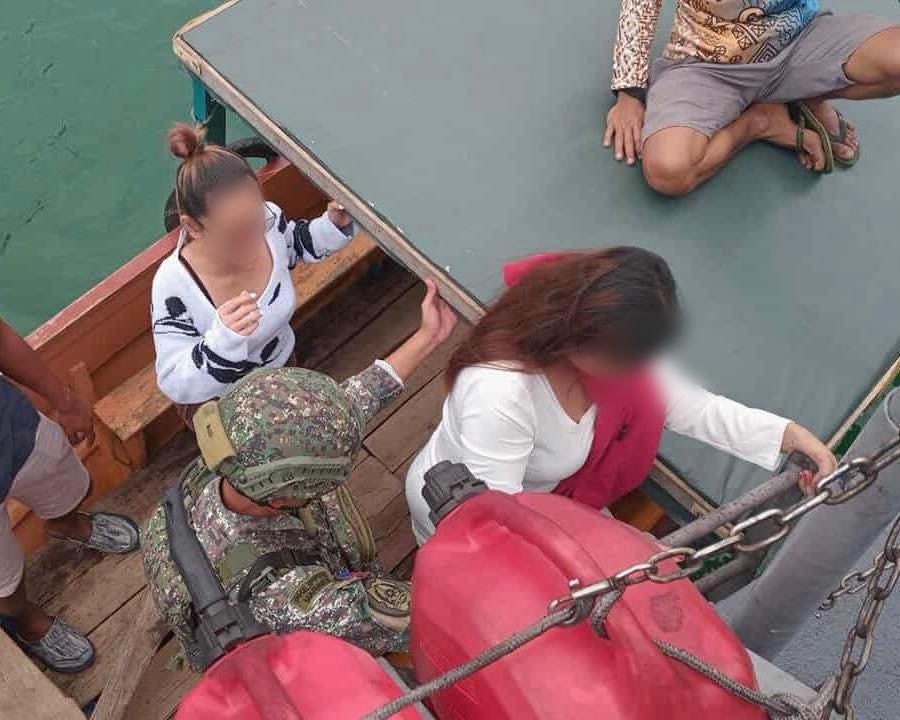
DAVAO CITY (September 10) — The rescue of 27 women on the shores of Bongao, Tawi-Tawi last week has once again exposed how the Philippines’ porous maritime borders continue to serve as lifelines for human trafficking syndicates.
With no documents, no legal protection, and no legitimate jobs awaiting them, the women became the latest victims in a crisis fueled by poverty and enabled by weak border control.
Authorities revealed that the victims, mostly from Metro Manila and several provinces in Luzon, were promised lucrative jobs abroad. Nine of them were bound for Thailand and Malaysia, recruited under false pretenses as customer service representatives and entertainers. However, initial investigations showed that all their travel documents were fake. Three suspected recruiters were reportedly arrested.
The September 5 rescue brought the number of potential trafficking victims recovered in Tawi-Tawi to 58 in just over a month, underlining the province’s vulnerability to cross-border exploitation.
A Trail of Rescues
Newsline has documented the following operations:
August 3, 2025: 2 victims rescued in Tawi-Tawi
August 8, 2025: 42 individuals, including 4 minors, intercepted from an alleged trafficking ring
September 5, 2025: 27 women rescued in Bongao, many promised jobs abroad
Nationally, the scale is even more alarming. By August 2025, at least 695 Filipino trafficking victims were repatriated from Cambodia, Laos, Myanmar, and Thailand. Among them were 312 minors, illustrating how children remain easy targets.
The Southern Backdoor: Unchecked and Exploited
Tawi-Tawi’s location, just a night’s boat ride to Sabah, Malaysia, and near Indonesia’s North Sulawesi—makes it a prime exit point for illegal trafficking.
Small wooden boats, like the jungkong and kumpit, traditionally used for fishing and trade, are now used to smuggle people. These boats blend in with normal traffic, making them hard to detect. Security patrols are sparse, and community watch systems are underfunded and disconnected from national agencies.
“The southern backdoor is wide open,” a local enforcement officer admitted. “Even if we rescue dozens, hundreds more pass through. Without stronger maritime security and regional cooperation, we’re always playing catch-up.”
Tito’s Story: Life in the Shadows
Tito, 48, a welder from Southern Mindanao, crossed into Malaysia via Tawi-Tawi using an expired passport. Lured by a friend’s promise of better pay, he lived undocumented for over a decade, sometimes working as a welder, other times as a plantation laborer.
His luck ended when Malaysian authorities raided his worksite. He was jailed for 15 months before being deported.
“Work abroad pays well,” Tito told Newsline. “But once they take your passport, you lose your identity. You stop existing. Money is good, but life is sacred.”
He frequently changed numbers, sent money home through intermediaries, and remained off the radar, even to his own family.
Strong Laws, Weak Enforcement
The Philippines has robust anti-trafficking laws, but enforcement remains inconsistent. Victims are often too afraid to testify, and traffickers hide behind fake identities.
While rescued victims are provided with food and transportation home, long-term support such as jobs, protection, and justice—is lacking.
A Global Crime, a National Weakness
The Philippines retains Tier 1 status in the U.S. State Department’s Trafficking in Persons (TIP) Report, recognizing its legal efforts. Yet the same report flags persistent issues: corruption, weak victim protection, and unsecured borders.
Southeast Asia’s trafficking networks thrive in poorly patrolled border areas. Filipinos trafficked to Cambodia and Myanmar have ended up in cyber-scam compounds. Others in Malaysia are forced into low-wage labor in plantations and construction.
Poverty and Porous Borders: A Deadly Mix
What drives people into traffickers’ hands is not just the hope for opportunity but the desperation of poverty. The ease with which victims can cross international waters only encourages syndicates to continue the trade.
A police officer in Tawi-Tawi, speaking anonymously, said reports of trafficking attempts are common. Most victims cite poverty as the reason for taking the risk, often recruited by friends or relatives abroad. Many pose as fisherfolk to slip through unnoticed.
“Yong kahirapan ang tumutulak sa kanila na sumugal,” the officer said. (Poverty drives them to take the risk.)
All rescued individuals are turned over to the Department of Social Welfare and Development (DSWD) for intervention before being returned to their home provinces.
Until the Philippines strengthens its maritime borders and addresses the poverty that pushes people into dangerous crossings, traffickers will continue to find victims along the southern shores.
For every person rescued in Bongao or Zamboanga, many more vanish quietly into the night. As long as the “southern backdoor” remains open, Filipinos will remain at risk.— Editha Z. Caduaya
Edith Z Caduaya studied Bachelor of Science in Development Communication at the University of Southern Mindanao.
The chairperson of Mindanao Independent Press Council (MIPC) Inc.