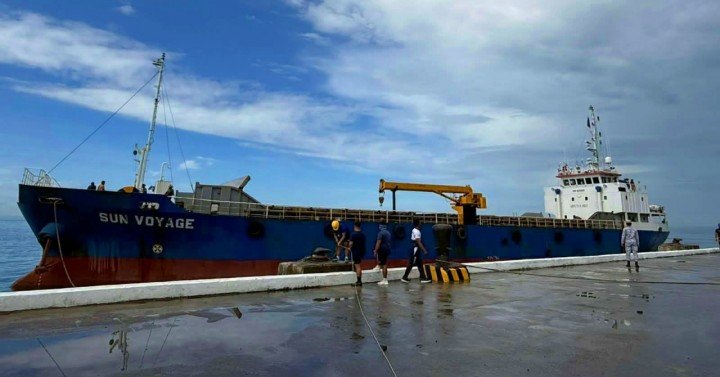
ZAMBOANGA CITY(March 3) — Two unlit vessels slipping through the waters off Datu Odin Sinsuat on Sunday night didn’t just trigger a maritime violation — they exposed the scale of smuggling activity still coursing through Western Mindanao’s sea lanes.
Personnel of the Western Mindanao Naval Command (WMNC) intercepted M/L Makhfeiyan and M/L M.K. Fiyan 1 after detecting them operating without navigational lights — a serious breach of international maritime safety rules designed to prevent sea collisions.
What authorities found onboard: around 2,000 master cases of undocumented cigarettes valued at PHP114 million.
Rear Adm. Constancio Arturo Reyes Jr., WMNC commander, said the vessels were flagged during routine patrol operations and are now under escort to Naval Station Romulo Espaldon in Barangay Calarian for investigation.
Authorities have yet to determine where the shipment came from — or where it was headed.
More Than Lost Taxes
Cigarette smuggling is often framed as a revenue issue. But in coastal communities across Maguindanao del Norte and neighboring provinces, it’s also a matter of public safety and governance.
Vessels operating without lights pose direct risks to fishermen and legitimate maritime traffic navigating the same waters at night. Undocumented cargo, meanwhile, signals organized networks capable of bypassing regulatory and border controls.
For local governments trying to strengthen post-conflict stability and improve economic governance, illicit trade undermines both.
Each shipment that slips through deprives the state of millions in excise taxes meant for health, infrastructure, and community programs. It also feeds shadow economies that weaken rule of law in already vulnerable coastal areas.
Pattern, Not Isolated Case
The PHP114-million haul marks WMNC’s first major seizure for March — but it follows two separate interceptions late last month that netted an estimated PHP197 million worth of smuggled cigarettes in the same operational area.
The pattern suggests that despite intensified patrols, Western Mindanao remains a preferred corridor for illicit shipments.
For communities along the southern maritime corridor, the Navy’s latest interception sends a message: enforcement is tightening. But it also raises a pressing question — how many shipments evade detection before one is caught?
As investigations continue, local officials and security forces face the broader challenge of not only intercepting contraband at sea, but dismantling the networks behind it — a test of both maritime security and governance in the region.