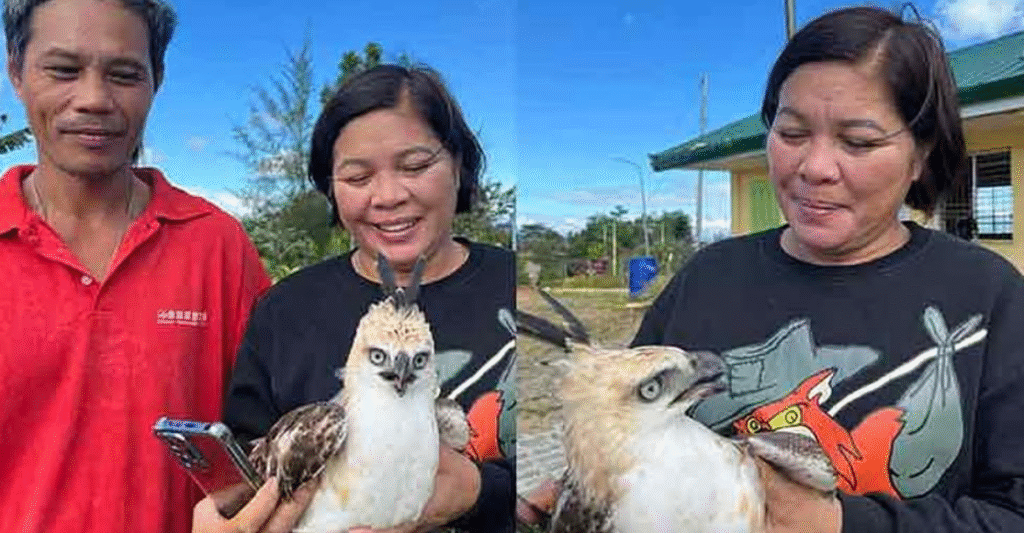
COMPOSTELA, DAVAO DE ORO (April 9) — A juvenile Philippine Hawk Eagle found inside a chicken cage in Compostela should have been just a routine wildlife rescue. Instead, it reveals a deeper question: who is responsible when the forest begins to disappear into backyards?
The young lawin was discovered in Sitio Kilabot, Barangay Panansalan after preying on two chicks—an act that could have easily led to its injury or death. In many rural communities, such encounters often end with animals being killed, seen as threats rather than protected wildlife.
That this eagle survived owed less to systems in place and more to individual restraint.
Suzette Makilan, a local school head, intervened and urged the caretaker not to harm the bird, citing its protected status. Within a day, the raptor was turned over to authorities—an outcome that, while commendable, highlights how much depends on awareness rather than enforcement.
Because under Philippine law, harming species like the Philippine Hawk Eagle—or the critically endangered Philippine Eagle—carries penalties. Yet enforcement in remote areas remains uneven, and knowledge of these protections is far from universal.
The presence of the eagle itself is telling.
Wildlife experts have long warned that increased sightings of raptors near human settlements are not signs of abundance, but distress—signals of habitat pressure, food scarcity, or displacement. When predators descend on chicken coops, it often means their natural hunting grounds are no longer enough.
In this sense, the rescue is as much about human accountability as it is about animal welfare.
The Philippine Eagle Foundation has repeatedly stressed that public response in such encounters can determine whether a species survives or suffers further harm.
“Even well-meaning actions can harm the bird. Raptors need specialized care,” the group said, emphasizing the need to minimize handling and immediately coordinate with trained responders.
But beyond proper handling lies a more uncomfortable truth: protection cannot begin only at the point of rescue.
It must start with how communities treat forests, enforce environmental laws, and understand their role as stewards of biodiversity. Local governments, too, are pressed to go beyond reactive measures—strengthening education campaigns, tightening monitoring, and ensuring that conservation is not left to chance encounters.
Because when a juvenile eagle ends up in a cage meant for chickens, the issue is no longer just about saving one bird.
It is about whether communities, institutions, and authorities are doing enough to protect the fragile line that separates survival from loss—for wildlife, and ultimately, for themselves.