CAGAYAN DE ORO CITY (April 9) — The Philippines’ labor market showed signs of recovery in February—but beneath the improved numbers lies a more uneasy reality: millions of Filipinos are still either out of work or stuck in jobs that aren’t enough.
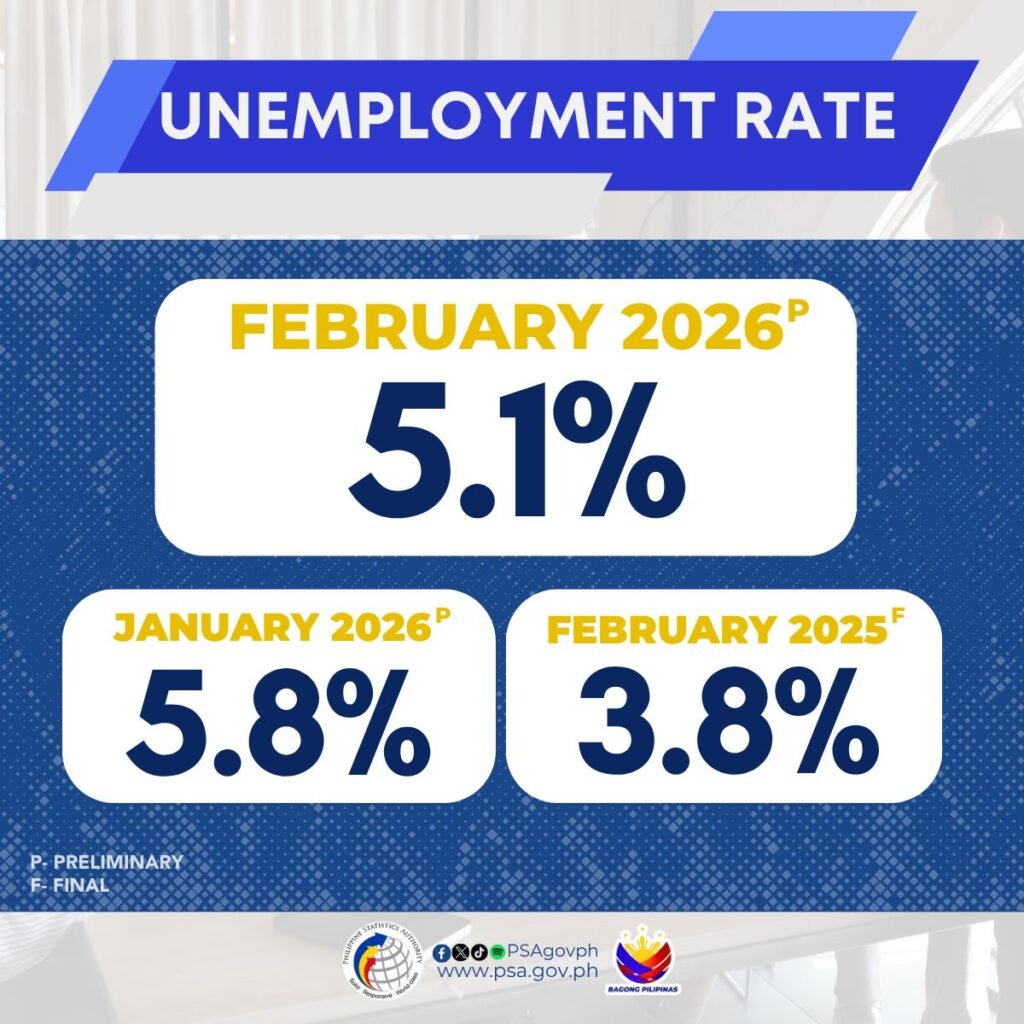
Data from the Philippine Statistics Authority show that 2.66 million Filipinos were unemployed in February 2026—lower than January’s 2.96 million, but sharply higher than the 1.94 million recorded a year ago.
The unemployment rate eased to 5.1%, while employment rose to 94.9%, translating to about 49.43 million Filipinos with jobs.
At first glance, the numbers suggest resilience.
But a deeper look complicates that picture.
An estimated 5.84 million Filipinos—about 11.8% of the employed—remain underemployed, meaning they are working but still seeking additional hours or income. On average, Filipino workers logged 40.9 hours a week, yet many still struggle to make ends meet.
The issue, analysts say, is not just job creation—but job quality.
The services sector continues to dominate employment at 63.5%, followed by agriculture (18.8%) and industry (17.7%). While sectors like administrative support, transport, and hospitality posted strong annual gains, these are often characterized by contractual, seasonal, or lower-paying work.
At the same time, some of the country’s most critical and traditionally stable sectors are shedding jobs.
Wholesale and retail trade lost 725,000 workers year-on-year, while agriculture and forestry—long a fallback for rural livelihoods—shed 523,000. Construction, another major employer, saw 484,000 jobs disappear.
These declines point to a labor market increasingly marked by churn rather than stability.
The Department of Economy, Planning, and Development acknowledged the mixed signals, with Secretary Arsenio Balisacan stressing the need to strengthen labor market resilience amid global uncertainties.
Yet the data suggests that resilience may be unevenly distributed.
While headline employment improves, more Filipinos are navigating precarious work arrangements, shifting sectors, or piecing together multiple income sources to stay afloat. For overseas Filipino workers—already facing deployment disruptions—the domestic labor market offers limited fallback options.
The result is a widening gap between employment and security.
Because in today’s labor landscape, having a job no longer guarantees stability—and rising employment figures may be masking a deeper problem: not a lack of work, but a lack of decent, reliable work.