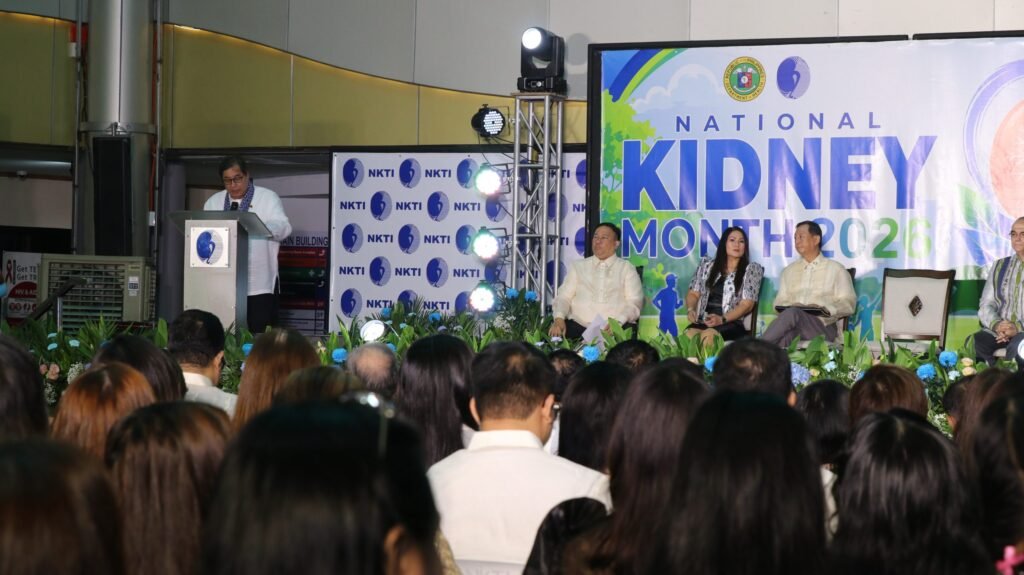
MANILA (June 3) — With an alarming statistic of one Filipino developing chronic kidney failure every single hour, the National Kidney and Transplant Institute (NKTI) has vowed to take its advocacy straight to the grassroots level through an expanded nationwide prevention campaign—an effort that carries urgent implications for geographically isolated and disadvantaged areas (GIDAs), particularly in Mindanao.
“The thrust of every year’s national kidney month celebration is to go out to the communities, go out to the LGUs, go to the local government hospitals and our partner DOH hospital, and to promote service, training, and research into the prevention of kidney disease,” said NKTI Executive Director Dr. Jose Dante Dator during the official kickoff ceremony for National Kidney Month on June 1.
This urgent push for grassroots intervention comes as data shows more than 64,000 Filipinos relied on dialysis treatment in 2024. Beyond those requiring treatment, the disease has proven increasingly fatal, with an estimated 39,000 deaths recorded every year attributable to kidney disease.
To highlight the alarming speed of this health crisis, Health Secretary Ted Herbosa pointed out that one Filipino develops chronic kidney disease every single hour, with hypertension, diabetes, and smoking as primary risk factors.
Mindanao’s GIDA communities face heightened risks
While the national figures are already alarming, health workers and advocates note that the burden is often deeper in Mindanao’s geographically isolated and disadvantaged areas, where early detection and long-term care remain difficult to access.
In provinces such as Bukidnon, Lanao del Sur, Maguindanao del Sur, Sultan Kudarat, and parts of the Zamboanga Peninsula, patients often face long travel times to reach dialysis centers concentrated in urban hubs such as Davao City, Cagayan de Oro, and General Santos.
Health professionals say these geographic barriers contribute to late diagnosis, with many patients already in advanced stages of kidney disease by the time they reach referral hospitals.
As a direct response to the escalating crisis, health authorities outlined critical interventions for patients already battling the illness. The intervention focuses on enhancing accessibility to treatment by establishing more specialty care centers and increasing financial and medical support for dialysis.
“This is why the Department of Health continues to advance the goals of universal health coverage through our 8-point action agenda. We are expanding access to preventive services, improving screening of diseases, and bringing essential services closer to communities,” said Herbosa, emphasizing early detection and proactive prevention.
Expanding financial support, but access gaps remain
Central to this initiative is the expansion of healthcare coverage under the Philippine Health Insurance Corporation (PhilHealth), as mandated by President Ferdinand R. Marcos Jr., to provide financial relief for patients.
The state insurer has increased its covered hemodialysis sessions from 90 to 156 sessions per year, with a subsidized rate of P6,350 per session. PhilHealth has also expanded its kidney transplantation benefit package to nearly P2 million, including post-transplant care and monthly immunosuppressive medication subsidies of P73,065 for pediatric patients and P40,725 for adults aged 19 and older.
However, in many parts of Mindanao’s GIDAs, health workers note that financial coverage alone does not solve the problem. Patients still face long travel distances, limited transport options, and additional out-of-pocket costs such as lodging and food when undergoing repeated dialysis sessions in urban centers.
Bringing kidney care closer to communities
National Kidney Month anchors a diverse lineup of patient education, wellness initiatives, advocacy campaigns, and community outreach programs.
Among these are “Wag Ma-Bato: Pangkabuhayan Para sa Tao,” a livelihood program for chronic kidney disease (CKD) patients, and “Bughaw na Bukas: Kidney Transplant para sa Mas Malusog na Buhay,” a hemodialysis lay forum aimed at increasing awareness on kidney transplantation.
The community outreach program focuses on screening services, diagnostic tests, and health lectures designed to empower communities to protect kidney health—an approach particularly crucial in Mindanao, where barangay-level health units often serve as the first and only point of care in remote municipalities.
National Kidney Month Chairperson Dr. Ernesto L. Gerial Jr. also highlighted the rising incidence of kidney disease among younger Filipinos, stressing that prevention must now extend beyond older populations.
“Pati sa mga kabataan, dumadami ang incidence ng kidney diseases kaya ang aming focus hindi lang sa mga matatanda, kundi sa mas nakakabata para mabigyan sila ng tamang gabay para sa pag-aalaga ng kanilang kidney health,” Gerial said.
A growing challenge for Mindanao’s health system
Under the theme “Tunay na Bughaw ang Buhay, Kung Ang Bato ay Masiglang Tunay,” this year’s National Kidney Month underscores the importance of early screening and healthy lifestyle habits.
For Mindanao, however, the challenge is compounded by geography, poverty, and uneven health service distribution. While urban centers continue to expand dialysis capacity, many rural and conflict-affected areas remain dependent on limited facilities and long referral pathways.
As one Filipino develops chronic kidney disease every hour, health experts warn that without stronger community-based prevention—especially in Mindanao’s hardest-to-reach areas—the burden on families and the healthcare system is likely to deepen further in the years ahead.