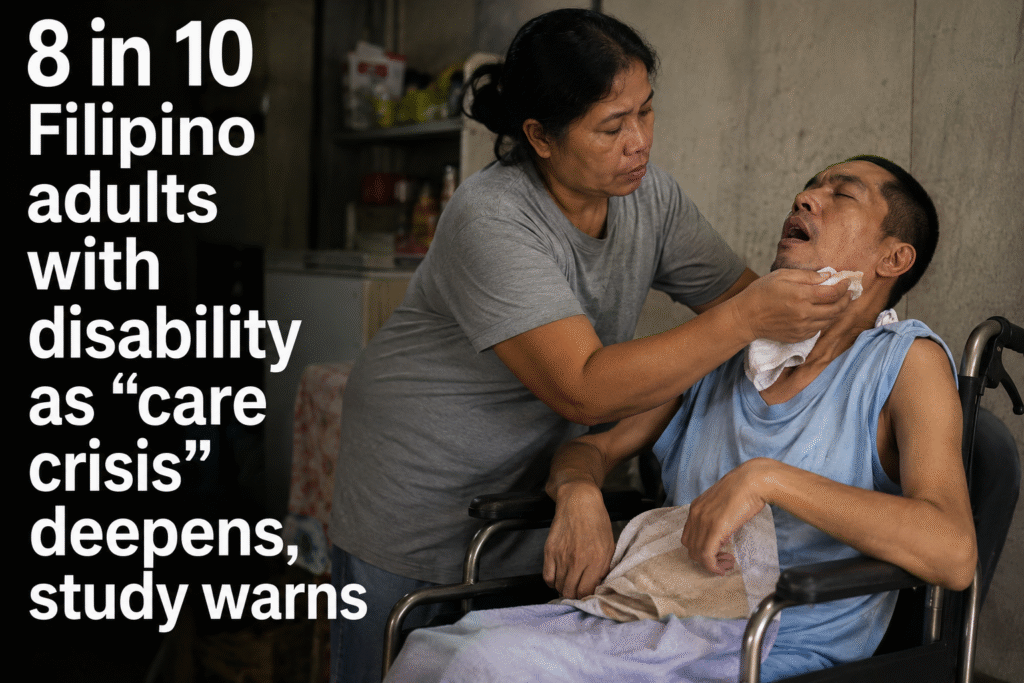
DAVAO CITY (May 8) — The Philippines is facing a growing but often unseen national burden: disability and long-term care needs that are rapidly outpacing the country’s support systems, pushing families — especially women — into the frontlines of caregiving with little assistance.
A new study by the Philippine Institute for Development Studies warns that 8 in 10 Filipino adults already live with some form of disability, a figure that signals not just a health issue but a looming social and economic crisis.
The situation is even more severe among older Filipinos, where nearly 9 in 10 are affected by at least a moderate disability — a trend expected to worsen as the country moves toward becoming an aging society by 2030.
The study, The Future Demand for Care in the Philippines, says the country is heading toward a “care crisis” driven by rising chronic diseases, shrinking families, and an overreliance on unpaid home-based care.
Non-communicable diseases — including heart disease, stroke, diabetes, and cancer — now account for 64 percent of deaths in the country, increasing the need for long-term care, rehabilitation, and daily assistance.
But the system meant to support this demand remains fragmented and underdeveloped.
Families are left to fill the gap, often at great personal cost. Those caring for children with disabilities may spend up to 80 percent more than average households, factoring in medical care, therapy, transport, and special needs support.
Behind these numbers is a quiet labor force: unpaid family caregivers.
The burden falls disproportionately on women, who spend an average of 28 hours per week on unpaid care work — more than three times that of men. The study says this entrenched pattern reinforces gender inequality while keeping caregiving largely invisible in policy planning.
At the same time, the country is losing trained caregivers and health workers to overseas jobs, where pay is significantly higher. This migration is shrinking the pool of available caregivers at home, deepening what researchers describe as a “leave-behind effect.”
The result is a system stretched thin: too few care workers, too few facilities, and too much responsibility resting on families already under financial pressure.
“At present, the care landscape is characterized by limited access to care services, an underdeveloped care industry, a lack of qualified care workers and professionals, and uneven distribution of existing facilities,” the study said.
Experts warn that relying on families as the default care system is no longer sustainable — especially as disability rates remain high and chronic illness becomes more common across all age groups.
The study calls for urgent government action to build a real “care economy,” including expanded community-based services, investment in professional caregivers, better data systems, and stronger social protection for households providing long-term care.
Without reform, researchers warn the gap between those who need care and those able to provide it will continue to widen — turning what is now a household burden into a nationwide crisis with long-term social and economic consequences.
For millions of Filipino families, the crisis is already here — not in policy papers or forecasts, but in daily routines shaped by exhaustion, rising costs, and the quiet reality of caring for loved ones with little formal support.