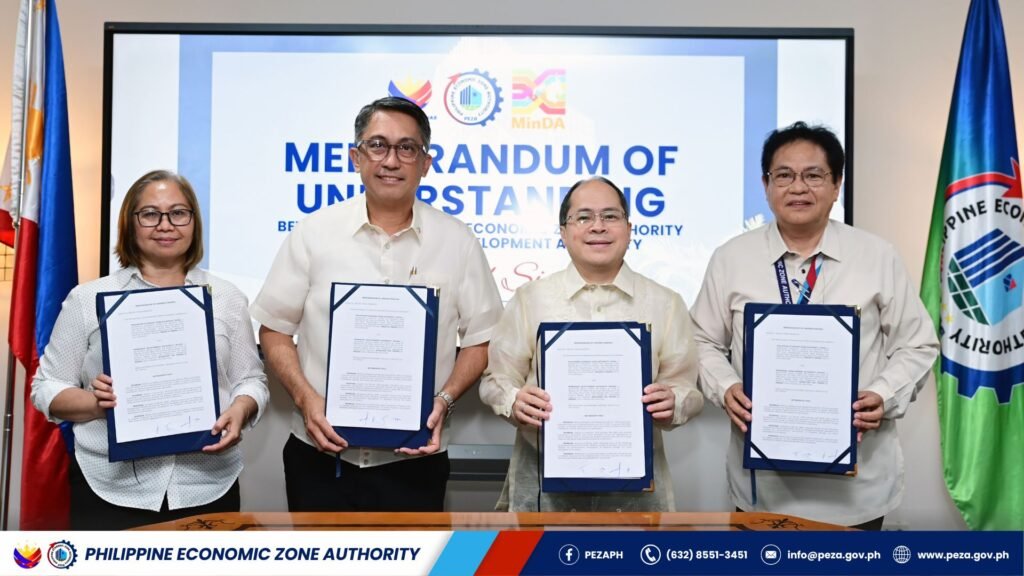
DAVAO CITY (March 4) — Two key government agencies are doubling down on efforts to turn Mindanao into the country’s next major investment magnet — but the success of the push will hinge on whether long-standing infrastructure and security gaps can finally be addressed.
The Philippine Economic Zone Authority (PEZA) and the Mindanao Development Authority (MinDA) signed an agreement last week to accelerate the development of economic zones across priority areas under the Mindanao Development Corridors (MDC) Program.
The goal: position Mindanao as a globally competitive, integrated growth region powered by stronger logistics, infrastructure, and investment flows.
Building on 42 ecozones — and counting
PEZA Director General Tereso Panga said 42 of the country’s 436 operating economic zones are already located in Mindanao — a footprint the agency wants to expand and diversify.
“Expanding and diversifying ecozone development in Mindanao is central to PEZA’s mandate,” Panga said, signaling that the region remains under-tapped compared to Luzon.
Under the deal, PEZA and MinDA will align planning and investment promotion campaigns, provide technical support to prospective ecozone developers, and conduct joint business matching to attract both domestic and foreign investors.
PPPs at the center
The partnership places public-private partnerships (PPPs) at the heart of the strategy — echoing the economic direction of Ferdinand Marcos Jr., who has emphasized infrastructure-led growth and interagency coordination.
Economic zones are being positioned as anchors of industrialization, job creation, and countryside development — particularly in areas covered by the MDC framework, which aims to connect growth corridors through ports, roads, and logistics networks.
MinDA Chair Leo Tereso Magno said the agency will work closely with local government units and private investors to promote existing zones while identifying new strategic sites.
Turning promise into performance
Mindanao has long been touted as the country’s “land of promise,” rich in agriculture, natural resources, and strategic location. Yet investors have historically cited concerns over infrastructure bottlenecks, power reliability, and peace and order in some areas.
The new PEZA-MinDA collaboration seeks to address those constraints through coordinated planning and targeted ecozone expansion.
The challenge now is execution: converting signed agreements into functioning industrial parks, actual factories, and sustained job creation.
If delivered effectively, officials say the partnership could rebalance the country’s investment landscape — shifting more economic activity beyond Metro Manila and bringing inclusive growth closer to Mindanao’s communities.
Whether that promise materializes will depend not just on incentives, but on infrastructure, governance, and investor confidence in the region’s long-term stability.