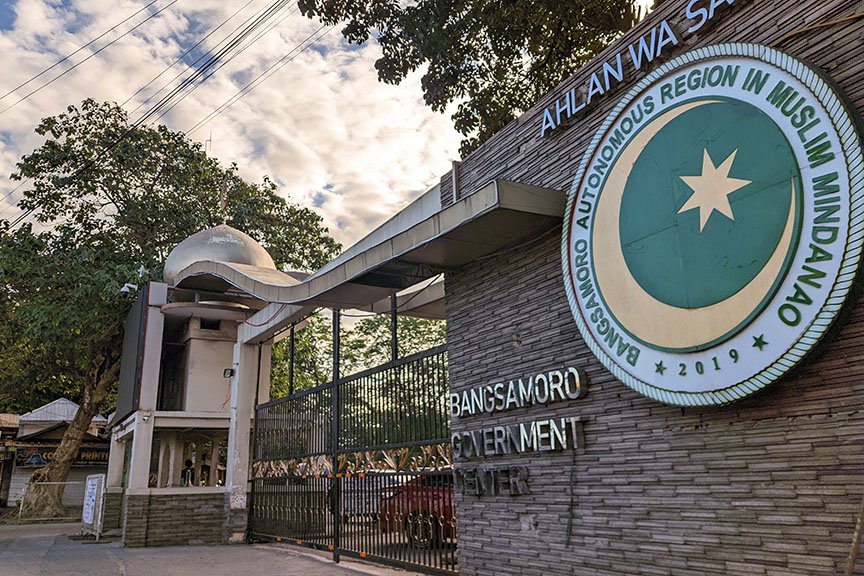
BARMM's Government Center. MindaNews file photo by BOBBY TIMONERA
MANILA (March 24) — The Commission on Elections (Comelec) has warned that escalating conflict in the Middle East could inflate the cost of holding the 2026 Bangsamoro parliamentary elections by as much as 25 percent—raising urgent questions about the country’s preparedness to safeguard democratic processes amid global crises.
Comelec Chair George Erwin Garcia said surging fuel prices, driven by geopolitical tensions, are already pushing up the cost of transporting election materials across the Bangsamoro Autonomous Region in Muslim Mindanao (BARMM), a geographically complex region where logistics depend heavily on land and sea travel.
“Logistics and supplies are directly affected,” Garcia said, noting that ballot papers, automated counting machines, and other election paraphernalia must be delivered to far-flung and often hard-to-reach areas—operations that become significantly more expensive as fuel prices climb.
But beyond the immediate budgetary strain, the warning underscores a deeper structural issue: the vulnerability of Philippine elections to external economic shocks.
Even before the projected increase, election logistics in BARMM have long been among the most expensive in the country due to security concerns, dispersed island municipalities, and limited infrastructure. A 20 to 25 percent surge in costs could stretch Comelec’s resources beyond its current budget—forcing either supplemental funding requests or operational compromises.
Garcia acknowledged as much, admitting that the poll body may face a funding shortfall if price pressures persist in the months leading up to the September 14, 2026 elections.
The situation places the burden squarely on the national government and Congress: whether to augment Comelec’s budget or expect the agency to absorb rising costs within existing allocations.
Election watchdogs warn that underfunding critical processes—such as the timely delivery of ballots or the deployment of secure equipment—could undermine not only efficiency but also credibility.
The timing is particularly sensitive.
The BARMM parliamentary elections are a cornerstone of the region’s evolving autonomous governance, seen as a key milestone in the peace process between the government and Moro groups. Any disruption, delay, or perceived compromise could have implications beyond logistics, potentially affecting political stability in a historically fragile region.
Yet the current predicament also reflects policy trade-offs beyond Comelec’s control.
The Philippines’ heavy reliance on imported fuel—combined with a deregulated oil industry—means global conflicts can quickly translate into domestic cost pressures. In this case, a war thousands of kilometers away could directly shape the price of running a local election.
What remains unclear is how contingency planning is being handled.
Has Comelec built sufficient buffers for such volatility? Are there alternative logistics strategies to reduce fuel dependence? And how quickly can additional funding be mobilized without disrupting procurement timelines?
So far, no detailed mitigation plan has been publicly outlined.
As preparations continue, the risk is not just higher costs—but the possibility that financial constraints could force difficult choices in executing one of the country’s most politically significant elections.
Because in BARMM, the challenge is not only to hold an election.
It is to ensure that rising global tensions do not erode the integrity of a democratic process already operating under complex and fragile conditions.