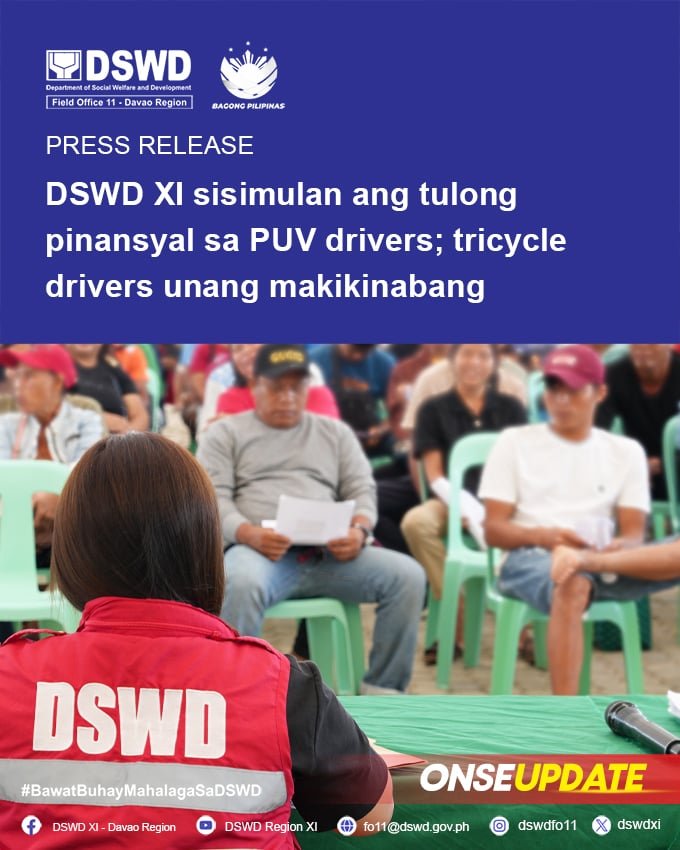
DAVAO CITY (April 8) — As fuel prices continue to squeeze daily earnings, the Department of Social Welfare and Development in Region XI is rolling out PHP150 million in cash relief for tricycle drivers—but the program’s scale and structure are already raising questions about reach, fairness, and long-term impact.
Regional director Rhuelo Aradanas said the agency is targeting 30,000 drivers, each to receive PHP5,000 under the Cash Relief Assistance (CRA), part of the government’s Assistance to Individuals in Crisis Situations (AICS).
The first wave, beginning April 8, will cover 14,670 beneficiaries across key cities, including Davao City, Tagum City, Panabo City, Digos City, Mati City, and the Island Garden City of Samal.
Aid arrives—but not for all
The assistance is framed as urgent relief for drivers battered by rising fuel costs. But with fewer than half of the target beneficiaries included in the initial rollout—and selection handled by local government units—questions are emerging over who gets prioritized, and why.
DSWD’s role is limited to disbursing funds, while LGUs determine the beneficiary list. That division, while administratively efficient, shifts accountability for inclusion and exclusion to the local level—where transparency mechanisms can vary widely.
Aradanas said those left out may still qualify in a second tranche, though no list or schedule has been finalized.
One-time relief vs. structural strain
At PHP5,000 per driver, the aid offers short-term breathing room. But for many tricycle operators facing daily fuel expenses and unstable passenger demand, the amount may only cover a few days to weeks of operating costs.
The program underscores a recurring policy tension: cash assistance as immediate relief versus the absence of longer-term interventions such as fuel subsidies, fare adjustments, or sector-specific support for informal transport workers.
“This is a program of the national government to support drivers affected by the fuel crisis,” Aradanas said—but the broader question is whether episodic payouts can keep pace with sustained price volatility.
Proof, permits, and barriers
Eligibility requirements—valid permits and driver’s licenses, plus documentation at payout sites—aim to prevent fraud. Yet they may also exclude marginal drivers, including those with expired papers or informal arrangements, who are often the most economically vulnerable.
Payouts will take place in centralized venues like public markets and city gyms, raising additional concerns over accessibility, transport costs, and crowd management, especially for drivers who must forgo a day’s income to claim aid.
A test of delivery and trust
With municipal rollouts set for April 16 and a possible second wave in cities, the program is shaping up as more than just a relief effort—it is a test of how social protection is delivered under crisis conditions.
For beneficiaries, the question is immediate: Will the cash arrive on time and without barriers? For government, the challenge runs deeper: Can short-term aid be distributed fairly and transparently—and can it evolve into more durable support for sectors hit hardest by economic shocks?