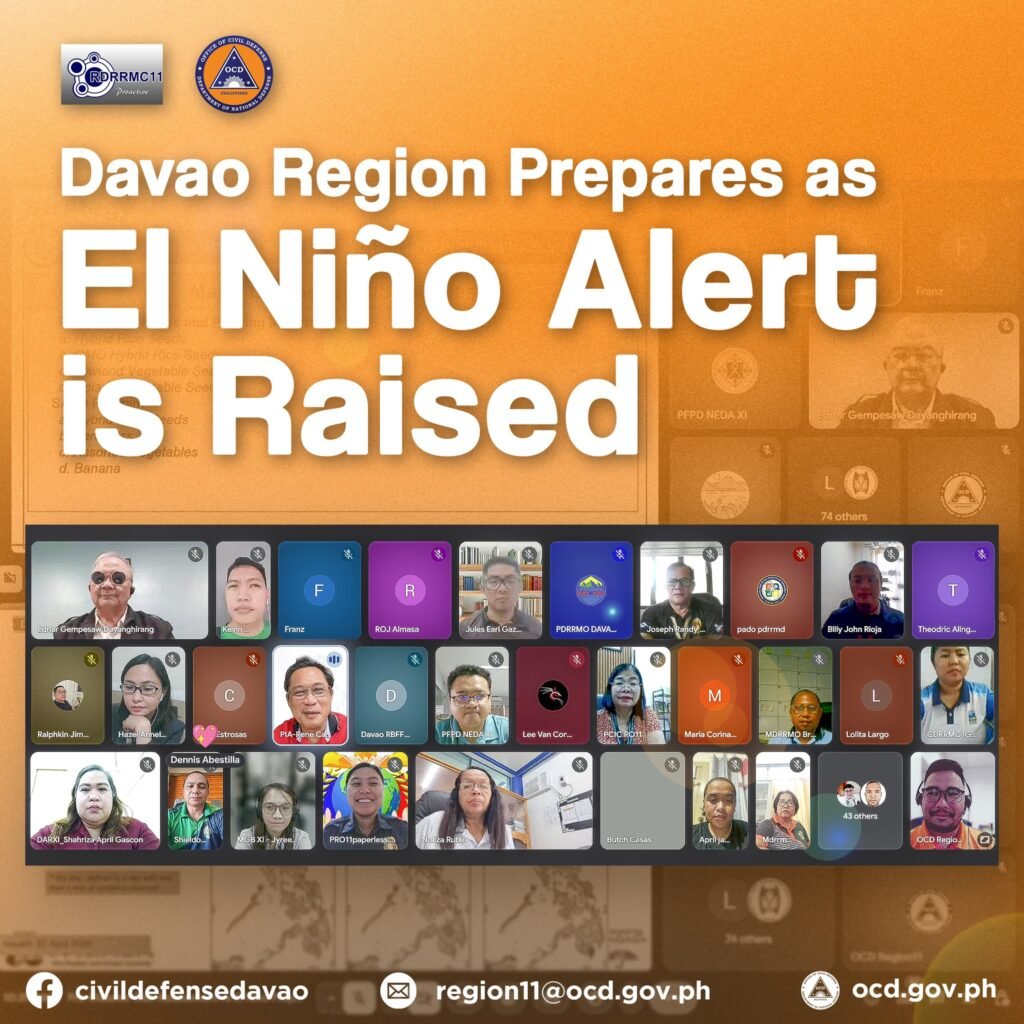
DAVAO CITY (April 28) — With drought risks looming, local governments across the region are shifting gears—mobilizing task forces and redirecting resources before El Niño conditions take hold.
The Office of Civil Defense in Davao Region (OCD-11) said nearly all LGUs have activated response teams, scaling down routine activities to prioritize water security, energy supply, and agriculture.
“We should not wait for the height of El Niño. Preparation must start now,” said Ednar Dayanghirang.
High probability, long impact
According to the Philippine Atmospheric Geophysical and Astronomical Services Administration (PAGASA), there is a 79% chance the dry spell will develop between June and August—and it could persist until early 2027.
That timeline is pushing LGUs to act early, with advisories already issued and contingency measures underway.
Agriculture in the crosshairs
Past data point to Davao del Sur as among the hardest-hit provinces during prolonged dry periods. Similar risks are emerging in Davao de Oro and Davao Oriental, where water-dependent crops are vulnerable.
In Davao del Norte, large portions of rice-producing areas are already flagged as high-risk—raising concerns over potential production losses and food supply disruptions.
Water and power under pressure
OCD-11 is urging stronger coordination with local water districts to secure supply as reservoirs and groundwater levels drop.
Dayanghirang also recommended that LGUs realign development funds, deferring non-essential programs to free up resources for drought response—such as water distribution, irrigation support, and emergency power measures.
Shifting priorities on the ground
Across the region, the activation of task forces signals a broader shift: from routine governance to crisis readiness.
For local governments, the challenge is not just managing the peak of El Niño—but stretching limited water, protecting crops, and keeping essential services running over a prolonged dry period.
As the region prepares for months of heat and reduced rainfall, officials are betting that early action will mean fewer losses—and more resilient communities when the drought hits hardest.