
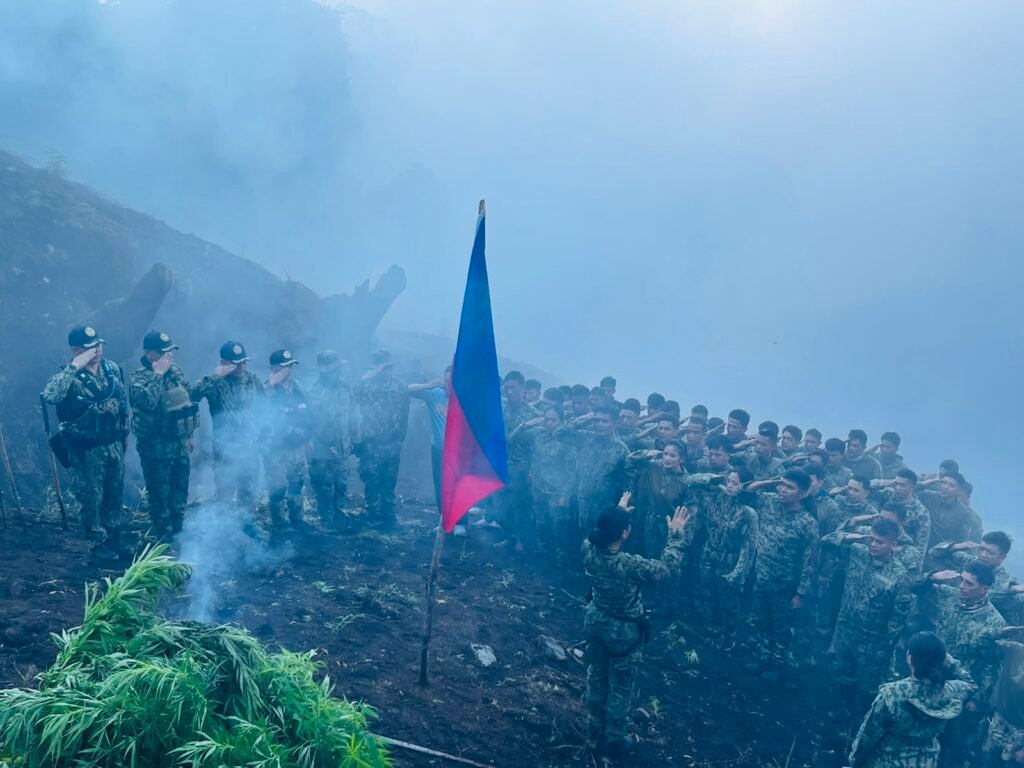
BAGUIO CITY, Philippines (May 19) — Thick smoke drifted across the mountains of Tinglayan as anti-drug operatives burned what authorities described as one of the largest marijuana plantations discovered in the Cordillera this year.
But beyond the ₱228 million worth of marijuana plants destroyed during the two-day operation on Mt. Chumanchil lies a deeper and more complicated reality quietly rooted in parts of the Cordillera hinterlands where some elderly residents have long regarded marijuana not as an illegal narcotic, but as traditional medicine.
The Police Regional Office–Cordillera Administrative Region (PRO-CAR) said operatives destroyed around 1.14 million fully grown marijuana plants spread across nearly 9.5 hectares in Barangay Loccong, Tinglayan, Kalinga during operations conducted from May 17 to 18. Authorities identified the area as among the long-standing marijuana cultivation “heartlands” in the province.
Mt. Chumanchil lies within the mountainous municipality of Tinglayan, home largely to the indigenous Butbut tribe, one of the major subgroups of the Kalinga ethnolinguistic people known for their rice terraces, mountain farming traditions, and deeply rooted tribal culture.
Authorities and local residents alike acknowledged that marijuana has thrived in the Cordillera mountains for decades because of the region’s cold climate, fertile mountain soil, thick forest cover, abundant rainfall, and difficult terrain conditions ideal for marijuana cultivation while also making plantation sites difficult for authorities to detect and access.
Law enforcement agencies have identified portions of Kalinga, Benguet, and Mountain Province as marijuana-growing areas since at least the 1970s and 1980s, though some local oral histories suggest small-scale cultivation existed even earlier in remote upland communities.
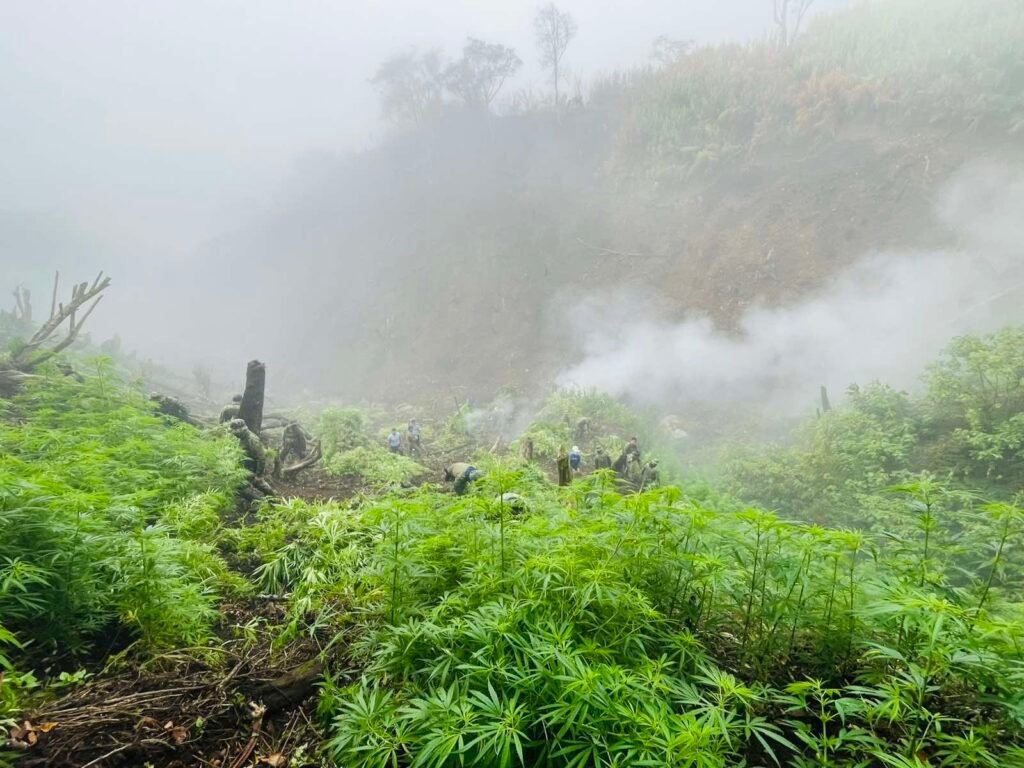
The steep terrain and isolated mountain trails also make law enforcement operations physically difficult, often requiring hours or days of trekking before authorities can reach plantation sites hidden deep in the hinterlands.-Photo-PRO CAR
For some elderly residents in isolated hinterland villages, marijuana was traditionally viewed less as a prohibited drug and more as a medicinal herb occasionally used in small quantities to ease body pain, arthritis, fatigue, insomnia, and discomfort from long hours of farming in the cold mountain highlands.
Anthropological accounts and local oral traditions have previously documented marijuana’s quiet presence in some indigenous Cordillera communities long before large-scale anti-drug campaigns reached the region.
But authorities stressed that the plantations discovered on Mt. Chumanchil far exceeded traditional or medicinal use.
Police said the sites contained more than one million fully grown marijuana plants spread across 10 plantation areas — an operation investigators believe points to organized cultivation intended for illegal distribution outside the Cordillera region.
The operation was conducted under Oplan “Revisit Everest” led by PRO-CAR Regional Director Ericson Dilag and supervised on the ground by Police Colonel Ledon Monte.
After documenting the plantation sites, operatives uprooted and burned the marijuana plants while investigators launched efforts to identify cultivators and financiers behind the operation.
Authorities later raised the Philippine flag atop Mt. Chumanchil in a symbolic assertion of government control over the mountainous area.
“Mt. Chumanchil belongs to us, the people of the Cordillera, and we will not allow anyone to destroy our children’s future,” Monte said during the ceremony.
PRO-CAR also continued its environmental rehabilitation efforts after the operation by planting tree seedlings in portions of the cleared areas — part of the regional police’s recent approach of pairing marijuana eradication operations with reforestation campaigns.
In previous operations across Benguet and Mountain Province, police officers also left handwritten messages urging cultivators to shift to vegetable farming and distributed basic farming tools to communities.
No arrests were reported during the latest operation.
But while smoke from burned marijuana fields slowly faded across Mt. Chumanchil, a more difficult reality remained buried beneath the mountains: that in some of the country’s most isolated hinterland communities, the debate over marijuana is no longer viewed solely through the lens of criminality but also through history, tradition, poverty, and survival.-Editha Z Caduaya