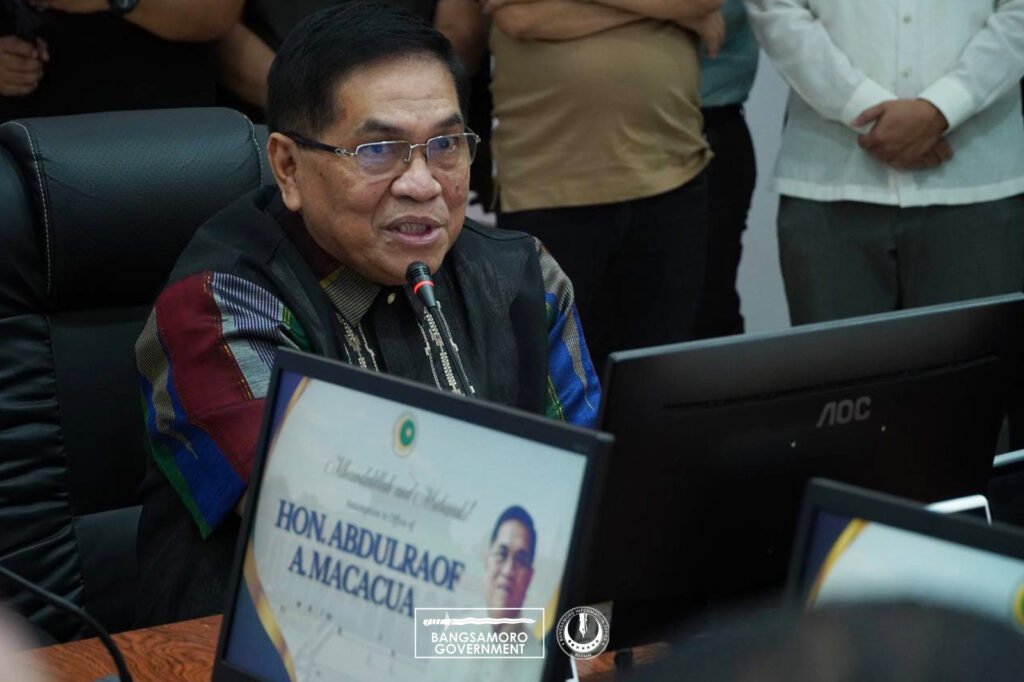
Abdulraof Macacua is standing by his move to remove Mohagher Iqbal as education minister of the Bangsamoro Autonomous Region in Muslim Mindanao despite mounting pressure from thousands of supporters and senior leaders of the Moro Islamic Liberation Front to reconsider the decision.
Speaking to reporters in Cotabato City on Monday, Macacua said fellow MILF leaders and mediators had appealed for a “brief respite” before enforcing his order, allowing Iqbal time to complete “necessary steps” following the controversy surrounding more than P2.2 billion in procurement transactions flagged by the Commission on Audit.
Macacua indicated he was open to the request, emphasizing his long-standing ties with Iqbal as “brothers” in Islam and in the MILF. Still, he underscored that the removal of any BARMM cabinet official remains within his authority as interim chief minister, regardless of whether formal administrative or criminal charges have been filed.
The standoff escalated after Macacua ordered Iqbal to resign by the close of office hours Monday or be “deemed resigned,” citing COA findings involving the Ministry of Basic, Higher and Technical Education.
Iqbal, however, rejected the demand in a May 16 letter.
“I respectfully decline to resign at this time,” Iqbal said, arguing that stepping down could be interpreted as an admission of guilt. He maintained that the audit observations were still preliminary and that the ministry was coordinating with COA for clarification and final evaluation.
The dispute has exposed growing political and factional tensions within the MILF-led BARMM transition government ahead of the region’s first parliamentary elections in September 2026.
On Monday morning, supporters estimated at more than 20,000 marched toward the BARMM government center to demand Iqbal’s retention and the reinstatement of former interim chief minister Ahod Ebrahim.
Protesters invoked the Comprehensive Agreement on Bangsamoro and Bangsamoro Organic Law, arguing that the MILF’s mandate to lead the BARMM transition should be protected from unilateral decisions.
Ebrahim himself publicly urged Macacua to reconsider the move, reminding him that decisions involving key MILF officials should be undertaken in consultation with the organization because of their implications on the peace process and BARMM governance.
Macacua later defended his action in a social media post written in Maguindanaon, saying he underwent “soul-searching” and performed optional and obligatory prayers before deciding to call for Iqbal’s resignation.
He said the move was guided by his commitment to “moral governance” — a principle first championed during Ebrahim’s administration — and pointed to previous removals of MILF-affiliated BARMM health officials over alleged administrative lapses as precedent.
The controversy now threatens to test the cohesion of the MILF-led transition government at a critical stage of the Bangsamoro peace process, with competing factions framing the issue either as a necessary accountability measure or a destabilizing political move within the autonomous region’s fragile power-sharing structure.