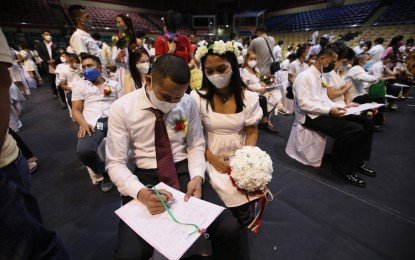
MANILA (July 9) — — For generations, marriage has been considered a milestone of adulthood for many Filipinos. Today, however, fewer couples are walking down the aisle as rising costs, changing priorities, and shifting social attitudes redefine what family life looks like.
Fresh data from the Philippine Statistics Authority (PSA), highlighted in a report by the Commission on Population and Development (CPD), reveal a steady decline in marriages over the past decade—a demographic shift that experts say could reshape the country’s future, from birth rates and housing demand to education, social protection, and economic planning.
Registered marriages fell by 13.5 percent over the past 10 years, dropping from 429,723 in 2014 to 371,825 in 2024.
The trend briefly reversed after the pandemic. Weddings plunged to just 240,775 in 2020 as lockdowns and restrictions halted ceremonies, then rebounded to 449,428 in 2022. But the recovery proved temporary, with marriages falling to 414,213 in 2023 before dropping another 10.2 percent last year.
For the CPD, the figures reflect more than changing wedding statistics—they signal evolving patterns of family formation in the Philippines.
“Beyond the numbers, these trends provide important demographic insights into how family formation is changing in the Philippines. They have far-reaching implications for fertility intentions, child well-being, social protection, housing, education, and long-term development planning,” the agency said.
The commission said understanding these demographic shifts is essential to designing policies that better support Filipino families in their changing realities.
Waiting longer to settle down
The data also show that Filipinos are marrying later in life.
Couples aged 25 to 29 accounted for the largest share of newlyweds in 2024, while the median age at marriage rose to 30 for men and 28 for women, up from 28 and 26, respectively, in 2015.
The increase suggests that many Filipinos are postponing marriage as they pursue higher education, establish careers, or seek greater financial stability before starting a family.
Civil registration records also reflected the wide age range among newlyweds. In 2024, the oldest individuals to marry were a 96-year-old man and an 87-year-old woman, while the youngest recorded were a 14-year-old boy and a 10-year-old girl.
Where Filipinos are still tying the knot
Despite the nationwide decline, Calabarzon remained the country’s marriage capital in 2024, recording 54,981 registered marriages, or 14.8 percent of the national total.
The National Capital Region followed with 48,448 marriages (13 percent), while Central Luzon registered 42,227 marriages (11.4 percent).
As fewer Filipinos say “I do,” the CPD said the challenge for government is no longer simply tracking marriage rates but understanding what changing aspirations and economic realities mean for the future of Filipino families—and ensuring policies evolve with them.