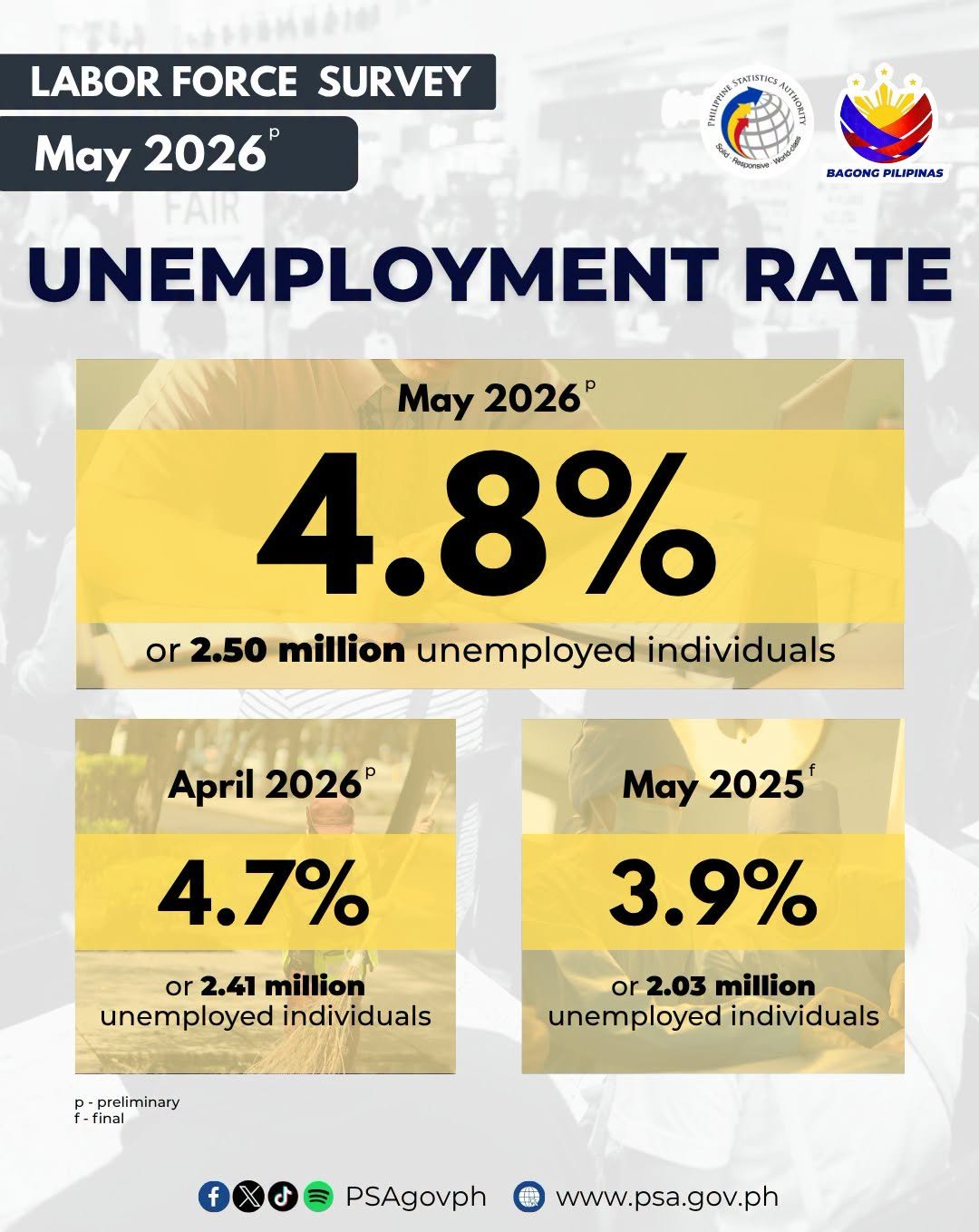
MANILA (July 9) — — More Filipinos were without work in May as the country’s unemployment rate climbed to 4.8 percent, leaving an estimated 2.5 million people searching for jobs despite continued hiring in the service sector and a decline in underemployment.
The latest Labor Force Survey released Wednesday by the Philippine Statistics Authority (PSA) showed 2.50 million unemployed Filipinos in May, up sharply from 2.03 million recorded during the same period last year. The increase pushed the unemployment rate above the 3.9 percent posted in May 2025, signaling renewed pressure on the country’s labor market.
Even with nearly 50 million Filipinos employed, the employment rate slipped to 95.2 percent, equivalent to 49.63 million workers. The figure was slightly lower than 95.3 percent in April and 96.1 percent a year earlier.
The labor force participation rate, which measures Filipinos aged 15 years and above who are either working or actively looking for work, improved to 63.8 percent from 62.7 percent in April. However, it remained below the 65.8 percent recorded in May 2025, bringing the country’s labor force to 52.13 million.
Most Filipinos still depend on wage jobs
Wage and salary earners continued to make up the bulk of the country’s workforce, accounting for 64.3 percent of all employed Filipinos.
Among them, nearly eight in every 10 workers were employed by private companies, while 14.2 percent worked in government offices or government-owned and controlled corporations.
PSA Undersecretary Claire Dennis Mapa said it is still too early to determine whether the recently approved ₱85 daily minimum wage increase in the National Capital Region has begun to influence employment trends.
Meanwhile, 27.2 percent of employed Filipinos were self-employed without paid workers, 6.8 percent worked as unpaid family workers, and 1.8 percent were employers operating family-run businesses or farms.
Fewer workers seeking extra hours
Despite the rise in unemployment, fewer employed Filipinos reported looking for additional work.
The underemployment rate declined to 12.2 percent in May from 15.2 percent in April, equivalent to 6.04 million workers seeking additional hours, another job, or better-paying employment.
The improvement suggests that while fewer Filipinos have jobs, those who remain employed may be finding more stable or longer work hours than in previous months.
Services expand while agriculture loses jobs
The service sector remained the country’s largest employer, accounting for 61.8 percent of total employment, followed by agriculture at 19.9 percent and industry at 18.3 percent.
Office-based and service-related industries continued to create jobs. Employment in administrative and support service activities increased by 329,000, while gains were also recorded in mining and quarrying (+184,000), human health and social work (+173,000), fishing and aquaculture (+170,000), and construction (+168,000).
However, these gains were offset by significant losses in other sectors.
The agriculture and forestry subsector suffered the biggest decline, shedding 905,000 jobs over the past year. Employment also fell in other service activities (-442,000), public administration and defense (-213,000), wholesale and retail trade, including motor vehicle repair (-141,000), and professional, scientific and technical activities (-75,000).
The latest labor figures paint a mixed picture of the Philippine economy. While service industries continue to generate employment and fewer workers are seeking additional jobs, rising unemployment and steep losses in agriculture underscore the continuing challenge of creating enough quality jobs for a growing labor force.