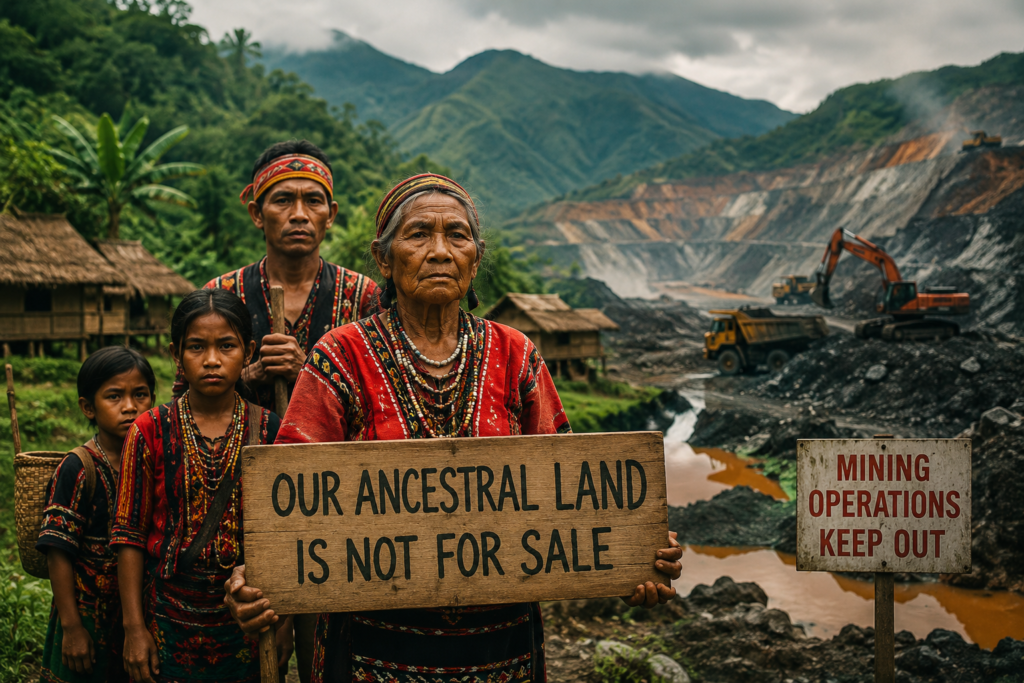
MANILA (August 10) — They are among the country’s oldest communities, guardians of forests and watersheds and keepers of languages and traditions passed from one generation to the next.
Yet for millions of Indigenous Filipinos, simply remaining on their ancestral land can still be a struggle.
On the International Day of the World’s Indigenous Peoples on Aug. 9, the spotlight turns once again to communities whose rights are recognized by Philippine law but whose lives continue to be marked by poverty, land disputes, displacement, environmental threats and, in some areas, conflict.
The numbers reveal the scale of the problem.
The Philippine Statistics Authority reported that Indigenous Peoples had the highest poverty incidence among the country’s basic sectors in 2023 at 32.4%—meaning nearly one in three Indigenous Filipinos belonged to families living below the official poverty threshold. The figure was higher than the poverty rates recorded among fisherfolk and farmers, at 27.4% and 27%, respectively.
And the country’s Indigenous population is far from small.
The 2020 Census counted 9.84 million Indigenous Peoples, equivalent to 9.1% of the Philippine household population. Subanons/Subanens, Manobos and Mandayas were among the country’s largest Indigenous groups.
A large majority live in Mindanao.
According to the 2026 edition of The Indigenous World, about 63% of the Philippines’ Indigenous population is in Mindanao, making the island the center of the country’s Indigenous rights and ancestral-land story.
For these communities, however, poverty cannot be separated from land.
When ancestral land becomes a battleground
For Indigenous Peoples, ancestral territory is more than a piece of property.
It is where food is grown, water is sourced, medicines are gathered, traditions are practiced and generations are buried.
It is also the foundation of cultural identity.
The Indigenous Peoples’ Rights Act of 1997 recognizes ancestral lands and domains and provides for the issuance of Certificates of Ancestral Domain Titles (CADTs) to formally recognize Indigenous ownership. The National Commission on Indigenous Peoples is mandated to protect and promote the interests and well-being of Indigenous Cultural Communities and Indigenous Peoples.
But recognition on paper does not automatically end disputes on the ground.
Across Mindanao, Indigenous territories have repeatedly come under pressure from mining, plantations, logging, energy projects, infrastructure development and other competing claims over land and natural resources.
That creates a fundamental conflict.
The land that sustains Indigenous communities is often the same land that investors and industries see as an economic resource.
When development projects enter ancestral territories, questions over consent, environmental protection, compensation and the right of communities to decide their own future become unavoidable.
The cost of being poor on resource-rich land
The contradiction is difficult to ignore.
Some Indigenous communities live in areas rich in forests, minerals, rivers and other natural resources, yet remain among the poorest sectors of Philippine society.
The PSA’s 32.4% poverty incidence among Indigenous Peoples in 2023 exposes this development gap.
It raises a question that has followed Indigenous communities for decades:
If ancestral territories generate wealth, why do the people who have lived there for generations remain poor?
The answer is complicated by geography and limited access to basic services.
Many Indigenous communities are located in remote and mountainous areas where schools, hospitals, roads, markets and stable sources of employment remain difficult to reach.
Climate change is adding another layer of vulnerability.
The Philippine Climate Change Commission has noted that Indigenous communities are disproportionately affected by climate-related displacement and environmental degradation because their livelihoods and cultural identities are closely tied to ancestral lands. From 2020 to 2022, more than 15 million Filipinos were displaced by 245 natural hazards.
For an Indigenous family, losing access to ancestral land after a disaster can mean losing not only a house or farm, but an entire way of life.
Mindanao’s Lumad communities
The crisis is especially visible among the Lumad communities of Mindanao.
For years, Indigenous communities in areas such as Davao de Oro, Bukidnon, North Cotabato, South Cotabato, Surigao del Sur and other parts of the island have faced conflicts involving ancestral land, armed groups, military operations and resource extraction.
Some Indigenous communities have also experienced displacement and disruption of education.
Reports have documented the struggles of Lumad communities forced away from their homes and schools amid security operations and land conflicts. In one recent account, Indigenous teachers and students described continued fears surrounding schools serving Lumad children.
For communities already struggling with poverty, displacement can be devastating.
A farmer driven away from ancestral land loses access to crops.
A child forced to leave school loses months or years of education.
A community separated from its territory can lose access to sacred sites, forests and traditional sources of food and medicine.
And when people are unable to return, displacement can gradually become permanent.
When defending land becomes dangerous
The WFTU, in its statement marking this year’s International Day of the World’s Indigenous Peoples, warned against discrimination, militarization and the criminalization of Indigenous communities defending their legitimate rights.
The concerns are not merely theoretical.
Indigenous rights groups have repeatedly raised alarm over alleged rights violations involving communities resisting mining, plantations and other projects. Recent reports have described Indigenous defenders being subjected to red-tagging and other forms of pressure when they oppose projects affecting their territories.
The danger is that a community’s attempt to protect its land can be portrayed as opposition to development.
But Indigenous communities are not necessarily rejecting development.
Often, they are asking a more basic question:
Development for whom—and at whose cost?
The right to decide
At the center of the Indigenous struggle is not simply land ownership.
It is self-determination.
The right to participate in decisions affecting ancestral territory.
The right to protect traditional livelihoods.
The right to preserve language and culture.
The right to decent work and social protection.
And the right to say no when a project threatens the community’s survival.
These principles are reflected in the country’s Indigenous Peoples’ Rights Act, including the recognition of ancestral domains and the institutions and traditions of Indigenous communities.
But implementation remains the critical test.
A title is meaningful only when communities can actually exercise the rights it represents.
Consultation is meaningful only when Indigenous voices can genuinely influence decisions.
And development is meaningful only when the people living on the land are not forced to sacrifice their homes, livelihoods and identity to make it possible.
Beyond Aug. 9
The International Day of the World’s Indigenous Peoples should therefore be more than a celebration of traditional dances, colorful clothing and cultural festivals.
Those are important.
But behind every cultural performance is a community trying to protect the conditions that allow that culture to survive.
Behind every ancestral domain map are families whose food, livelihood and identity are tied to the land.
And behind every Indigenous rights campaign is a demand that has remained remarkably consistent:
Let us live on our land. Let us protect it. Let us have a voice in what happens to it.
The WFTU said the international observance should be a call to action, urging trade unions and progressive organizations to stand with Indigenous Peoples in their struggles for justice, equality, decent work and protection of their territories.
For the Philippines, that call is particularly urgent.
Because with nearly 9.84 million Indigenous Filipinos and almost one-third living below the poverty line, recognition alone is not enough.
The country’s Indigenous Peoples do not need to be remembered only once a year.
They need their ancestral lands protected, their children educated, their livelihoods secured, their voices heard and their rights enforced.
For many Indigenous communities, the fight is not simply about preserving the past.