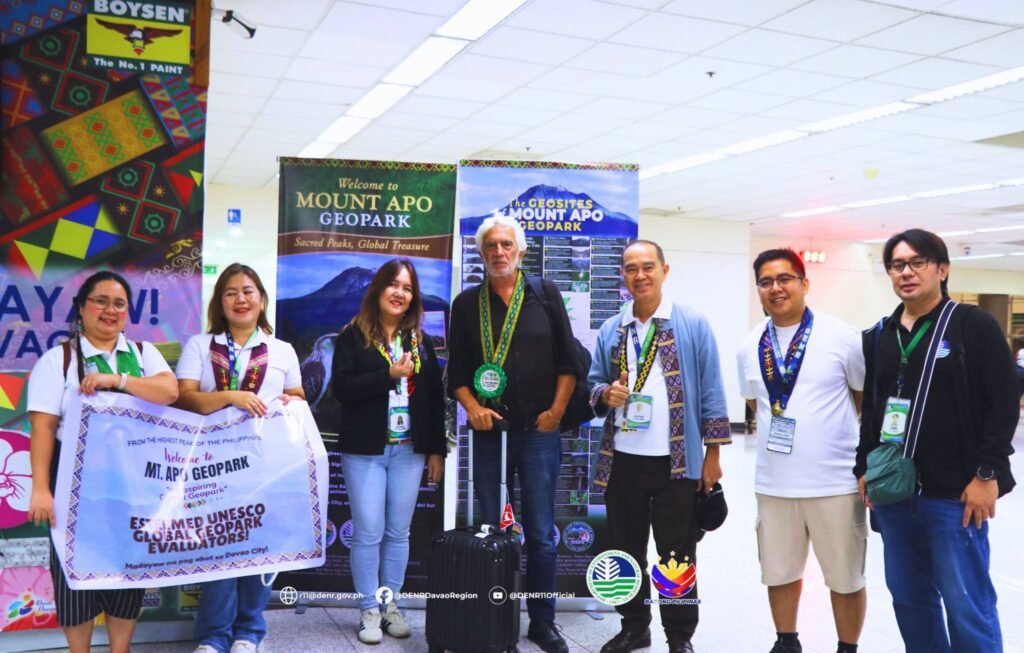
DAVAO CITY(August 18) — Mount Apo’s bid to become the Philippines’ second UNESCO Global Geopark has entered a crucial stage as international evaluators begin a five-day on-site mission to examine whether the country’s highest peak can balance its extraordinary geology and biodiversity with Indigenous culture and community-led development.
Dr. Guy Martini of France and Chenggong Zhang of China arrived in Davao City Sunday, Aug. 16, to validate Mount Apo’s application for the prestigious designation.
The evaluators will verify the self-evaluation document jointly submitted by the Department of Environment and Natural Resources (DENR) regional offices in Davao and Soccsksargen, focusing on three key areas: conservation, education and sustainable community-led development.
For Mindanao, the evaluation is more than a search for another international tourism distinction. It is a test of whether Mount Apo’s natural wealth can translate into lasting benefits for the communities that have protected and lived with the mountain for generations.
More than the country’s highest peak
During the Partners in Stewardship: Mt. Apo Geopark Stakeholders’ Dialogue in Davao City, Mount Apo Natural Park protected area superintendent Clint Michael Cleofe presented the framework of the 640-square-kilometer, or 64,000-hectare, protected area.
First declared a national park in 1936 and legally gazetted under Republic Act 9237 in 2003, Mount Apo stretches across seven local government units in Regions XI and XII.
Its claim to global significance is anchored on four interconnected features: geological tectonics, clean energy, biodiversity and Indigenous culture.
Mount Apo was shaped by the rare double-verging arc-arc collision of the Molucca Sea Plate and the Philippine Sea Plate, a geological process that helped form the country’s highest peak.
Its geology also provides a practical demonstration of how natural resources can support communities. Within the protected area is a major geothermal production field operated by the Energy Development Corporation and Philippine National Oil Corporation.
The mountain’s diverse physical and geological features have also created habitats with a high level of species endemicity.
But for UNESCO evaluators, the mountain’s value cannot be measured by geology alone.
Indigenous communities at the heart of the bid
Mount Apo is also a cultural landscape deeply connected to the Bagobo Tagabawa, Bagobo Klata and Obu-ManoboIndigenous communities.
Following initial activities with the Bagobo Klata, Martini and Zhang are scheduled to visit Indigenous Cultural Communities in Digos City and Santa Cruz, Davao del Sur, where they will meet members of the Bagobo Tagabawa and Obu-Manobo tribes.
The itinerary also includes cultural heritage sites, schools, community-based ecotourism initiatives such as Lake Agco hot springs, and the Mount Apo Geothermal Production Field in Cotabato Province.
These community visits could prove critical to the evaluation.
A UNESCO Global Geopark is not simply a designation for a beautiful or geologically important place. It seeks to connect geological heritage with education, conservation, culture and sustainable development.
For communities around Mount Apo, that means the value of the designation should extend beyond visitors and tourism revenues. It should help protect traditional knowledge, strengthen local livelihoods and ensure that Indigenous peoples remain active stewards of the landscape.
‘We are here to help, not to judge’
For Martini, the geopark concept goes beyond simply managing a protected territory.
It is about developing a deeper and more holistic understanding of a place by bringing together its cultural, natural, geological and intangible heritage.
By connecting these different forms of heritage, he said, communities could develop sustainable policies while strengthening their pride in the territory they call home.
Zhang echoed this approach, emphasizing that the evaluators are not coming simply to inspect or judge Mount Apo.
“We are here not just to conduct the evaluation. We are here to help; we are not to judge,” Zhang said.
He said the team wants to see how Mount Apo successfully connects geo-heritage, clean geothermal energy and community development, adding that they want to help tell “the beautiful story of Mt. Apo to the whole world.”
DENR XI regional director Ma. Mercedes Dumagan said Mount Apo possesses geological, biological and cultural values that deserve recognition not only in the Philippines but internationally.
A global label, a local responsibility
Preparation for the application began in 2022, eventually leading to the formal submission of Mount Apo’s nomination.
If successful, Mount Apo would become only the second UNESCO Global Geopark in the Philippines after Bohol, giving Mindanao a major international platform for its geological, ecological and cultural heritage.
But the bigger challenge may begin after recognition.
A global designation could bring greater tourism interest, investment and international attention. It could also place greater pressure on the fragile ecosystems and communities that make Mount Apo unique.
The challenge, therefore, is not simply to convince UNESCO that Mount Apo is globally significant.
It is to show that the mountain can be developed without losing the very qualities that make it worthy of global recognition—and that the people who have long lived alongside it will remain central to its protection and future.
The evaluators will prepare a report that will undergo further review by member states of the UNESCO International Geoparks and Geosciences Programme.
A final decision on Mount Apo’s nomination is expected in 2027.
Until then, the mountain’s UNESCO dream rests on a simple but demanding proposition: that protecting Mount Apo’s rocks, forests, wildlife and cultures must go hand in hand with improving the lives of the communities that call it home.