DAVAO CITY (September 2) — When government officials decide how to spend public money, families want to know one thing: Will these funds actually help our children?
A program that helps answer that question is now expanding across Mindanao.
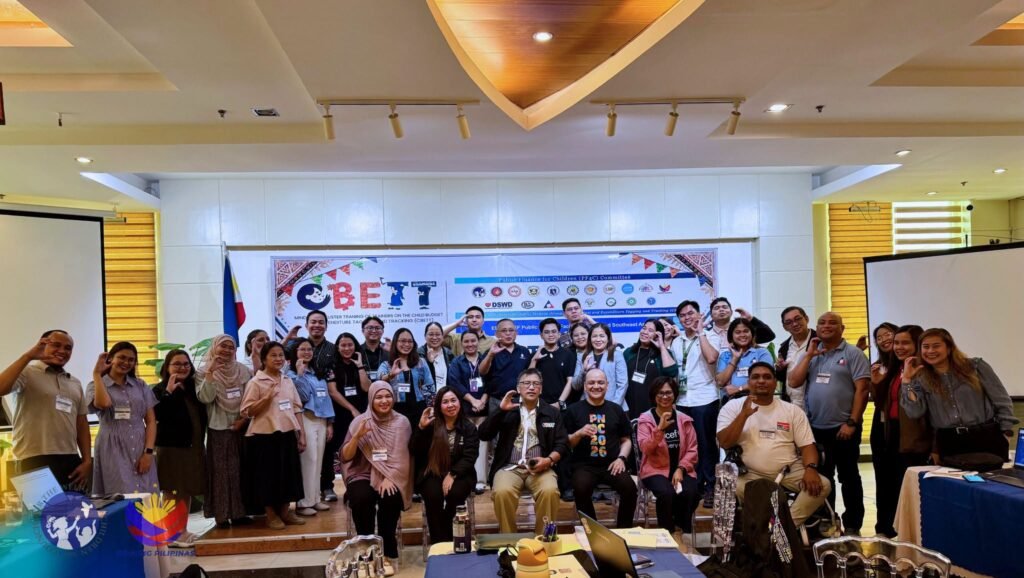
The Child Budget and Expenditure Tagging and Tracking (CBETT) program recently trained representatives from Regions IX, X and XI to help local governments keep track of money intended for children.
The five-day training was held in Davao City from Aug. 24 to 28 and was led by the Council for the Welfare of Children (CWC).
The participants came from government groups working on children’s welfare. They were trained to teach others how to identify, record and follow government spending for children.
In simple terms, CBETT helps government see how much money is being set aside for children, what it is supposed to pay for and whether it is actually being used for those purposes.
Why should families care?
Government budgets may sound like something meant only for officials.
But families see the results of those decisions every day.
A budget can help determine whether a child has access to a health center, nutritious food, a safe school, social services or protection from abuse and violence.
It can also affect whether programs for children continue or disappear because there is not enough money to support them.
That is why keeping track of children’s funding matters.
Families deserve to know that money meant to help children is reaching the programs and services they need.
Making children’s needs visible
Children have many needs, but those needs can sometimes compete with other government priorities.
CBETT helps local governments identify spending that directly benefits children.
This can include money for children’s health, education, nutrition, protection and other services.
It also gives government workers a clearer way to check whether these programs are receiving the support they need.
The training follows a national agreement among the CWC, the Department of Budget and Management, the Department of the Interior and Local Government, and the Bureau of Local Government Finance.
But families do not need to understand all the government offices or technical rules to understand the bigger picture.
The basic idea is simple: plan the money, spend it properly and check where it goes.
Bringing the program closer to communities
The training in Davao City brought together representatives from Regions IX, X and XI.
These newly trained regional resource persons can now help teach other government workers in their areas.
The goal is for the program to reach provinces, cities and municipalities across Mindanao.
That matters because decisions about children’s services are often made close to home.
A family in a rural community may need a working health center.
A child may need help staying in school.
Another may need food assistance, protection from violence or access to social services.
For these programs to work, they need funding.
More than numbers on paper
A government budget is not simply a list of numbers.
It can mean a classroom that has the materials children need, a health program that reaches mothers and babies, food for children who are struggling with malnutrition or assistance for a child who needs protection.
But setting aside money is only the first step.
The next question is whether the money actually reaches the children it is meant to help.
That is where CBETT can make a difference.
By keeping track of children’s funding, government workers can identify where money is going and where there may be gaps.
It can also give communities a better basis for asking questions about public spending.
The real test: what children receive
The Council for the Welfare of Children said the expansion of CBETT to Mindanao is an important step toward building a nationwide group of people who can help local governments plan and track spending for children.
The CWC thanked representatives and government offices from Regions IX, X and XI for taking part in the training.
It also acknowledged the support of Social Watch Philippines, the European Union, UNICEF and partner government agencies.
But the real test begins after the training.
Can the lessons learned in Davao City help local governments make better decisions about children’s needs?
Can families see improvements in the services available to them?
And can communities be more confident that money intended for children is being spent where it is needed most?
For parents and children, those are the questions that matter.
Because a child-friendly budget is not really about numbers. It is about making sure every peso meant for children helps build a healthier, safer and better future for them.