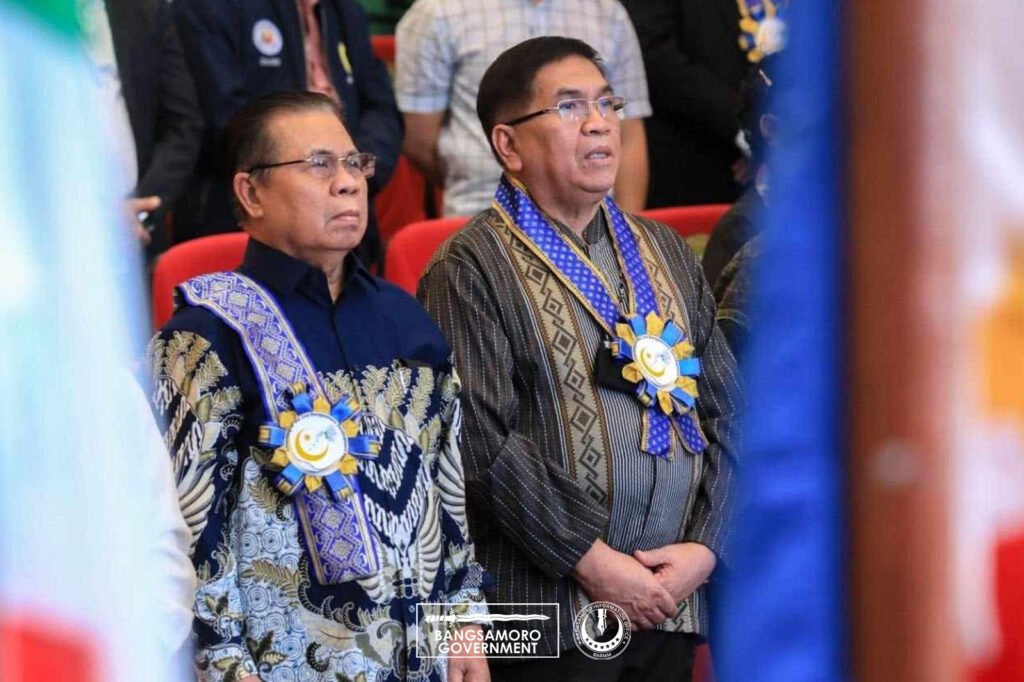
Photo: Bangsamoro Autonomous Region in Muslim Mindanao
COTABATO CITY (April 10) — What was once a unified revolutionary front is now edging toward a political split, as two longtime comrades—Ahod Ebrahim and Abdulraof Macacua—appear headed for a high-stakes showdown in the first-ever parliamentary elections of the Bangsamoro Autonomous Region in Muslim Mindanao (BARMM).
With the Commission on Elections closing the filing of party accreditation and participation on April 7, the contours of a contest for chief minister are beginning to take shape—one that could redefine power within the Bangsamoro government.
From comrades to contenders
Ebrahim and Macacua share a political and revolutionary history spanning decades, from the Moro National Liberation Front to the Moro Islamic Liberation Front, movements that fought for Moro self-determination and eventually brokered peace agreements with the Philippine government.
But the transition from armed struggle to parliamentary politics is exposing internal fault lines.
Ebrahim, chair of the MILF and president of the United Bangsamoro Justice Party (UBJP), is widely expected to anchor the party’s bid for chief minister. His name tops UBJP’s 40-member party-list slate—conspicuously without Macacua.
Macacua, the incumbent interim chief minister and MILF field commander, is charting a different path.
Parallel power blocs emerge
In a move widely seen as a political pivot, Macacua’s allies helped form the Bangsamoro Federalist Party (BFP), which mobilized thousands of supporters and formally joined the September 14 elections.
Though not listed among its nominees, Macacua is expected to run for a district seat in Maguindanao del Norte—widely viewed as a strategic step to position himself for the chief minister post.
The emerging alignment is broader than a single party.
The Bangsamoro People’s Party (BPP), part of the opposition coalition, has openly expressed support for Macacua. Other groups, including the Alliance of Bangsamoro Tri-Peoples’ Party (ABOT), are also rallying behind him, signaling the formation of a multi-party coalition.
A test of MILF unity
The split is striking because both camps trace their roots to the MILF, which remains the dominant political force in BARMM. For years, the assumption was that the group would enter the region’s first parliamentary elections united behind a single candidate.
That assumption is now unraveling.
Political observers say the formation of rival parties—and the exclusion of Macacua from UBJP’s slate—suggest that internal negotiations have broken down.
High stakes for a new political system
The September 14, 2026 elections will be a defining moment for BARMM, marking the transition from an appointed interim government to an elected parliamentary system under the Bangsamoro Organic Law.
Eighty lawmakers—32 from district seats and 48 through party and sectoral representation—will convene the first regular Parliament. From among themselves, they will elect the chief minister.
That structure makes coalition-building crucial—and fluid.
While UBJP retains a strong base as the MILF’s official party, Macacua’s growing coalition could reshape the balance of power, especially if it consolidates support across political clans, sectoral groups, and non-MILF blocs.
Uncertain endgame
As of now, neither camp has formalized its full electoral strategy. Macacua has yet to declare his party affiliation for his district run, while his allies stop short of officially naming him as their standard-bearer.
Still, the trajectory is clear: BARMM’s first parliamentary elections are no longer just a milestone in self-governance—they are becoming a referendum on leadership within the Bangsamoro movement itself.
And for the first time in decades, its most prominent figures may face off not as allies, but as rivals at the ballot box.