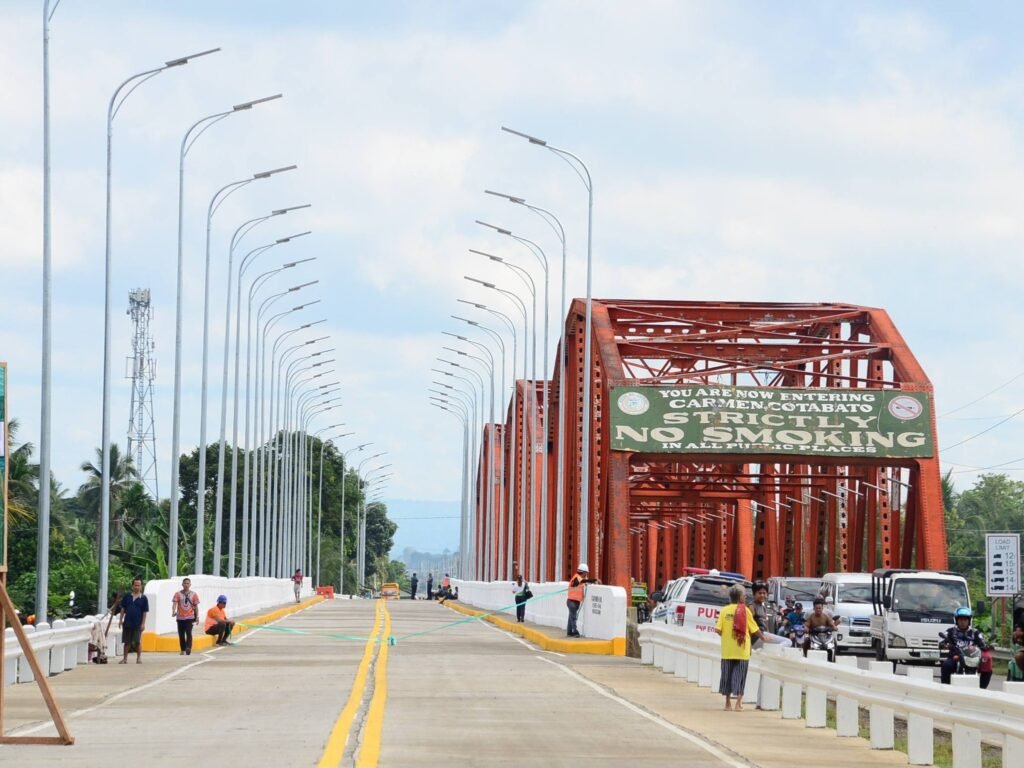
KABACAN, North Cotabato(May 5) — For years, a narrow crossing between Kabacan and Carmen meant long lines of trucks, delayed harvests, and lost income by day’s end. On Monday, that changed.
With the opening of the Carmen and Lumayong parallel bridges, communities along the Bukidnon–Cotabato corridor are finally seeing traffic move—and with it, livelihoods.
The twin structures now link Region 10 and Region 12 more efficiently, doubling road capacity and turning a chronic choke point into a four-lane gateway for trade.
For drivers like Alemar Kali, a decade on Kabacan roads has meant hours lost in gridlock. Now, trips are shorter, fuel costs lighter, and earnings steadier.
Farmers stand to gain even more.
Corn, sugar, and coconut—staples of the local economy—move daily through these towns. Before, delays often meant spoilage or reduced quality. With faster transport, produce reaches markets sooner, cutting post-harvest losses and raising farmgate returns.
“This is not just about easing traffic—it’s about putting money back into farmers’ pockets,” local officials said.
Governor Emmylou Taliño-Mendoza underscored the wider economic impact, pointing to Carmen’s role as an agro-industrial hub. The town hosts major processors like Univanich Carmen Palm Oil Corporation, which relies on steady inflow of raw materials from surrounding farms.
With smoother logistics, processors can scale up operations, creating more stable demand for local produce and jobs for nearby communities.
The bridges also reinforce the province’s “Trigon” agri-industrial zone, where Kabacan and Carmen serve as strategic gateways connecting upland farms to regional markets.
Backed by nearly ₱500 million in public investment and led by the Department of Public Works and Highways, the project signals a broader push to modernize Mindanao’s infrastructure—not just for mobility, but for inclusive growth.
For the Mindanao Development Authority, the payoff is clear: faster logistics, lower costs, and stronger food security across the region.
And on the ground, the benefits are immediate.
Where trucks once idled for hours, they now roll through. Where drivers once lost income to traffic, they now make more trips a day. And where farmers once worried about spoilage, they now see a clearer path from field to market.
The bridges, residents say, don’t just connect roads—they connect opportunity.