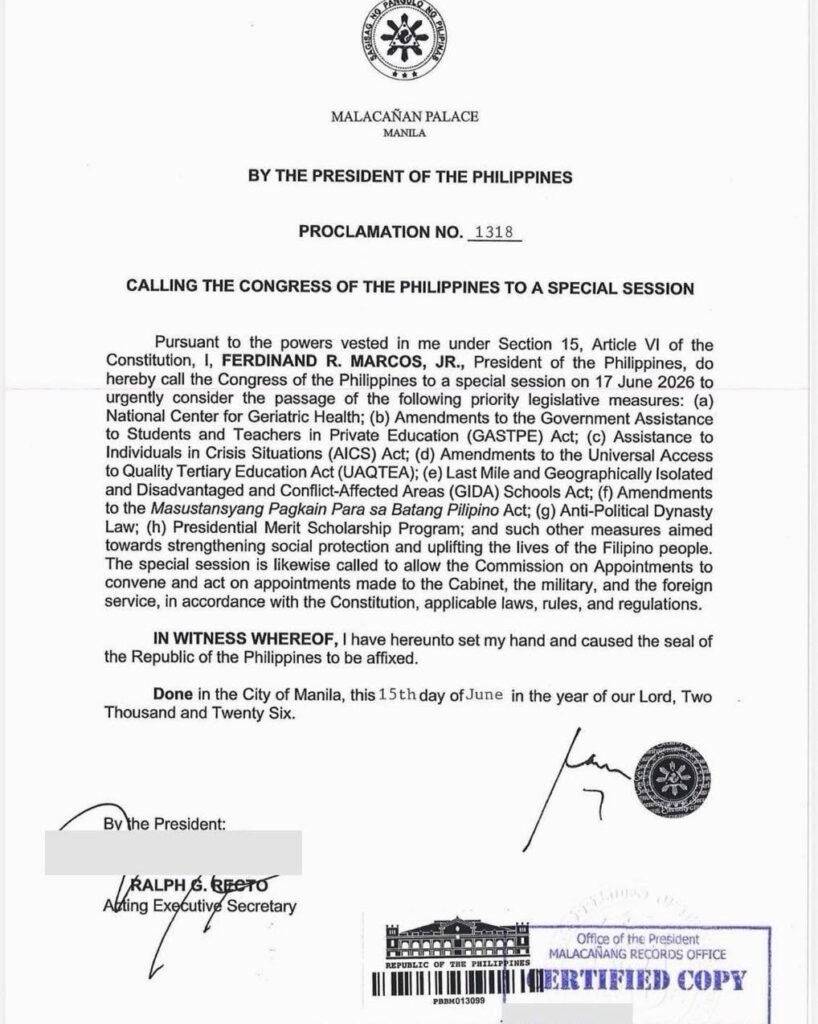
MANILA (June 16) — President Ferdinand Marcos Jr. has called Congress to a special session on June 17 in a bid to move forward several priority measures that have been delayed amid ongoing leadership disputes in the Senate.
In a proclamation signed on June 15 by Acting Executive Secretary Ralph Recto, the President directed lawmakers to convene and urgently consider a number of bills focused on social protection, education, and public welfare.
The special session comes at a time when legislative work in the Senate has been largely stalled due to a prolonged leadership conflict that has disrupted regular proceedings and delayed action on pending measures.
Among the priority bills identified by the President are the proposed establishment of a National Center for Geriatric Health, amendments to the Government Assistance to Students and Teachers in Private Education (GASTPE) Act, the institutionalization of the Assistance to Individuals in Crisis Situations (AICS) program, and proposed changes to the Universal Access to Quality Tertiary Education Act.
Also included are measures seeking to strengthen support for Last Mile and Geographically Isolated and Disadvantaged Areas (GIDA) schools, amend the Masustansyang Pagkain Para sa Batang Pilipino Act, establish a Presidential Merit Scholarship Program, and pass a long-debated Anti-Political Dynasty Law.
The administration said lawmakers may also deliberate on other measures aimed at strengthening social protection and improving the lives of Filipinos.
Beyond legislation, the special session will allow the Commission on Appointments to act on pending nominations and appointments involving Cabinet officials, members of the military, and foreign service personnel.
The President’s move follows weeks of political tensions within the Senate that have hampered its ability to conduct legislative business.
The conflict intensified late last month after a proposal by the group led by then Senate President Alan Peter Cayetano to introduce remote voting procedures prompted members of the minority bloc, headed by former Senate President Tito Sotto III, to walk out in protest. The absence of a quorum prevented the chamber from proceeding with its agenda.
The dispute escalated further when regular plenary sessions were suspended for two consecutive days, adding to the uncertainty over Senate leadership and legislative operations.
Complicating matters was Cayetano’s refusal to recognize the installation of Senator Sherwin Gatchalian as president pro tempore and acting Senate president. The leadership struggle followed an earlier reorganization in May that removed Sotto from the Senate presidency and reshuffled key committee chairmanships.
Before Congress adjourned on June 3, senators aligned with Sotto were able to secure enough votes to establish a quorum, declare leadership positions vacant, and elect Gatchalian as Senate president pro tempore. However, the group fell one vote short of electing a new Senate president.
Malacañang has since recognized Gatchalian as the official leader of the Senate, signaling the administration’s position in the ongoing leadership dispute.
With Congress set to reconvene in special session, attention now turns to whether lawmakers can set aside political differences long enough to advance measures that the administration says are urgently needed to improve education, expand social services, and strengthen government support for vulnerable sectors.