MATI CITY – Starting on Monday, June 1, Davao Oriental will open its border to all public and private transportation from all areas in the Davao Region under General Community Quarantine, including Davao City.
This after Governor Nelson Dayanghirang and the local chief executives of the province agreed on policies and measures which will be implemented amidst the pandemic.
But some provisions in the guideline might be amended as President Rodrigo Duterte has placed Davao Oriental and four other provinces of Davao region under Modified General Community Quarantine come June 1.

The pronouncement to open up the borders of all GCQ areas is mandated under the Omnibus Guidelines for General Community Quarantine issued by the national government through the Inter-Agency Task Force for the Management of Emerging Infectious Diseases.
Dayanghirang in a statement thanked Davao Regional Task Force on COVID-19 headed by Davao City Mayor Sara Duterte-Carpio, who agreed with the governors of the Davao Region to provide enough time to the local government units to set up screening protocols and deploy the required personnel.
“We need to follow what is mandated under the law. We will not impede the movement of people coming in and out of our province. However, we also have to set up screening protocols in order to protect our people,” Dayanghirang stressed, noting that necessary planning must be made as the province cannot afford to do haphazard preparations amidst the massive exodus of people who are expected to come into the province. Most of them are returning Davao Oriental residents who are stranded in Davao City.
Guidelines
Under Executive Order 25 which the Governor has released yesterday, the provincial government is implementing strengthened and stricter health screening measures at all provincial border entry points as well as terminals.
Included in the policy is the strict implementation of the “No Embarkation Form, No Entry Policy”. All passengers coming in must fill out the said form which can be downloaded online or provided at the borders.
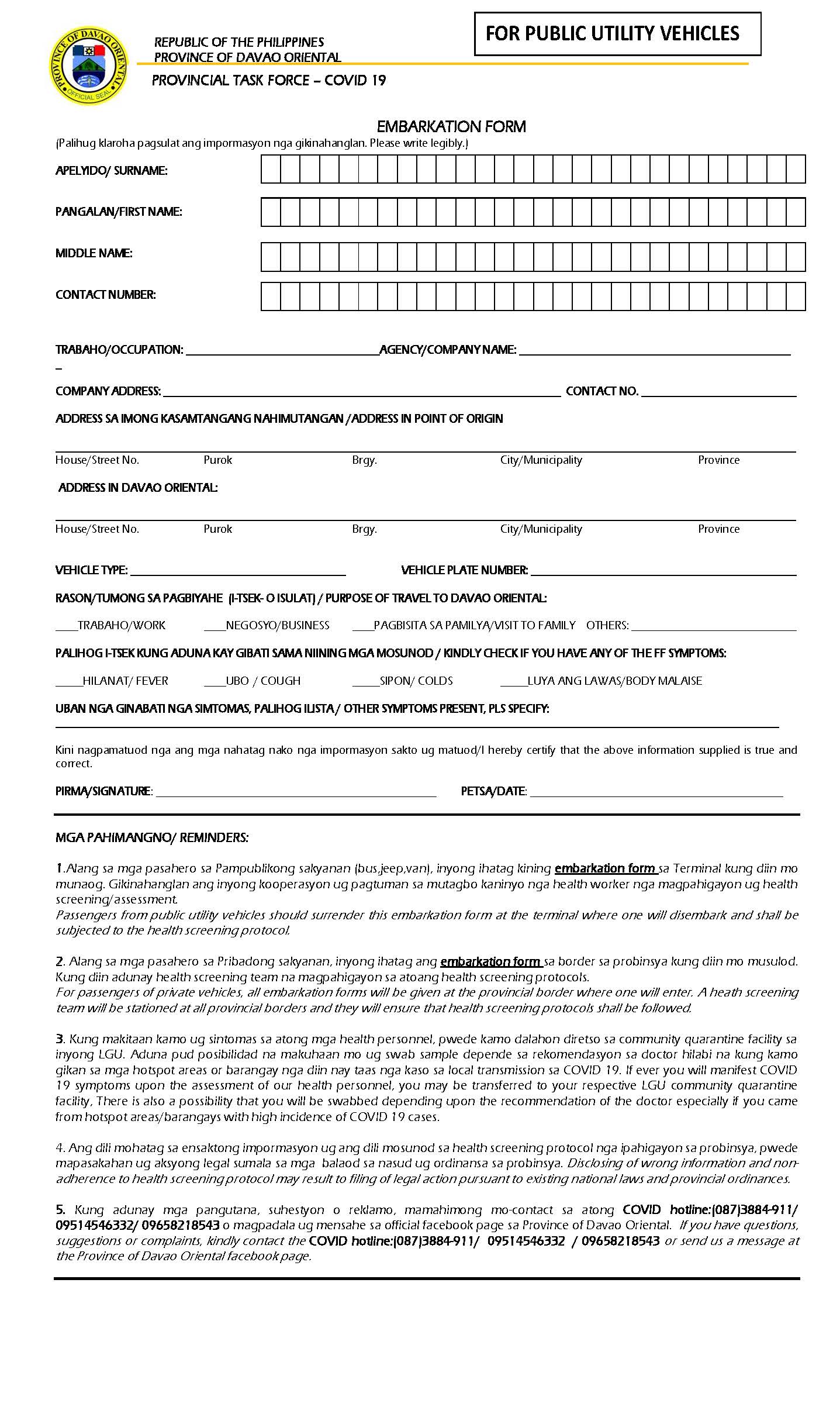
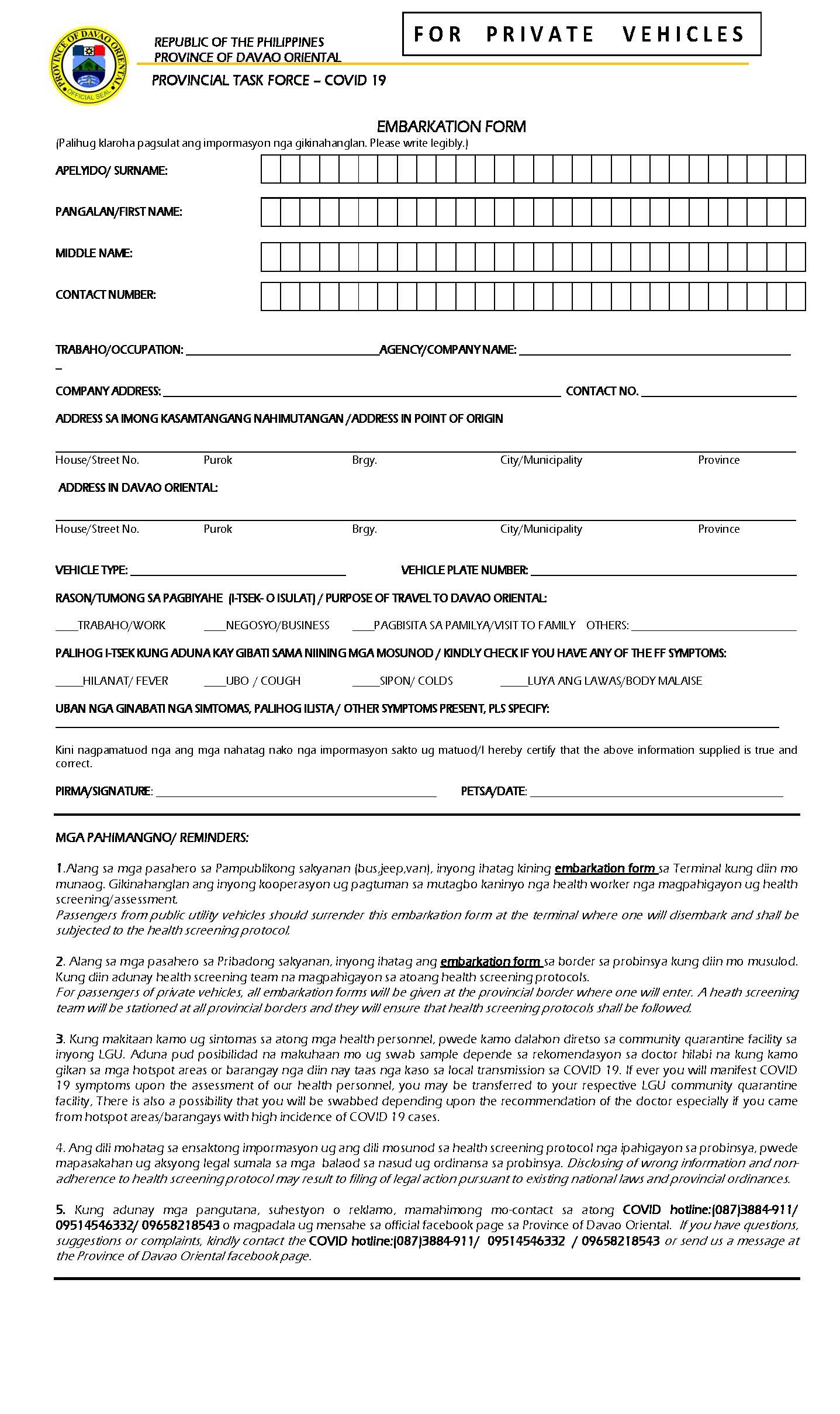
Action Officer of the Provincial Task Force on Covid-19 Dr. Reden Bersaldo stressed that this is among the measures the province is implementing to ensure that there is slim chance for Covid suspects to come in undetected. “And even if they will be able to enter, we can easily contact trace them,” he said, noting that the Provincial Task Force has carefully looked into the details anticipating the influx of the returning residents.

Meanwhile, to regulate the persons coming in, the borders will only be opened for all public and private vehicles from Monday to Friday at 9:00 in the morning to 4:00 in the afternoon.
As for public utility vehicles, there will be “one bus per route per day” while picking up and dropping off of passengers anywhere besides its destination is strictly prohibited. “Bus trips will be from terminal to terminal only,” said Dr. Bersaldo, saying this will prevent unnecessary exposure of the passengers.
He said this way the passengers will be all accounted for and will be properly assessed at the screening booths installed by the city and the municipal LGUs at its inland terminals.
A screening team led by a medical officer will assess all passengers disembarking the vehicles and will determine if there is a need for the passenger to be subjected to a swab test. Passengers who will show flu-like symptoms will immediately be sent to the quarantine center for isolation.
For passengers of private vehicles, they will be assessed at the provincial borders. Those who have symptoms will be contained at the border and will be fetched by their LGU for isolation and swabbing.
Meanwhile, all returning residents without symptoms will undergo a 14-day quarantine at their respective homes.
In an ideal set-up, these individuals should have separate bedroom and bathroom. While this set-up does not apply to all, the general public is advised to observe the minimum health standards at home which include proper physical distancing among family members, provision of personal necessities such as utensils, towels, and use of facemasks.
Detect, Isolate, Treat
Bersaldo said that the province’s policy on inter-zonal travel adopts the concept of the National Action Plan Strategy to combat COVID-19 which involves the “Detect, Isolate, Treat” Approach.
“All our policies involve screening at the border and the terminals. With this strategy, if there are Covid suspects, we can isolate them right away – whether home quarantine or isolation at the barangay isolation units or community quarantine centers. Then we will test them,” he said, adding that the province will make use of the 11,000 sets of test kits it has procured.
However, amidst the new protocols, the Provincial Task Force on Covid-19 does not guarantee that no one will test positive for the coronavirus given the expected influx of people. “That’s why before someone will test positive, we will do the necessary steps to really contain people. That’s why everybody who comes in should be tracked. By containing them, we will decrease the chance of local transmission,” he added.-with DavOr PIO