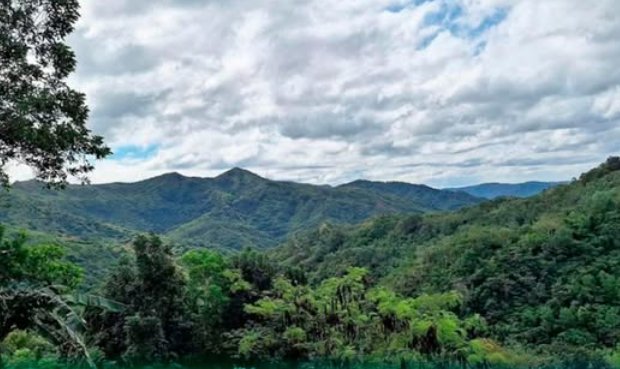
MANILA (August 6) — The Department of Environment and Natural Resources (DENR) is positioning the country’s forests as a major source of rural jobs and investment, identifying 1.18 million hectares of potential forest investment areas that could generate an estimated ₱38 trillion in production value from 2027 to 2052.
But the scale of the projection also raises a more difficult question: can the government unlock the economic value of forest lands without repeating the environmental costs of poorly managed development?
DENR Secretary Juan Miguel Cuna said the agency is moving to make suitable forest areas available for responsible, climate-smart investments, particularly in rural communities where livelihood opportunities remain limited.
“For too long, many of our rural communities have struggled with limited livelihood options, even as vast forest lands around them remain underused,” Cuna said.
“Through this new policy, we are opening suitable forest areas to responsible, climate-smart investments so that forests become engines of jobs, incomes, and local enterprise,” he added.
The policy is anchored on DENR Administrative Order No. 2026-34, which establishes a climate-informed system for identifying, evaluating and promoting forest investment opportunities.
Through the Forest Management Bureau (FMB), DENR has identified about 1.18 million hectares of Potential Investment Areas (PIAs) that could be developed under Sustainable Forest Land Management Agreements (SFLMAs).
The agency estimates that the areas could generate around ₱4 billion in annual revenue from tree plantations, agroforestry, grazing, ecotourism, renewable energy and other special forest uses.
Agroforestry dominates the pipeline
More than 550,000 hectares of the identified investment areas are earmarked for agroforestry, making it the largest category in the pipeline.
Tree plantations and renewable energy projects account for other major portions.
The potential investment sites are spread across the country, except the National Capital Region, but the largest concentrations are in regions where forests are also economically and ecologically significant.
Eastern Visayas accounts for the biggest identified area at 196,083.78 hectares, followed by Caraga with 177,201.18 hectares and Davao Region with 144,035.25 hectares.
Together, the three regions account for about 517,320 hectares, or nearly 44 percent of the country’s identified PIAs.
That puts a substantial portion of the proposed forest investment program in Mindanao and Eastern Visayas—areas where forest resources are closely linked to agriculture, Indigenous communities, biodiversity and rural livelihoods.
₱38 trillion projection needs scrutiny
The DENR’s projected ₱38 trillion production value over 25 years translates to roughly ₱1.52 trillion annually on average if spread evenly across the period.
That figure, however, is a projection of potential production value—not necessarily government revenue, private investment actually committed, or income that will directly reach rural households.
The distinction is important.
Turning 1.18 million hectares into investment-ready areas does not automatically guarantee jobs. Actual benefits will depend on which projects materialize, who receives the agreements, how much capital is invested, the number and quality of jobs created, and whether communities gain a meaningful share of the resulting income.
The government will also have to monitor whether forest-based investments remain within ecological limits, particularly in areas vulnerable to landslides, flooding, biodiversity loss and climate-related hazards.
Development comes with limits
DENR said the new policy does not open all forest lands to commercial development.
Activities that are incompatible with sustainable forest management are prohibited under the administrative order, including sanitary landfills and housing or subdivision developments within forest lands.
That restriction is critical as the agency seeks to reconcile economic development with forest protection.
The proposed investment areas include activities such as agroforestry, tree plantations and ecotourism that can potentially generate livelihoods while retaining forest functions. But even these activities can create environmental pressure if poorly planned or implemented at excessive scale.
The policy therefore places the burden on DENR to ensure that “climate-smart” does not become merely an investment label.
For communities in Caraga, Davao and Eastern Visayas, where large portions of the proposed investment areas are located, the outcome will ultimately be measured on the ground: whether forest investments create stable rural jobs, protect watersheds and biodiversity, and give local communities a fair economic stake without turning forest lands into another frontier for resource extraction.
The ₱38-trillion projection is ambitious.
The harder task is making sure that the wealth projected from the forests does not come at the expense of the forests themselves.