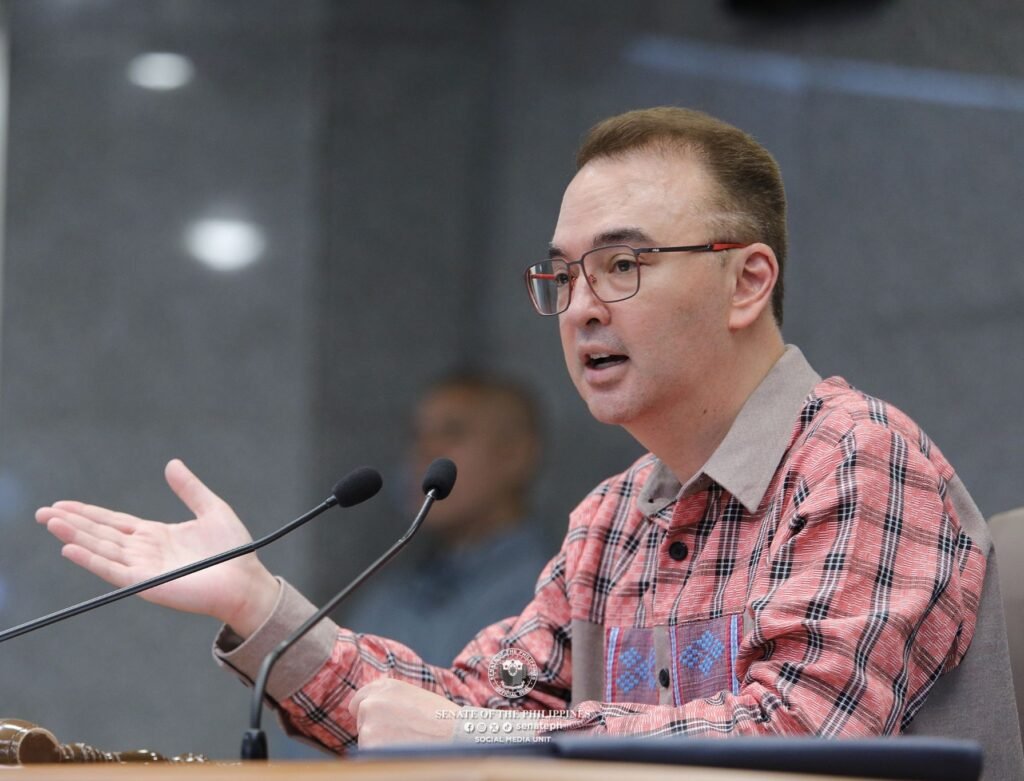
MANILA (May 13) — A historical fact check has contradicted claims made by newly installed Senate President Alan Peter Cayetano that no senator had ever been arrested inside Senate premises, further intensifying tensions surrounding the attempted arrest of Ronald dela Rosa over an International Criminal Court-linked warrant.
Cayetano made the assertion during Monday’s Senate session while defending the decision to place Dela Rosa under Senate protective custody and prevent agents from serving the warrant inside the chamber.
“No senator was allowed to be arrested ever in the Senate premises,” Cayetano declared, citing former senators Juan Ponce Enrile, Jinggoy Estrada, Ramon Revilla Jr., Antonio Trillanes IV, and Leila de Lima as examples.
However, records show that both Trillanes and De Lima were in fact arrested within Senate premises during the Duterte administration.
Trillanes was arrested inside the Senate on Sept. 25, 2018 while Congress was in session after the Philippine National Police served a rebellion warrant issued by the Makati Regional Trial Court following then-President Rodrigo Duterte’s revocation of his amnesty.
Reports at the time stated that police officers coordinated with Senate officials before serving the warrant at the senators’ lounge, where Trillanes later accompanied authorities peacefully out of the building before posting bail.
Trillanes himself directly disputed Cayetano’s statement in a social media post.
“Back in 2018, Makati RTC issued a warrant against me for rebellion and it was served by the PNP while the Senate was in session,” he said.
Former senator De Lima was likewise arrested from her Senate office in February 2017 after the Muntinlupa Regional Trial Court issued a warrant tied to drug charges that international human rights groups later criticized as politically motivated.
Agents from the Criminal Investigation and Detection Group (CIDG) escorted De Lima from her Senate office after she voluntarily surrendered the morning after the warrant was issued.
The fact check clarified that while Cayetano was correct in stating that Enrile, Estrada, and Revilla were not arrested inside the Senate, none of the three were physically present there when arrest warrants were issued in connection with the pork barrel scam cases in 2014.
Instead, all three surrendered separately to authorities outside Senate grounds.
The issue resurfaced after dramatic scenes unfolded Monday involving Dela Rosa, who allegedly evaded agents of the National Bureau of Investigation (NBI) attempting to serve an ICC-linked warrant.
CCTV footage shown during Senate proceedings reportedly captured Dela Rosa running through a fire exit and stumbling on a staircase before reaching the plenary hall, where he later cast the decisive vote electing Cayetano as Senate president.
The Senate subsequently cited NBI personnel in contempt and temporarily placed the building under lockdown.
The controversy has now expanded beyond the attempted arrest itself, raising broader questions about institutional precedent, Senate authority, executive coordination, and the constitutional boundaries between legislative independence and law enforcement powers.
For observers, the dispute also reflects how competing narratives over legality, sovereignty, and political accountability continue to shape the country’s increasingly polarized political climate.