COTABATO CITY (June 2) — As the Bangsamoro Autonomous Region in Muslim Mindanao (BARMM) approaches a historic political transition, members of the region’s interim parliament have begun crafting a 10-year strategic framework intended to guide the institution long after the transition government’s mandate expires.
The initiative comes at a pivotal moment for the Bangsamoro peace process. For the first time since the ratification of the Bangsamoro Organic Law (BOL) in 2019, voters are expected to elect members of a regular parliament in September 2026, formally ending years of governance under an appointed transition authority.
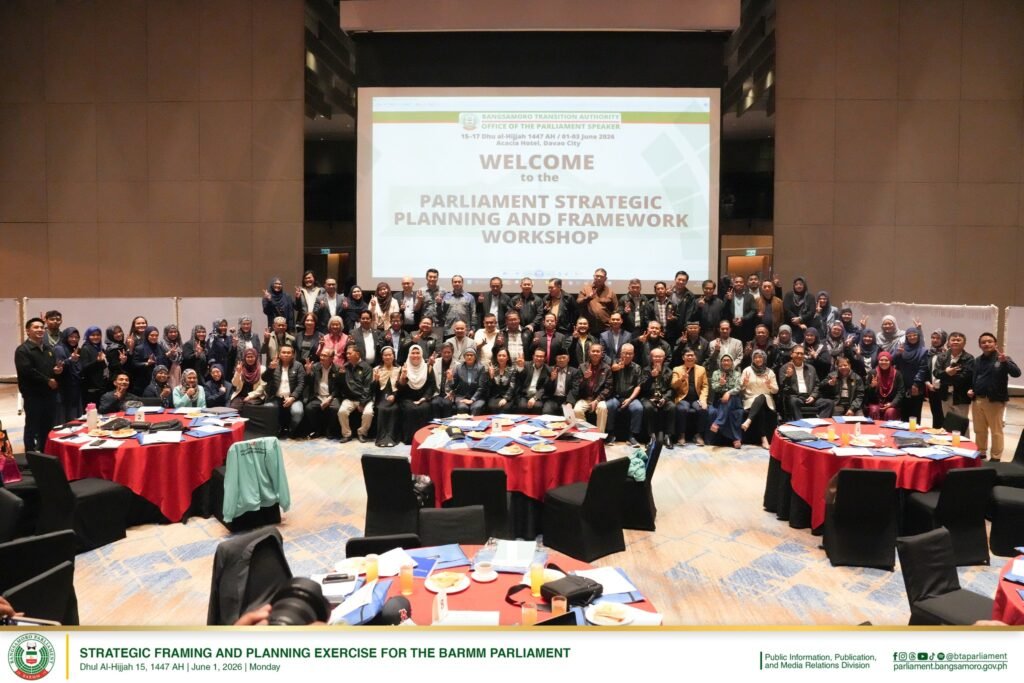
According to a statement released Tuesday, the three-day Parliament Strategic Planning Framework Workshop in Davao City brings together members of the Bangsamoro Transition Authority (BTA) to define long-term priorities for legislation, oversight, and representation.
BTA Speaker Mohammad Yacob described the exercise as an effort to prepare the institution for its next phase of development and ensure continuity beyond the transition period.
“The institution must continue to evolve to reflect the aspirations of the Bangsamoro people while strengthening participatory governance, accountability and public service,” Yacob said.
The workshop, facilitated by the Development Academy of the Philippines, seeks to establish policy directions and governance frameworks that incoming lawmakers can build upon after the elections.
Yet the initiative also highlights a fundamental challenge confronting BARMM: how to transform a transition institution into a stable democratic legislature capable of surviving political turnover, leadership changes, and competing regional interests.
The BTA was created as a temporary governing body under the BOL, tasked with laying the foundations for autonomous governance while implementing provisions of the peace agreement between the Philippine government and the former Moro Islamic Liberation Front. Since its establishment, the body has enacted key regional laws and built institutions intended to support self-governance.
However, political observers have long argued that the true test of the Bangsamoro experiment will begin only after elected representatives assume office. Unlike appointed transition officials operating under a shared mandate, future parliamentarians will emerge from electoral competition, potentially bringing new political alliances, priorities, and ideological differences into the regional legislature.
In a message delivered by his son and chief of staff, Jamel Macacua, BARMM Chief Minister Abdulraof Macacua expressed support for the planning initiative, emphasizing the regional government’s commitment to translating long-term priorities into policies and programs that produce tangible outcomes for Bangsamoro communities.
The workshop also featured the turnover of a parliamentary roadmap by the Westminster Foundation for Democracy, outlining measures aimed at ensuring institutional continuity and stability as BARMM enters a new political era.
While strategic planning may provide a roadmap, its success will ultimately depend on how future elected leaders uphold and implement its recommendations. The challenge facing the first regular parliament will not only be preserving institutional gains made during the transition but also demonstrating that autonomous governance can deliver meaningful improvements in representation, accountability, and development.
As the September 2026 parliamentary elections draw closer, the framework being drafted today may serve as one of the final legacies of the transition government—and one of the first tests for the parliament that follows.