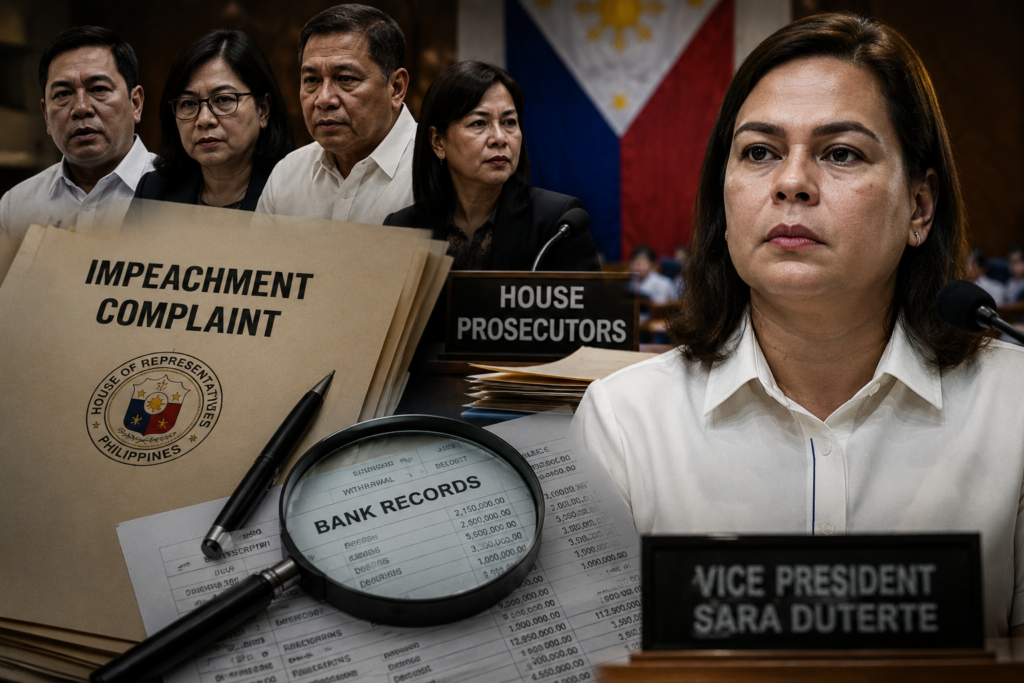
MANILA (June 1) — The impeachment battle against Vice President Sara Duterte is entering a more aggressive phase, with House prosecutors preparing to summon officials from her own circle and seek access to bank records that could become crucial pieces of evidence in one of the most consequential political trials in recent Philippine history.
House prosecutors say they are preparing to present at least 25 witnesses when the Senate convenes as an impeachment court, including officials from the Office of the Vice President (OVP) and the Department of Education (DepEd) who worked closely with Duterte during her tenure.
The move signals a strategy aimed at piercing the walls of loyalty surrounding the vice president and testing whether insiders can help establish the allegations contained in the Articles of Impeachment.
Lead prosecutor and Batangas Rep. Gerville Luistro described many of the prospective witnesses as “hostile witnesses” — individuals expected to be sympathetic to Duterte but whose testimony prosecutors believe remains necessary to establish facts central to the case.
“These are people very much attached to the Vice President,” Luistro said, acknowledging that many are expected to remain loyal to their former superior.
The prosecution’s reliance on hostile witnesses highlights a fundamental challenge confronting the impeachment effort: proving allegations that largely involve decisions, transactions, and activities carried out within institutions Duterte directly controlled.
But the more consequential battle may involve access to financial records.
For months, questions surrounding Duterte’s finances have hovered over congressional investigations. Yet prosecutors admit that some of the most potentially significant evidence remains beyond public scrutiny.
During House hearings, lawmakers heard testimony from officials of the Anti-Money Laundering Council (AMLC) regarding billions of pesos in covered and suspicious transactions linked to Duterte and her husband, lawyer Manases Carpio. However, actual bank records and testimony from bank officials were never presented.
Now prosecutors are preparing to change that.
Once the impeachment trial begins, the House panel intends to ask the Senate impeachment court to issue subpoenas compelling banks to produce records and requiring bank officials to testify.
The request could become a defining moment in the proceedings.
Unlike ordinary investigations, impeachment trials possess broader powers to compel the production of evidence. Prosecutors argue that the constitutional duty to determine whether a public official committed impeachable offenses outweighs restrictions typically imposed by bank secrecy laws.
If granted, the subpoenas could provide the public with its first detailed glimpse into financial records that lawmakers have repeatedly cited but have not yet fully disclosed.
The financial questions have become particularly significant because congressional hearings previously revealed an apparent discrepancy between Duterte’s declared assets and transaction records discussed by AMLC officials.
According to testimony before the House, Duterte and Carpio reportedly recorded billions of pesos in covered and suspicious transactions between 2006 and 2025. Yet their Statements of Assets, Liabilities and Net Worth (SALN) reportedly declared no cash on hand or cash in bank for several consecutive years.
Whether that discrepancy can be explained—or whether it supports allegations of unexplained wealth—may become one of the trial’s central points of contention.
The impeachment complaint itself goes beyond financial issues.
The articles approved by the House accuse Duterte of culpable violation of the Constitution, graft and corruption, bribery, betrayal of public trust, and other high crimes. The allegations range from the alleged misuse of confidential funds to claims of unexplained wealth and accusations involving threats against senior government officials.
Taken together, the charges represent an unprecedented challenge to the political standing of a vice president who remains one of the country’s most influential political figures and the heir to one of its most powerful political dynasties.
The Senate trial will ultimately hinge on whether prosecutors can transform allegations raised during congressional hearings into evidence capable of convincing at least 16 senator-judges to convict.
That threshold remains high. So too are the political consequences.
A conviction would not only remove Duterte from office but permanently bar her from holding any future public position. An acquittal, on the other hand, could reinforce her political standing and reshape the balance of power ahead of future national elections.
For now, prosecutors are betting that documents, bank records, and testimony from individuals closest to Duterte may provide the strongest answers to questions that have lingered throughout the investigation.
The impeachment trial, therefore, is no longer simply about accusations. It is increasingly becoming a contest over who controls the facts—and whether the Senate can compel the evidence needed to settle them.