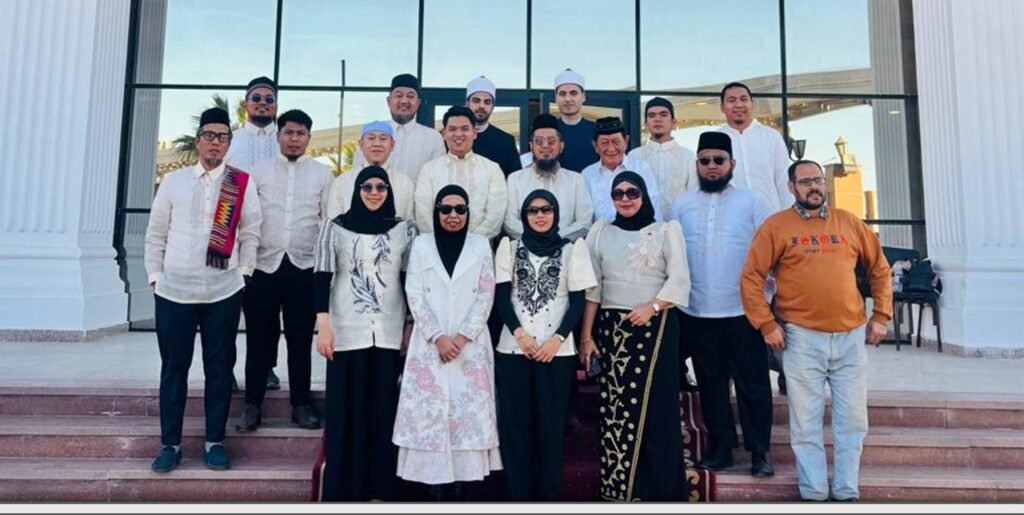
Filipino Shari’ah Judges and Imams join in the 36th International Conference of the Supreme Council for Islamic Affairs in Cairo, Egypt, from Jan. 10-20, 2026. (Photo courtesy of Director Aleem Arsad Abdulrahman)
COTABATO CITY (February 11) — As conversations on ethics and artificial intelligence reshape professions worldwide, Bangsamoro Shari’ah leaders are bringing home global insights aimed at strengthening Islamic legal services, protecting women and families, and reinforcing peace in the region.
Two representatives from the Bangsamoro Autonomous Region in Muslim Mindanao (BARMM) joined Filipino Shari’ah judges and imams at the 36th International Conference of the Supreme Council for Islamic Affairs in Cairo, Egypt, for a 10-day intensive training focused on Islamic professionalism and ethical leadership.
The conference, held from January 10 to 20 and themed “Professions in Islam: Their Ethics, Impact, and Future in the Age of Artificial Intelligence,” was sponsored by the Republic of Egypt in partnership with the Philippine government.
Representing the Bangsamoro region were Aleem Arsad Abdulrahman, Director III of the Shari’ah Public Assistance Office (SPAO) and a Shari’ah counselor, and Atty. Mohammad Rayyan Domado of the Bangsamoro Attorney General’s Office (BAGO).
For Abdulrahman, the training was not merely academic — it carries direct implications for vulnerable sectors in BARMM.
“This activity is the result of peaceful dialogues between Egypt’s Ministry of Awqaf and the Philippines’ NCMF,” Abdulrahman said.
“This opportunity has given me more ideas and enlightenment, especially in serving the Bangsamoro through strengthening the implementation of Shari’ah in the region.”
Strengthening Protection for Women and Families
In BARMM, Shari’ah courts handle cases involving marriage, divorce, custody, inheritance, and other personal status laws that directly affect Muslim women and families.
Strengthening ethical standards and professional competence among Shari’ah practitioners could translate into clearer guidance, faster case resolution, and better protection of rights — especially for indigent litigants.
Established under the Bangsamoro Administrative Code, the Shari’ah Public Assistance Office (SPAO) provides free legal assistance to poor constituents across the region.
Enhancing its institutional capacity means expanded access to justice for women seeking fair settlement in marital disputes, inheritance claims, and family-related concerns.
By reinforcing professionalism and accountability, leaders say Islamic legal reform can help ensure that Shari’ah services are not only faith-based but also rights-sensitive and community-centered.
Linking Ethical Governance to Lasting Peace
Beyond legal services, officials view the Cairo conference as part of a broader peace-building effort in the Bangsamoro region.
The National Commission on Muslim Filipinos (NCMF) described the gathering as an avenue for advancing intellectual and professional excellence in Islam, emphasizing the “evolving role of professions in shaping ethical, impactful, and forward-looking Muslim communities.”
“This initiative underscores the importance of intellectual development as a cornerstone of Muslim leadership and identity,” the NCMF said, “while promoting the values of tolerance, coexistence, and mutual understanding — principles vital for Filipino Muslims to thrive both locally and globally.”
For BARMM, where autonomous governance remains closely tied to the success of the peace process, strengthening Islamic institutions is seen as part of sustaining regional stability. Transparent, ethical, and accessible Shari’ah systems can reinforce public trust — a key ingredient in maintaining peace.
Global Dialogue, Local Impact
Participation in international Islamic forums signals growing institutional maturity within BARMM’s legal and religious structures. Exposure to global discussions on ethics, professionalism, and emerging technologies such as artificial intelligence provides leaders with new frameworks to modernize systems while remaining grounded in Islamic principles.
From Cairo’s global stage to Cotabato’s local courts, Bangsamoro officials say the goal is clear: ensure that Islamic law continues to serve justice, protect families, uplift women, and contribute to enduring peace in the region.