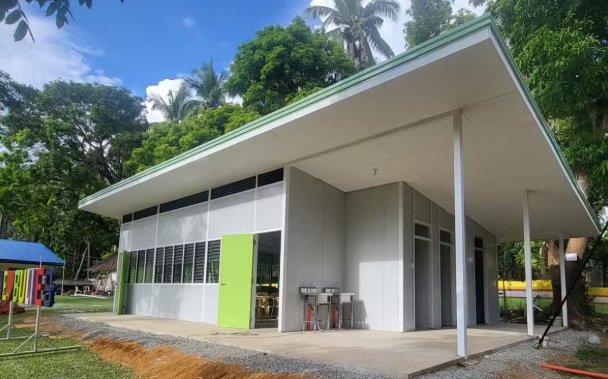
MANILA (July 10) — For thousands of Filipino students whose education is often interrupted by earthquakes, typhoons, and overcrowded classrooms, help is arriving in the form of fast-build, disaster-resilient learning spaces designed to keep classes going when schools are at their most vulnerable.
The Department of Education (DepEd) is accelerating the nationwide rollout of Learning Continuity Spaces (LCS)—prefabricated classrooms that can be installed in just four to eight weeks—to ensure children can continue learning even after disasters strike.
Education Secretary Sonny Angara said the initiative answers President Ferdinand R. Marcos Jr.’s directive to address the country’s classroom shortage while making schools more resilient to climate-related emergencies.
“We need to speed up the establishment of safe facilities to ensure the continuous learning of our students, especially in calamity-prone areas,” Angara said.
For many communities, the modular classrooms mean more than replacing damaged buildings. They provide children with a safe place to return to, restore routines after disasters, and reduce prolonged learning disruptions that often affect the poorest and most disaster-prone areas.
DepEd said 878 Learning Continuity Spaces are now in different stages of implementation. So far, 34 classrooms are ready for use, 453 are under construction, and 391 are in the procurement phase, bringing the government closer to easing classroom congestion while expanding access to education.
The program is also reaching General Santos City, where new five-classroom buildings are being completed at Romana C. Acharon Elementary School and H.N. Cahilsot Central Elementary School, giving more students access to safer and more conducive learning environments.
A further P226.4 million has been allocated to build 109 additional modular classrooms across seven regions, with 83 units earmarked for the Davao Region—the largest allocation nationwide—to help schools recover from recent earthquakes and strengthen preparedness for future disasters.
Beyond responding to immediate classroom shortages, education officials say the initiative is part of a longer-term strategy to build a more resilient education system.
Unlike temporary tents or makeshift learning areas, the semi-permanent structures are designed to withstand harsh weather, can be deployed rapidly after emergencies, and remain functional for years, allowing communities to recover faster while minimizing interruptions to children’s education.
As climate-related disasters become more frequent, DepEd’s investment in resilient school infrastructure underscores a growing recognition that protecting education is also about protecting communities. Every classroom completed means fewer missed school days, less disruption for families, and a stronger foundation for children whose futures should not be determined by the next earthquake or typhoon.