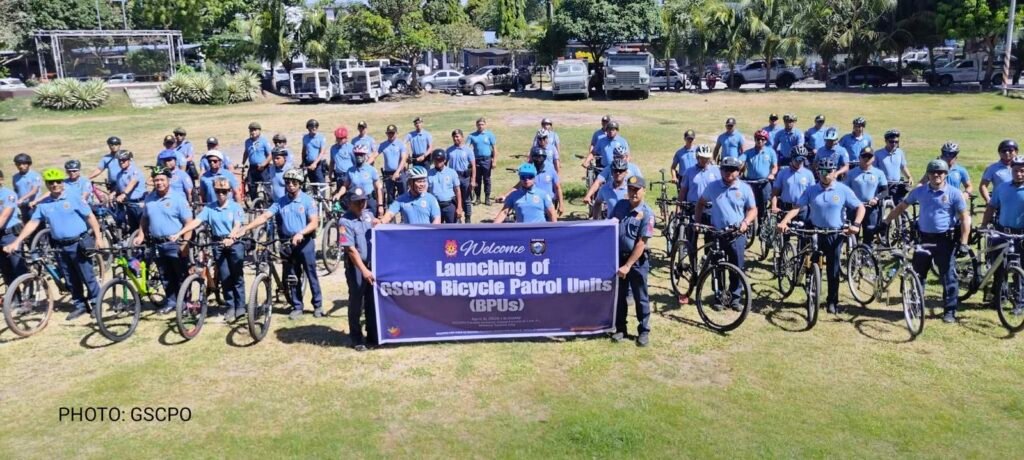
GENERAL SANTOS CITY(April 11) — As surging fuel prices strain government operations nationwide, the General Santos City Police Office (GSCPO) has turned to bicycle patrol units—highlighting how frontline services are adapting to the deepening energy crisis.
The move places the GSCPO among a growing number of local agencies exploring cost-cutting measures as oil price volatility continues to ripple across transport, public safety, and basic services.
Deployed in key areas such as markets, transport terminals, and residential neighborhoods, the bicycle patrols are designed to sustain police visibility while reducing dependence on fuel-powered vehicles.
GSCPO City Director Nicomedes P. Olaivar Jr. said the shift offers immediate operational relief.
“The bicycle does not require gasoline, so operational costs are directly reduced. This allows us to save even as oil prices continue to rise,” he said.
According to Olaivar, bicycle patrols provide near-total fuel savings compared to traditional patrol vehicles, with each unit potentially saving hundreds of thousands of pesos annually—resources that can be redirected to other policing needs.
But beyond local efficiency, the initiative reflects a broader national reality: government agencies are increasingly being forced to recalibrate services as fuel costs eat into limited budgets.
Across the country, transport groups have scaled down operations, local governments have activated energy contingency plans, and calls have intensified for tax relief and subsidies to cushion the impact of rising oil prices on both workers and public institutions.
Within this context, GSCPO’s bicycle patrols also serve a functional advantage. Officers can move through narrow streets and traffic-heavy zones more quickly, improving response times in dense urban areas where patrol cars are often slowed down.
Olaivar emphasized that the strategy goes beyond short-term crisis management.
“This is not just for the fuel crisis—it is a long-term strategy for cost efficiency, visibility, community policing, and urban mobility,” he said.
The initiative also strengthens community engagement, as officers on bicycles are more approachable and visible—an approach aligned with evolving models of localized, people-centered policing.
As the fuel crisis continues to test the limits of public service delivery, the shift in General Santos underscores a growing policy question: how long can frontline services adapt through stopgap measures before broader, systemic interventions are required to stabilize costs and protect essential operations?