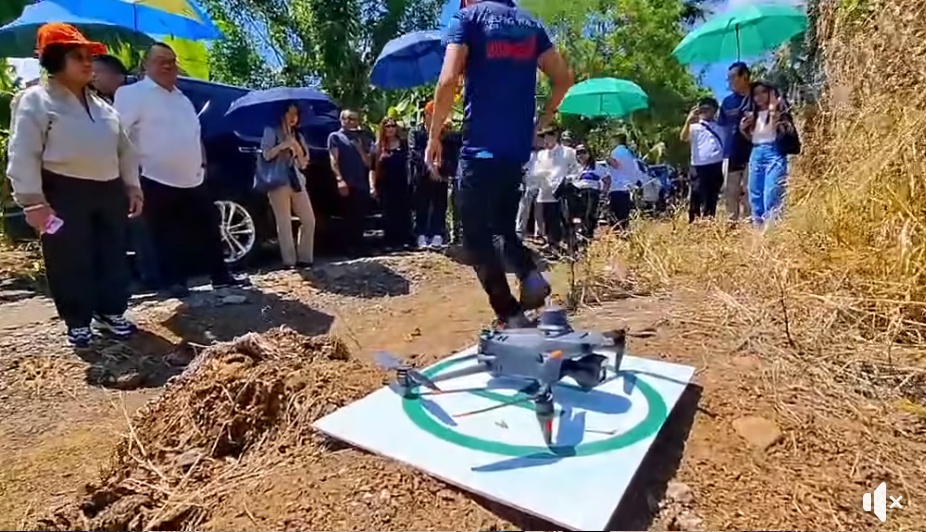
DAVAO CITY (April 1) — In the banana heartland of southern Philippines, a new experiment is taking flight—promising precision, speed, and early warning in an industry long crippled by a disease it still cannot cure.
The Department of Agriculture in the Davao Region has signed a deal with E-Supportlink Co., Ltd. to pilot AI-powered drones that can detect infections in banana plants before symptoms become visible.
On paper, it is the kind of intervention the industry has been waiting for.
On the ground, it raises a more uncomfortable question: Is technology racing ahead of the deeper problems it cannot fix?
A crisis without a cure
At the center of the initiative is Fusarium wilt—a soil-borne fungus that has haunted banana plantations for decades.
It spreads silently, kills slowly, and once embedded in soil, can make land unusable for years. There is still no reliable cure.
“Up to now, we have not yet found the true solution,” DA-11 Regional Director Macario Gonzaga said.
That reality frames the drone project less as a breakthrough—and more as a defensive move.
Early detection, limited control
The technology uses drones equipped with multispectral imaging to scan plantations. Artificial intelligence then analyzes plant health data to flag early-stage infections, potentially before farmers can see any damage.
If it works, the system could shift farm management from reactive to preventive—allowing infected plants to be isolated before outbreaks spread.
But detection is not eradication.
Even with earlier warnings, farmers are still left managing a disease that cannot be removed from contaminated soil. The risk is that technology improves visibility without fundamentally changing outcomes.
A pilot with big expectations
The pilot project, covering just 15 hectares in Davao del Norte and Davao de Oro, is modest in scale but heavy in expectation. It is being monitored by the Department of Science and Technology, with the goal of eventual expansion.
Officials say the system could also improve plantation mapping, plant counting, and overall farm management—longstanding gaps in the industry.
But scaling remains the real challenge.
Drone systems, AI analytics, and data infrastructure require investment, technical skills, and sustained support—resources that many smallholder farmers lack.
Without that, the technology risks becoming another tool that benefits large plantations while leaving smaller growers behind.