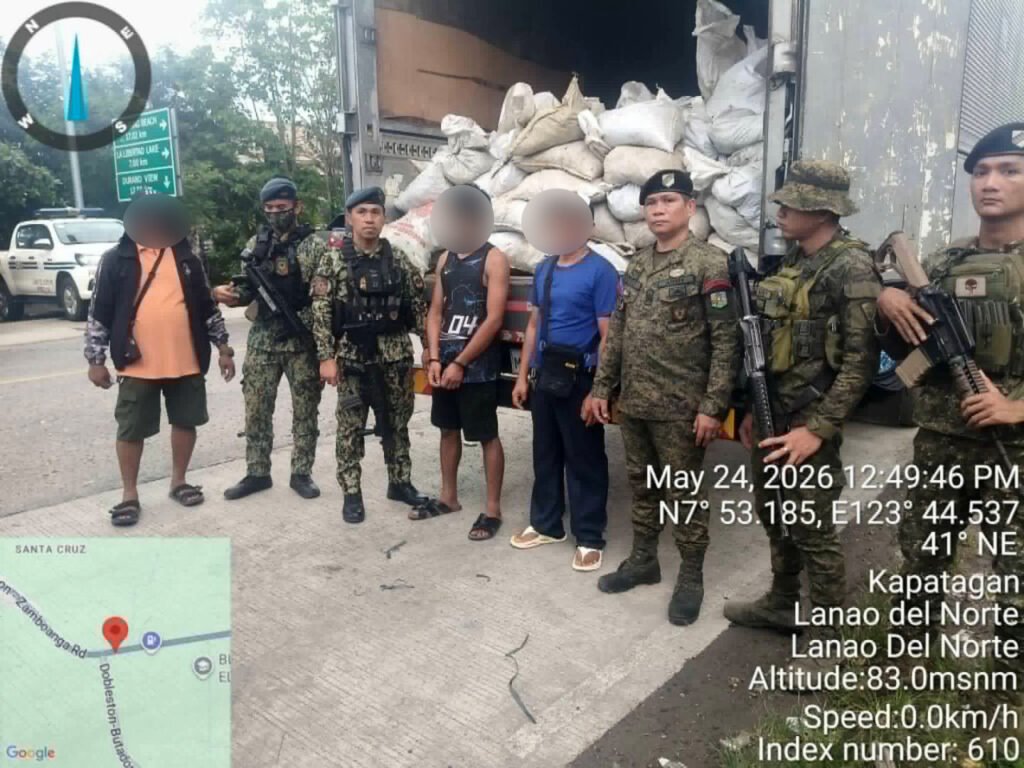
ZAMBOANGA CITY(May 26) — A routine checkpoint operation over seat belt violations in Lanao del Norte uncovered a much bigger issue confronting Mindanao: the continuing illegal transport of mineral ores across the region.
Police on Sunday intercepted three trucks carrying 1,674 sacks of alleged ore minerals worth an estimated PHP5.3 million after drivers reportedly failed to present legal transport documents.
Authorities said the first truck was stopped during a highway checkpoint operation in Kapatagan town after personnel noticed a violation of the Seat Belts Use Act of 1999. Upon inspection, police found 546 sacks of suspected ore minerals valued at around PHP1.7 million.
The discovery triggered intensified checkpoint operations later that morning, leading to the interception of two more trucks carrying another 1,110 sacks of ore minerals worth approximately PHP3.6 million.
The drivers and truck personnel were brought to the police station for documentation while the confiscated cargo was turned over for examination by the Mines and Geosciences Bureau.
Col. Leo De Leon Sua said the operation demonstrated the effectiveness of coordinated anti-illegal mining enforcement efforts.
But the seizure also highlighted what environmental groups and authorities describe as a persistent and expanding illegal mineral transport network operating across parts of Mindanao.
In recent months alone, authorities across Northern Mindanao and Caraga reported multiple interceptions involving undocumented mineral ores and illegal mining operations.
In Bukidnon last year, authorities seized around PHP10 million worth of suspected mineral ores at a checkpoint in San Fernando town after a truck driver reportedly failed to present proper transport permits.
In Misamis Oriental, separate anti-illegal mining operations in Opol and Manticao towns led to the confiscation of hundreds of sacks of mineral ores, mining equipment, and transport vehicles linked to alleged unauthorized extraction activities.
Authorities in Agusan del Sur also arrested 19 individuals last year for hauling illegally mined mineral ores without permits through Bunawan town.
Meanwhile, enforcement agencies in Surigao del Sur recently shut down illegal mining activities along the Carac-an River involving heavy equipment and millions of pesos worth of gold ore materials.
Provincial governments in areas such as Davao Oriental and Lanao del Sur have likewise intensified crackdowns after local officials warned that unauthorized mining and mineral hauling were already causing serious environmental degradation.
Environmental experts warn that illegal and unregulated mineral extraction contributes to deforestation, river siltation, soil erosion, flooding, and water contamination — problems that directly affect farming communities, fisherfolk, and indigenous peoples in resource-rich areas of Mindanao.
Officials in Lanao del Sur earlier warned that illegal quarrying and mining activities have caused forest loss, landslides, polluted waterways, and threats to community safety and livelihoods.
Beyond environmental destruction, authorities also fear that undocumented mineral transport operations may point to larger underground extraction networks that evade taxes, bypass environmental safeguards, and operate outside government monitoring systems.
For many rural communities in Mindanao, the risks are immediate and personal. Residents living near mining areas often face damaged rivers, declining agricultural productivity, unstable hillsides, and increased flooding during heavy rains.
As anti-illegal mining operations continue across the island, environmental advocates say the issue is no longer only about confiscated ores or arrested transporters. It is about protecting communities, natural resources, and livelihoods from long-term environmental damage driven by unregulated extraction activities.