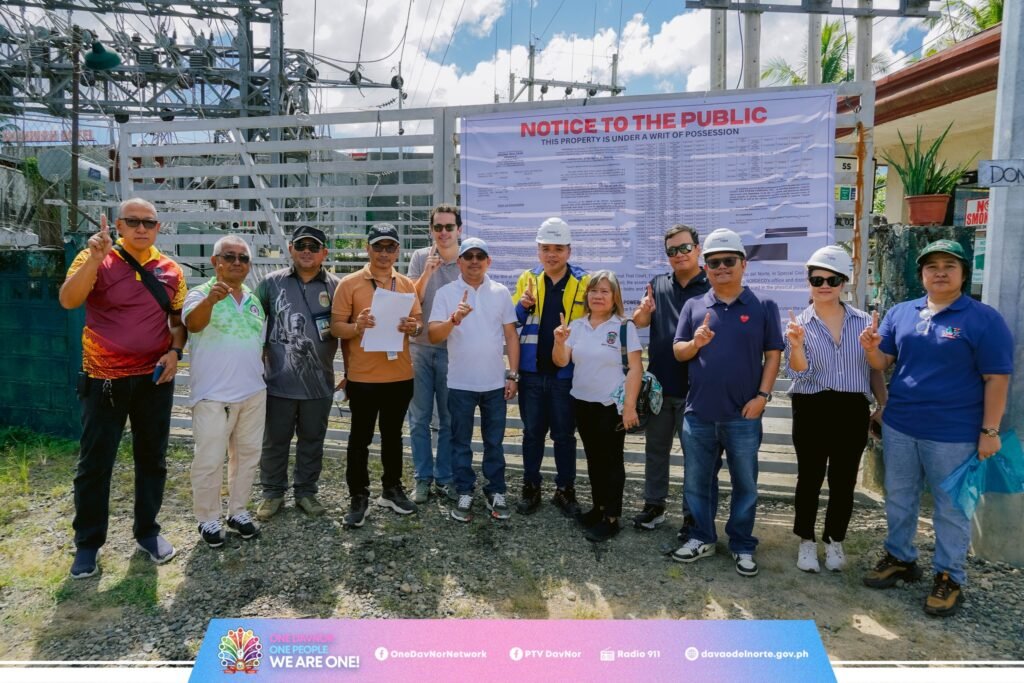
DAVAO CITY (March 27) — A high-stakes power struggle is unfolding in Davao del Norte as Davao Light and Power Company moves to take over key energy assets from Northern Davao Electric Cooperative, triggering a legal showdown that could reshape electricity distribution — and economic prospects — in the province.
At the center of the dispute is the court-enforced transfer of four substations, a move that signals both opportunity and uncertainty for consumers and businesses alike.
Court-backed takeover, but only partial control
On March 25, a sheriff enforced a writ of possession issued by the Regional Trial Court in Tagum City, granting Davao Light control over substations in Barangays Canocotan, Mirafuentes, and Apokon, as well as a facility in Asuncion.
The order stems from a February 27 ruling and included Nordeco’s office in Tipaz, Magugpo.
Yet the takeover remains incomplete. Crucially, the distribution lines — the backbone of electricity delivery to homes and businesses — are still under Nordeco’s control, creating a fragmented system where infrastructure and service responsibility are split.
Aboitiz expansion meets local resistance
The move forms part of the broader expansion strategy of Aboitiz Power Corporation, the parent firm of Davao Light, as it pushes deeper into high-growth areas across Mindanao.
Control of substations gives Davao Light a strategic foothold in the local grid. But without full authority over distribution, its ability to deliver immediate improvements remains constrained — at least for now.
Nordeco, however, is not backing down.
The cooperative has elevated the dispute to the Supreme Court of the Philippines, filing a petition for review and seeking a temporary restraining order. It insists the case is “not final” and maintains that its franchise — valid until 2028 — remains intact.
Nordeco also invoked legal precedent to argue that power distribution need not be exclusive, raising the possibility of overlapping service providers — a scenario that could further complicate regulation and accountability.
Risk of disruptions beyond Tagum
Beyond the courtroom, the transition carries immediate operational risks.
Nordeco flagged potential service disruptions in municipalities reliant on the Asuncion substation, including New Corella, Talaingod, Kapalong, and even parts of neighboring provinces like Laak in Davao de Oro.
With one entity controlling substations and another handling distribution lines, coordination failures could translate into outages — a concern both sides publicly acknowledge but have yet to fully resolve.
Aging systems, missing data
Davao Light is also inheriting infrastructure challenges.
Some of the acquired substations are aging and may require urgent upgrades, while gaps in operational data — such as load profiles and maintenance records — complicate efforts to stabilize and optimize the grid.
These technical constraints raise questions about how quickly promised improvements in reliability can materialize.
Consumers in limbo
For now, electricity consumers remain under Nordeco’s billing system.
Davao Light clarified it will only begin billing once it gains legal control over distribution assets, at which point it plans to conduct baseline meter readings and roll out a new billing framework.
Until then, households and businesses are left in a transition phase — served by one provider, but potentially soon billed by another.
Economic promise — if transition holds
Local officials see potential upside.
Davao del Norte Governor Edwin Jubahib said improved power reliability could boost investor confidence, particularly in energy-intensive sectors like manufacturing and agribusiness.
Stable electricity is widely seen as a cornerstone of regional growth. But that promise hinges on a smooth transition — one that avoids disruptions that could stall production, strain supply chains, and deter investment.
A contested transition with regional impact
The takeover marks a pivotal — but unresolved — chapter in Mindanao’s evolving energy landscape.
With legal battles pending, infrastructure gaps emerging, and operational control divided, the situation remains fluid. For now, Davao del Norte finds itself caught between two power providers — and at the center of a transition where the stakes extend far beyond electricity.