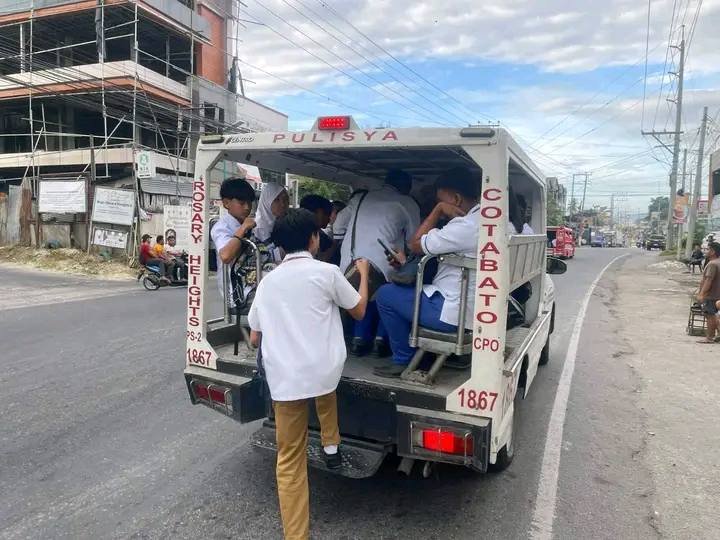
COTABATO CITY(March 26) — For hours on Monday, the streets of Cotabato City fell unusually quiet — not from calm, but from disruption.
A nationwide transport strike brought public mobility to a near standstill, leaving thousands of commuters stranded as jeepneys, vans, and tricycles simultaneously halted operations. Only a handful of habal-habal motorcycles continued to run, restricted to one passenger each under traffic regulations — far from enough to meet demand.
Students missed classes. Workers scrambled for alternatives. Others simply waited.
Into the gap stepped the Cotabato City Police Office, deploying patrol vehicles not for law enforcement, but as makeshift public transport.
“It was a humanitarian gamble,” said Jibin Bongcayao, noting that even police cars were used to ferry stranded residents. “We were fortunate that no major crimes occurred during those hours.”
Additional support came from emergency vehicles of the Ministry of the Interior and Local Government (BARMM), dispatched under orders of Abdulraof Macacua, reflecting how the disruption stretched beyond transport into broader governance concerns.
A Protest Rooted in Survival
Behind the paralysis was a deeper economic strain.
More than 1,500 drivers and operators in the city joined the strike, echoing a nationwide protest over rising fuel costs and stagnant fares. For many, continuing operations has become financially unsustainable.
“Even if we keep driving, most of what we earn goes to fuel,” said Bads Ali. “What’s left for our families is barely enough.”
Transport groups are pushing for fare increases, arguing that current rates no longer reflect the reality of repeated fuel price hikes.
Relief vs. Reform
In response, the Bangsamoro government announced a ₱5,000 social amelioration package for affected residents, along with a fuel subsidy for drivers — a move meant to cushion the immediate impact.
But transport leaders were quick to point out its limits.
“That amount can be gone in 15 days,” Ali said. “Then we’re back to zero.”
The divide highlights a recurring policy tension: short-term relief versus structural reform. While subsidies provide temporary breathing room, drivers argue that without fare adjustments, the system remains economically broken.
A Fragile System
The strike — and the city’s near paralysis — exposed how fragile the local transport system has become. With limited alternatives and heavy reliance on small-scale operators, even a one-day stoppage can ripple across education, employment, and basic mobility.
By Monday evening, transport operations gradually resumed. But the issues that triggered the strike remain unresolved.