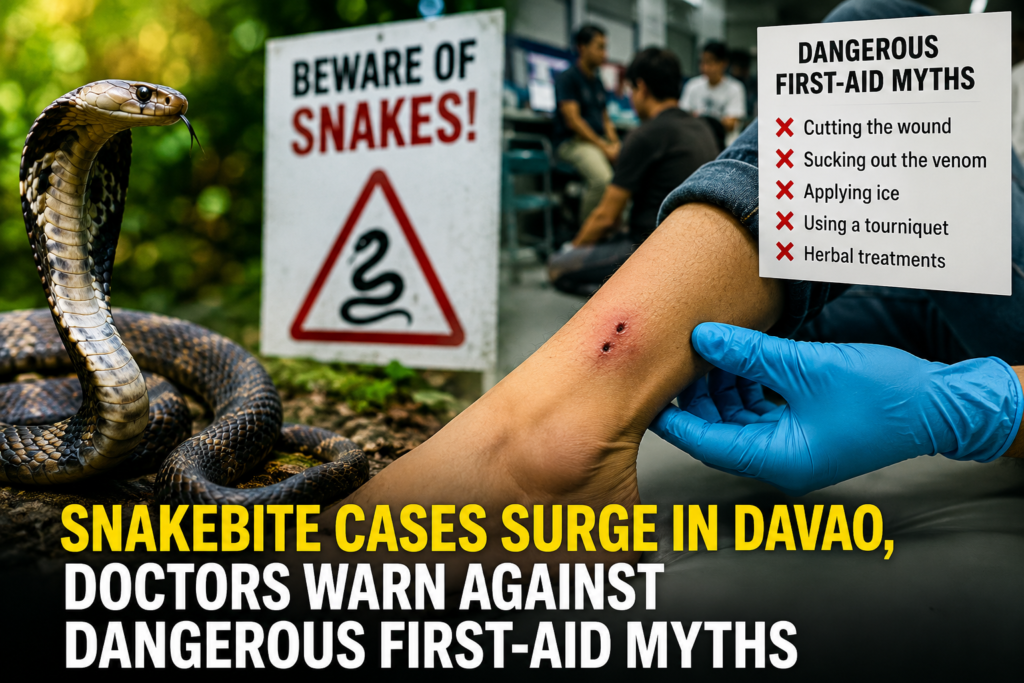
DAVAO CITY (July 3) — A sharp rise in snakebite cases in the Davao Region is exposing a dangerous gap in public awareness, with health experts warning that delays caused by traditional remedies and attempts to catch snakes are costing lives.
The Southern Philippine Medical Center’s (SPMC) Advanced Toxicology Specialty Center is urging snakebite victims to seek immediate hospital treatment, stressing that there is no proven first-aid treatment that can replace prompt medical care.
“If bitten, the victim must be transported straight to the nearest hospital. We do not advocate washing the wound because manipulating it may further spread the venom,” said Dr. Ella Joy Nogas, medical officer of the SPMC poison center, during the Healthy Davao Media Forum.
Her warning comes after a widely circulated video from Bansalan showed bystanders focusing on catching and killing the snake and applying a plant stem to the victim’s wound instead of rushing the person to a hospital. The victim died before receiving medical treatment.
“Please, please, there is no first aid for snakebite. Just transport the patient immediately to us,” Nogas said.
The SPMC Poison Center has recorded a 60 percent increase in snakebite patients, reflecting both greater public awareness that antivenom is available and the growing frequency of human encounters with snakes.
Snakebites have consistently ranked among the poison center’s three most common cases since it opened in 2015. Annual admissions have climbed from fewer than 200 during its first year to about 600 today—equivalent to roughly one patient every day.
Health officials attribute the trend partly to rapid urban expansion into formerly rural and forested areas, increasing contact between people and wildlife.
Paquibato District remains among the city’s snakebite hotspots, prompting authorities to strengthen community preparedness through the Chemical Safety and Snakebite Care Caravan, a joint initiative of the City Disaster Risk Reduction and Management Office, the SPMC Poison Center, Central 911 and the Bureau of Fire Protection.
The program trains barangay responders to recognize venomous bites and prioritize rapid transport over ineffective—and often dangerous—traditional practices.
While not every snakebite is venomous, Nogas emphasized that only trained medical personnel can determine whether envenomation has occurred. The region is home to highly venomous species, including the King Cobra and the Samar Cobra (Naja samarensis), for which antivenom is available at SPMC and Davao Regional Medical Center.
For doctors, the growing number of cases highlights a larger public health challenge: correcting persistent myths that delay life-saving treatment. As snake encounters become more common with expanding development, they say the most effective response remains the simplest—skip the folk remedies, leave the snake alone, and get the victim to a hospital immediately.