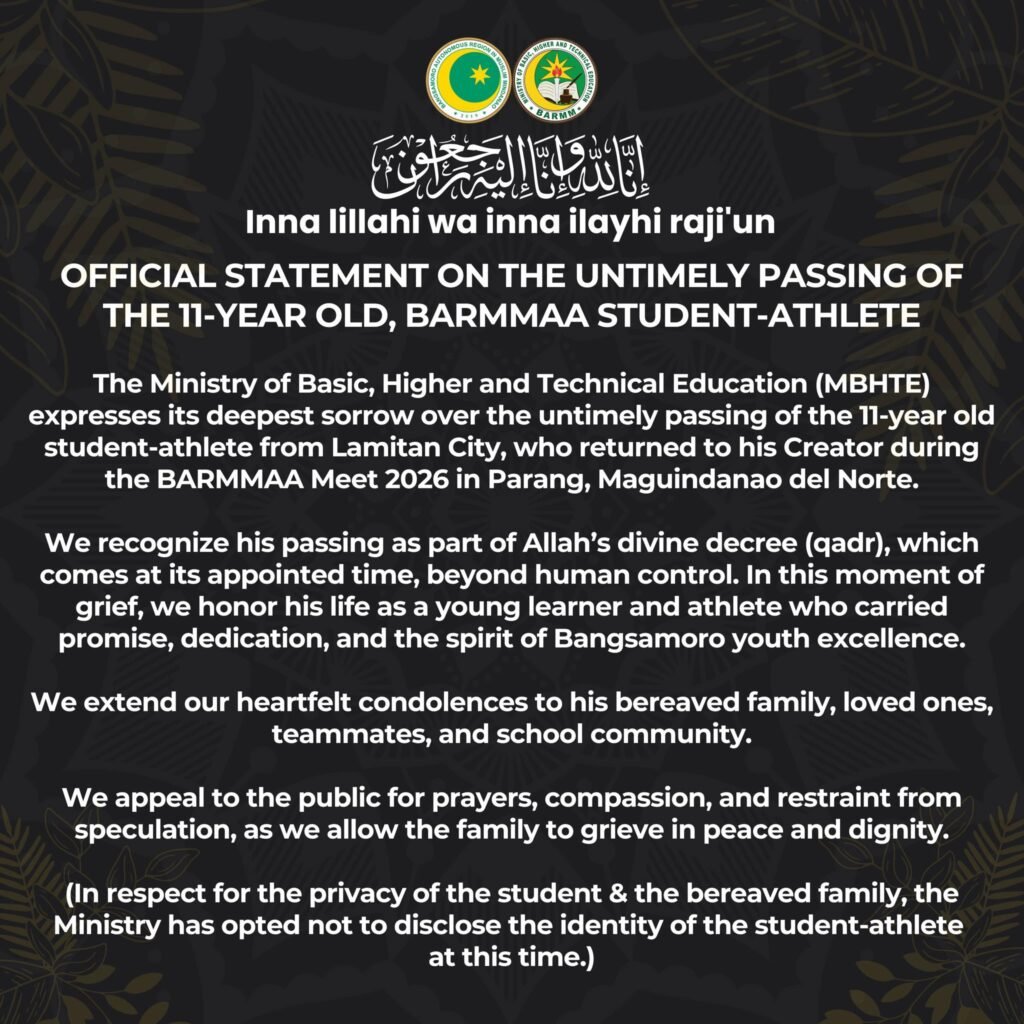
COTABATO CITY (April 15) — The death of an 11-year-old athlete at the ongoing BARMMAA Meet 2026 has drawn an outpouring of grief—and a rare moment of political unity—but beneath the gestures of solidarity lie unresolved questions about the safety and welfare of thousands of student-athletes.
Phiben Ansoc, a Grade 5 pupil from Lamitan City, died late Sunday night after choking while eating dinner at a makeshift billeting quarter in Parang. He had been set to compete in sepak takraw the following day.
He was rushed to a district hospital and later referred to Cotabato Regional Medical Center, where he was declared dead past 11 p.m., according to authorities.
Unity in Grief—Across Political Lines
In the aftermath, leaders across the Bangsamoro region—many of whom are expected to face off in the first parliamentary elections in September—momentarily set aside political rivalries.
At the Bangsamoro Transition Authority Parliament, members raised ₱160,000 in assistance, with ₱110,000 given to the bereaved family and the remainder allocated for immediate improvements to athlete facilities.
Officials including Mohagher Iqbal and Abdulraof Macacua also moved to support the family and address logistical concerns, including facilitating the transport of the child’s remains back to Basilan.
For some observers, the response reflects the region’s political maturity—an ability to unite in moments of loss.
Beyond “God’s Will”: Calls for Accountability
Yet the framing of the tragedy as “God-ordained” by some quarters has drawn quiet concern from advocates, who warn that such narratives risk deflecting attention from preventable risks.
Online reports preceding the incident pointed to inadequate water supply, overcrowded sleeping arrangements, and limited electricity in billeting areas housing around 7,000 delegates.
While authorities have not directly linked these conditions to the choking incident, child welfare advocates argue that the overall environment matters.
“Accidents do not happen in a vacuum,” one local educator noted. “Conditions of care, supervision, and preparedness all play a role.”
Emergency Fixes After the Fact
In response to mounting concerns, the government moved quickly:
- The Ministry of Basic, Higher and Technical Education was called to a parliamentary hearing to help craft reforms
- Drinking water distribution was intensified across billeting sites
- Fire trucks were deployed to secure water supply for sanitation and cooking
- Police and community watch personnel were assigned to secure quarters
These interventions, however, came after the incident—raising questions about preparedness prior to the event’s opening.
A System Under Strain
The BARMMAA Meet 2026 is one of the region’s largest youth gatherings, bringing together roughly 7,000 athletes and delegates from across geographically and economically diverse areas—from island provinces like Basilan and Tawi-Tawi to inland communities in Maguindanao and Lanao del Sur.
Managing such a scale of event requires not just logistics, but robust child protection systems, including:
- safe billeting standards
- adequate nutrition and supervision
- emergency medical readiness
- clear accountability mechanisms