DAVAO CITY(March 9) — Conservationists are calling on communities in Surigao del Norte to step up forest protection after a new nesting site of the critically endangered Philippine Eagle was discovered in the forests of Gigaquit.
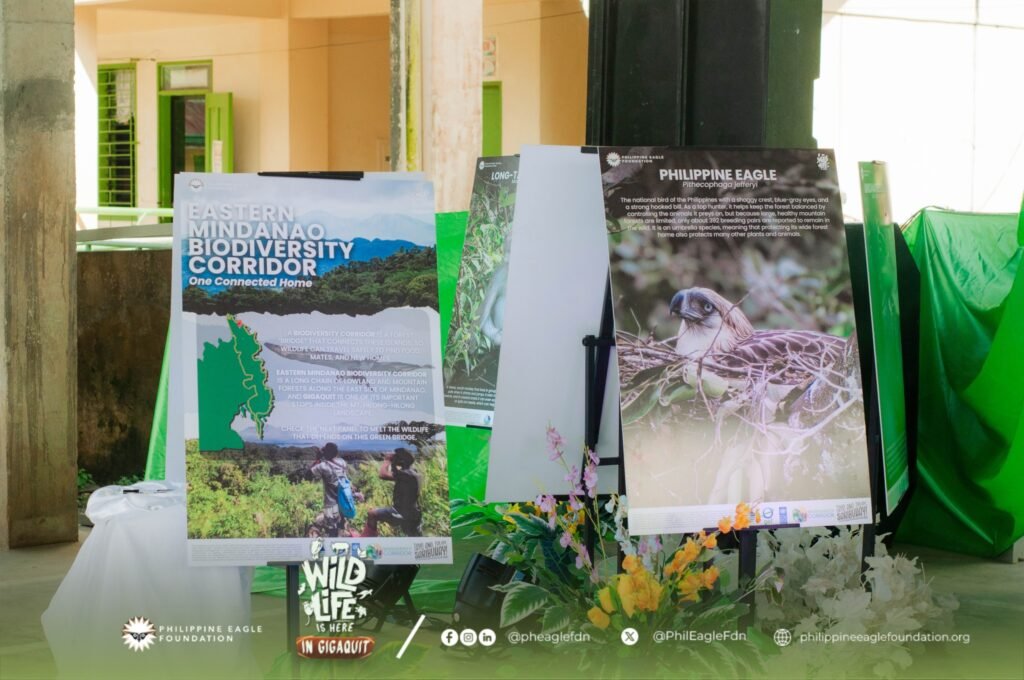
The discovery was highlighted during the “Wildlife is Here” campaign led by the Philippine Eagle Foundation (PEF), which brought wildlife education activities to students of Lasicam-Perral National High School on Monday in observance of World Wildlife Day.
Conservationists said the newly confirmed nesting site underscores the urgent need for community-led protection of forests, which serve as the breeding grounds for the country’s national bird.
“Philippine Eagle nesting sites are ancient nesting sites,” said Jayson Ibañez. “If we want to preserve the species, we must preserve these breeding sites because they are the only places where the eagles can safely lay eggs and reproduce.”
Scientists estimate that fewer than 392 breeding pairs of Philippine eagles remain in the wild, making it one of the world’s rarest raptors.
From rescue to conservation movement
The push for stronger protection in Gigaquit traces back to the rescue of a young eagle named “Balikatan” in 2020 in the forests of Sitio Bayobo, Barangay Mahanub, within the Mount Hilong-Hilong Key Biodiversity Area.
The juvenile eagle had been wounded by a farmer using a homemade marble gun who did not realize he had shot a critically endangered bird. The farmer’s family attempted to care for the injured raptor for weeks but eventually sold it when they could no longer afford the costs.
Authorities later located the farmer and explained the importance of protecting the species. He eventually joined Bantay Banwa, the community forest guard program of the Gigaquit local government.
The rescue of Balikatan — whose name means “shoulder to shoulder” — sparked a broader conservation push in the area.
Since 2020, the PEF, the municipal government, and the Community Environment and Natural Resources Office in Tubod have conducted regular forest patrols and wildlife monitoring to protect eagle territories.
Confirming a breeding pair
A biodiversity survey conducted from August to September 2025 confirmed the presence of a breeding pair of Philippine eagles in the forests of Gigaquit.
Researchers documented two nest trees, both on large Tagongtongan trees, a preferred nesting tree species for the raptor.
While one earlier nesting site appeared abandoned, field researchers later discovered a newly established active nest about one kilometer away, suggesting continued breeding activity in the same forest territory.
The survey was led by PEF biologists Andrei Von Mariano C. Tirona and Deo Denniz Taganas together with indigenous forest guards and local environment officials.
During the expedition, the team observed adult eagles and a nesting female incubating an egg. However, conservationists later confirmed that the female abandoned the egg in February after about two months of incubation.
Although the egg was fertilized, the embryo died early in development.
PEF said eagle eggs are typically incubated for 58 to 60 days, with both parents taking turns guarding the nest while the male hunts for food during the early stages of chick development.
Protecting forests protects people
Despite the failed hatch, conservationists say the discovery remains significant because it confirms the continued presence of a breeding pair — and highlights the importance of protecting their habitat.
Retired Lt. Gen. William Hotchkiss III said the Philippine eagle plays a vital ecological role as an apex predator.
“Its presence indicates healthy, intact forests,” Hotchkiss said. “Where the eagle thrives, biodiversity thrives. Where forests are strong, watersheds are secure.”
Local officials say the town has already taken steps to safeguard the ecosystem.
Chandru Bonite said the municipality continues to enforce Municipal Ordinance No. 2005-15, which protects wildlife, regulates destructive practices, and promotes responsible management of natural resources.
The town has also declared opposition to mining activities in order to protect the Baoy Watershed and its limestone karst forests, a key habitat for the eagle and other species.
Community conservation
Although a small municipality, Gigaquit has invested in training local forest guards, strengthening wildlife patrols, and sustaining environmental education campaigns centered on the Philippine eagle and the endangered Mindanao Bleeding-heart.
Conservationists say the community’s involvement will determine whether the eagle population survives.
“Saving the Philippine eagle means protecting forests for the next generation of Filipinos,” Ibañez said. “When we protect the eagle’s home, we also protect the ecological balance that sustains people and wildlife.”