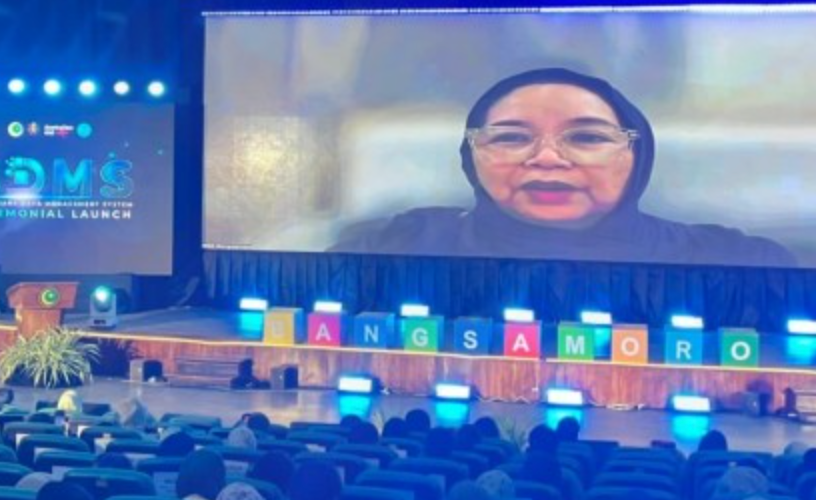
MSSD-BARMM Minister Raissa Jajurie delivers her video message during the launch of the Beneficiary Data Management System (BDMS) at the BARMM administration center in Cotabato City on Tuesday (April 28, 2026). The BDMS launch marks the introduction of a centralized digital platform for MSSD to monitor and manage beneficiary records for its programs across the region. (Photo courtesy of MSSD)
COTABATO CITY (May 1) — The Ministry of Social Services and Development has launched a regionwide digital system aimed at fixing long-standing gaps in aid distribution across the Bangsamoro.
Unveiled on April 28 at the Shariff Kabunsuan Cultural Complex, the Beneficiary Data Management System (BDMS) consolidates records of recipients of government assistance—marking the first unified database of its kind in the Bangsamoro Autonomous Region in Muslim Mindanao.
Officials said the platform, developed with support from the Australian government and the United Nations Children’s Fund, is designed to streamline social services while minimizing duplication and irregularities.
One system, wider reach
The BDMS brings together data on beneficiaries of at least 10 social protection programs, covering households across Maguindanao del Sur, Maguindanao del Norte, Lanao del Sur, Basilan, and Tawi-Tawi, as well as the cities of Cotabato, Marawi, and Lamitan.
It includes profiles of conflict-affected families, disaster-hit communities, persons with disabilities, and elderly residents—groups often hardest to reach in a region shaped by displacement and recurring crises.
For field workers, the system is expected to speed up verification and targeting, allowing faster and more accurate delivery of aid on the ground.
Fixing gaps in aid delivery
Social services minister Raissa Jajurie said the digital shift will enable frontline staff to better track beneficiaries and ensure assistance reaches intended recipients.
On the ground, aid workers say the change could be significant.
“Before, we had to check multiple lists and sometimes names were repeated or missing,” said a municipal social worker in Maguindanao del Sur who asked not to be named. “With one system, it will be easier to verify who really needs help, especially during emergencies.”
In Marawi, where many families are still rebuilding years after conflict, residents expressed cautious optimism.
“Sometimes ayuda is delayed or we are not sure if we are included,” said Fatima Abdul, a 42-year-old mother of four. “If this system makes it clearer and faster, that will really help families like ours.”
Officials acknowledged that past programs were vulnerable to inefficiencies and overlaps—issues the BDMS aims to address by centralizing records and improving transparency.
Backed by partners
The launch was attended by representatives from UNICEF, including Mindanao field office chief Andreas Wuestenberg, and officials from the Australian government.
Bangsamoro Chief Minister Abdulrauf Macacua welcomed the initiative, emphasizing its impact on vulnerable sectors.
“We are grateful to our partners for helping make this possible,” Macacua said, noting that the system will benefit poor Muslim, Christian, and non-Moro indigenous communities across the region.
From paper to platform
With BDMS now operational, BARMM joins a growing number of governments shifting toward digital welfare systems—an approach seen as key to improving accountability and ensuring that limited resources reach those who need them most.
For communities across the Bangsamoro, the success of the system will ultimately be measured on the ground.
“As long as the help comes faster and reaches the right people, that’s what matters,” the Maguindanao social worker said.