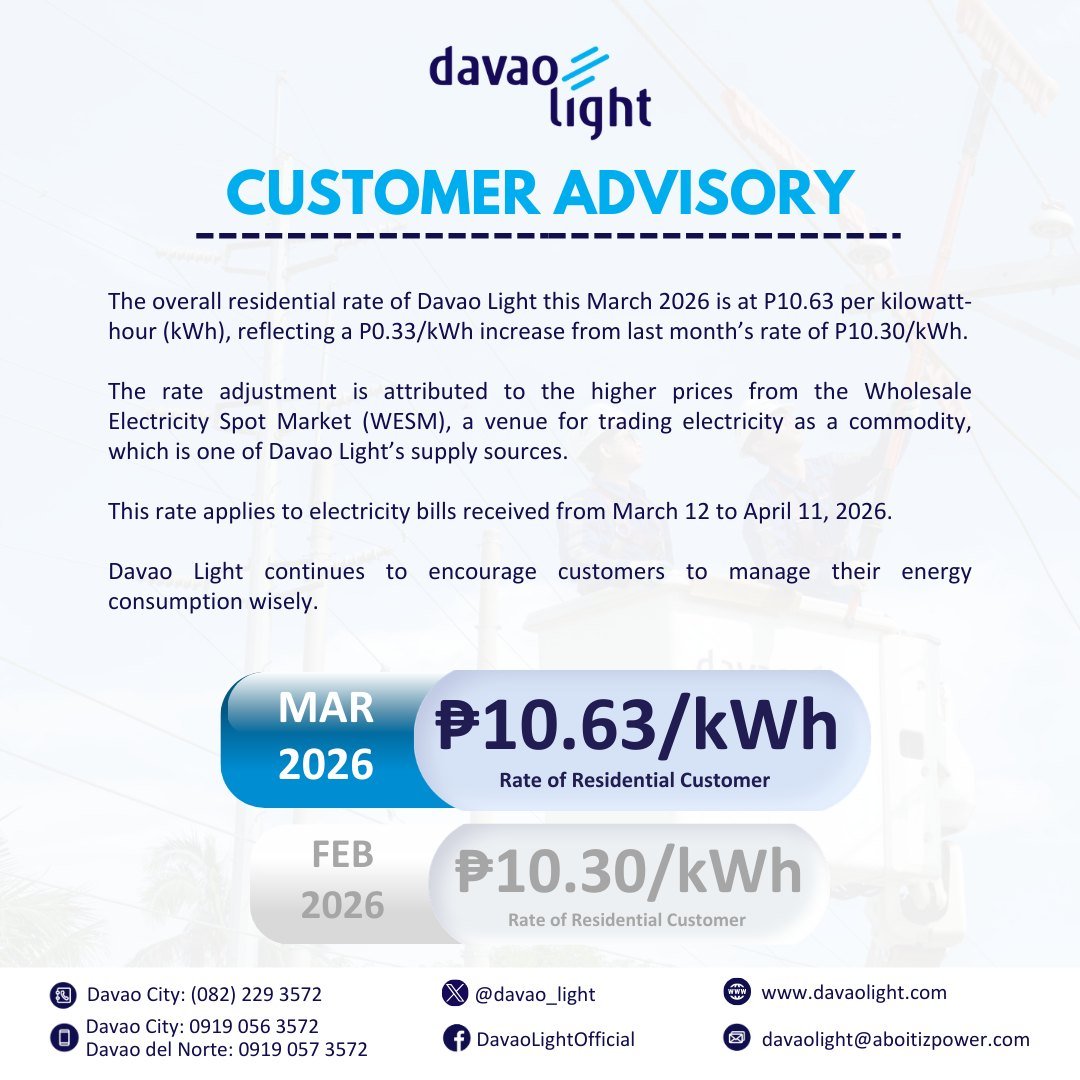
DAVAO CITY (March 21) — Electricity rates in Mindanao are beginning to reflect the full impact of global fuel volatility, with Davao Light and Power Co., Inc. raising residential tariffs for the March–April billing cycle—adding pressure to households already grappling with rising living costs.
The utility increased its residential rate to ₱10.63 per kilowatt-hour (kWh), up ₱0.33/kWh from the previous month. For a typical household consuming 200 kWh, this translates to an additional ₱65 to ₱66 in monthly electricity bills.
While the adjustment appears modest, its significance lies in what is driving it—and what may come next.
Market-driven power costs
According to Davao Light, the increase is largely due to higher prices from the Wholesale Electricity Spot Market (WESM), where electricity is traded like a commodity.
This signals a key vulnerability in the power system: electricity prices are closely tied to fuel markets, particularly in a grid still reliant on fossil fuels.
“With ongoing tensions in the Middle East pushing global fuel prices higher, electricity costs may be affected,” said Fermin Edillon, head of the company’s Reputation Enhancement Department.
In practical terms, consumers are not just paying for electricity—they are paying for global geopolitical risk embedded in generation costs.
The hidden weight of small increases
For many households, the added ₱65 may seem manageable. But layered onto other rising costs—fuel, transport, and food—it contributes to a broader erosion of purchasing power.
This is especially significant in nearby regions like the Bangsamoro Autonomous Region in Muslim Mindanao, where economic vulnerability is higher and inflation has recently reversed course:
- From –1.0% (deflation) in December 2025
- To around 2%+ inflation by early 2026, driven largely by food and transport
Electricity, while not always the largest expense, acts as a secondary amplifier—increasing household spending and indirectly raising the cost of goods and services.
Subsidies, but limited relief
Davao Light implemented a ₱0.01/kWh Uniform Lifeline Subsidy charge in compliance with a resolution from the Energy Regulatory Commission (ERC).
However, the structure of the subsidy highlights a gap:
- It primarily benefits low-consumption households
- Those exceeding 100 kWh monthly use—a common threshold for urban families—face additional charges
At the same time, under-recovery charges—mechanisms allowing utilities to recoup past costs—remain embedded in current bills, further adding to consumer burden.
These adjustments are standard in the industry, but in periods of rising prices, they become more visible—and more contentious.
A region exposed to fuel shocks
Mindanao’s energy landscape makes it particularly sensitive to global price swings:
- A significant share of generation still depends on fuel-based sources
- Supply gaps are often filled through WESM purchases, which are price-volatile
- Transmission constraints can limit access to cheaper power sources
As a result, even localized rate adjustments are often symptoms of wider systemic exposure.
Efficiency as the last line of defense
With limited control over generation costs, consumers are left with demand-side measures.
Davao Light has urged households to reduce consumption through:
- Turning off unused appliances
- Maximizing natural lighting
- Using energy-efficient devices
While practical, these measures shift responsibility to consumers—many of whom already operate within tight energy budgets.
What comes next
The current increase may not be the last.
Because electricity billing reflects previous supply costs, the full impact of ongoing global fuel tensions may only appear in the coming months.
This creates a lag effect:
- Today’s geopolitical shocks
- Become tomorrow’s electricity bills
The bigger picture
The Davao Light rate hike is not an isolated adjustment—it is part of a broader pattern emerging across Mindanao and the Philippines.
As fuel prices rise globally, their effects cascade:
- Into transport fares
- Into food prices
- And now, more visibly, into electricity costs