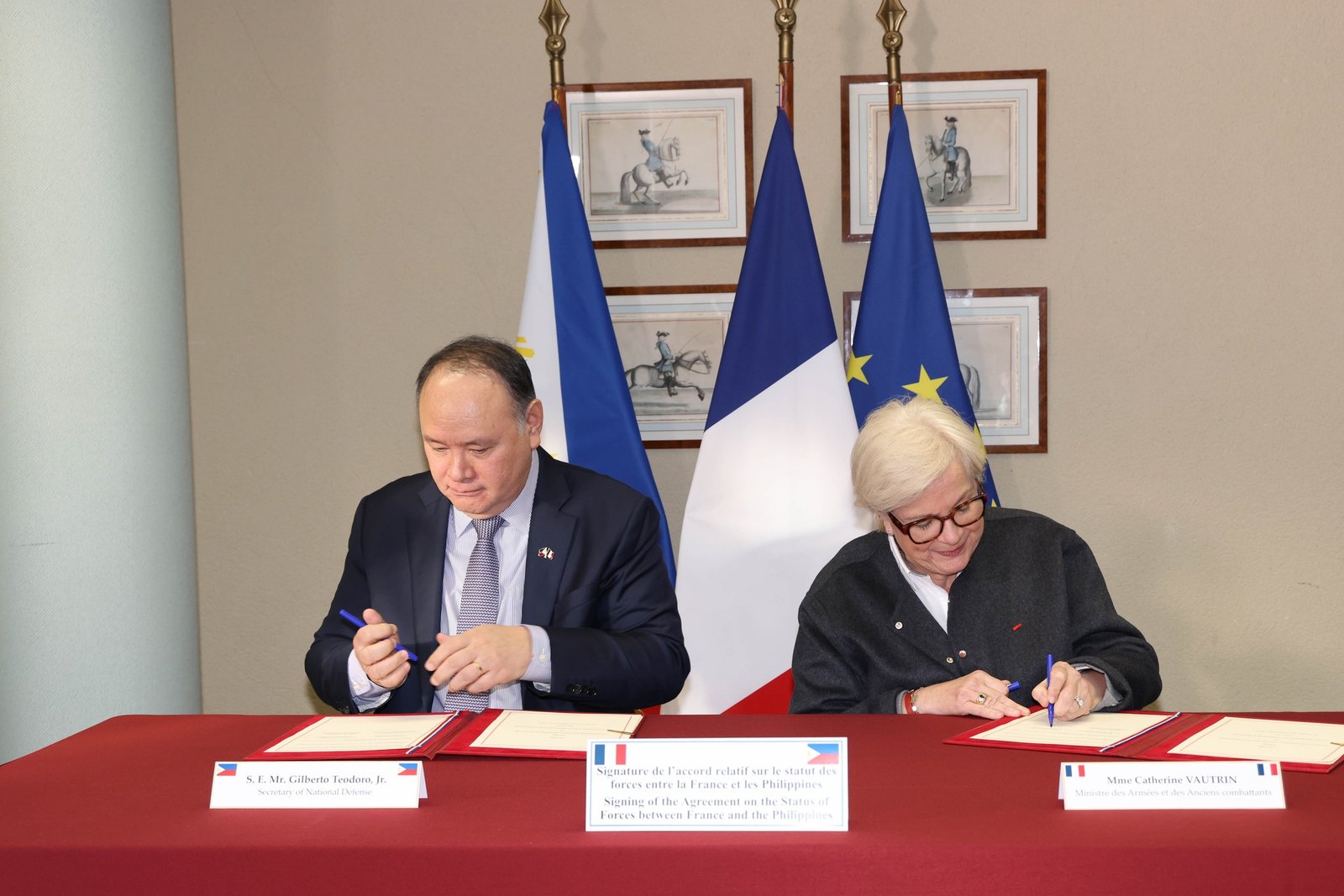
Photo: Department of National Defense - Philippines
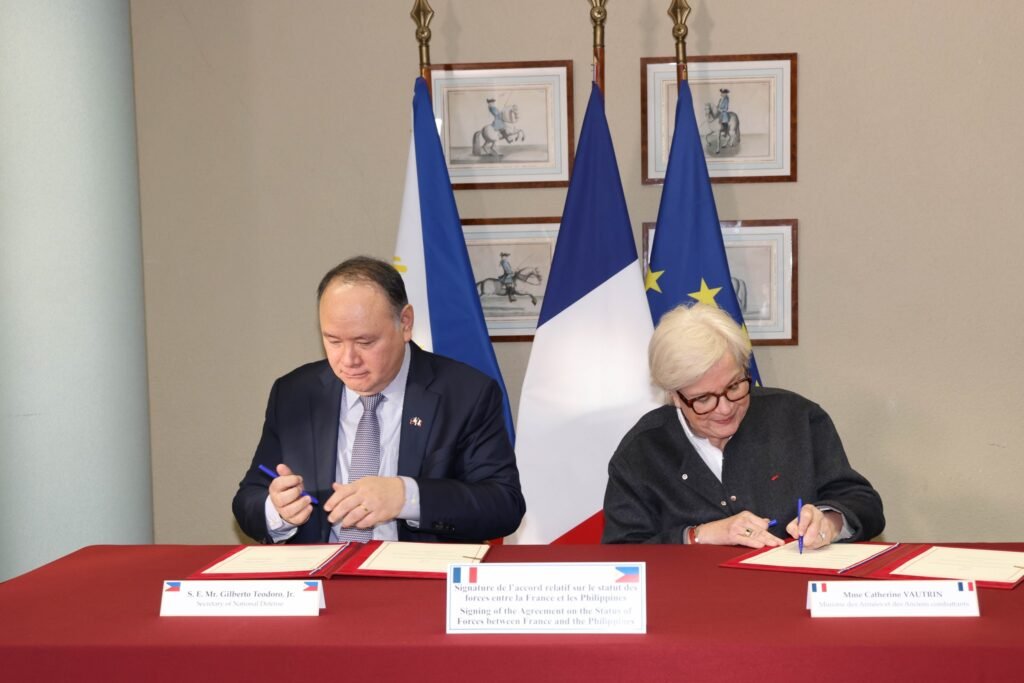
Photo: Department of National Defense – Philippines
MANILA(March 29) — The Philippines has signed a landmark visiting forces agreement with France, marking its first such defense pact with a European partner and signaling Manila’s widening security strategy beyond its traditional allies.
The agreement—formally known as the Status of Visiting Forces Agreement (SOVFA)—was signed during the Paris Defense and Strategy Forum following a bilateral meeting between Gilbert Teodoro Jr. and French Armed Forces Minister Catherine Vautrin at the historic École Militaire.
Teodoro described the deal as a fast-tracked outcome of growing trust between Manila and Paris, noting that negotiations began only a year ago under authorization from Ferdinand Marcos Jr..
At its core, the SOVFA provides the legal framework for French and Philippine troops to operate in each other’s territories—paving the way for expanded joint exercises, disaster response coordination, and maritime security cooperation.
But beyond technical cooperation, the agreement reflects a deeper strategic recalibration.
For decades, the Philippines’ defense posture has largely centered on its alliance with the United States. The inclusion of France—a major European military power—signals Manila’s intent to diversify its security partnerships amid rising geopolitical tensions in the Indo-Pacific.
Teodoro emphasized that the agreement also aligns with broader efforts to uphold international law, particularly the United Nations Convention on the Law of the Sea, which underpins maritime rights and has been central to disputes in the region.
The focus on maritime domain awareness and interoperability suggests that the partnership could extend into contested waters, where freedom of navigation and territorial claims remain flashpoints.
Still, questions remain about how far this cooperation will go.
Unlike longstanding arrangements such as the Philippines’ Visiting Forces Agreement with the United States, the new pact with France will need to translate from framework to actual deployments, exercises, and sustained presence to have tangible impact.
It also comes at a time when European powers are increasingly asserting a role in Indo-Pacific security—raising the prospect of a more crowded and complex strategic environment.
For Manila, the challenge will be balancing these expanding partnerships while maintaining coherence in its defense policy.
The SOVFA may be a milestone, but its significance will ultimately depend on whether it evolves into a consistent, on-the-ground security presence—or remains largely symbolic of diplomatic alignment.